I listened again, the way the card told me to.
Room fourteen, chair under the doorknob, my good headphones on, the ones that make you hear a person swallow. Episode three of Red Water, “The Long Night.” Forty-eight minutes. I’d mixed it myself in a rented studio in Chicago at two in the morning in August 2022. I knew where every breath was. I knew where I’d put the cello in, and where the cello came out so Ray’s voice could land on silence.
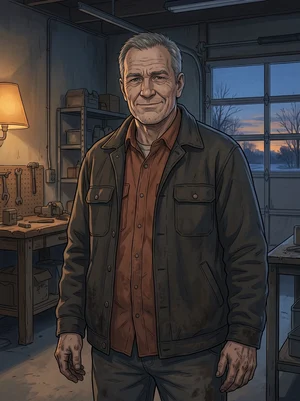
RAY SUND: Around midnight I got in the wrecker and I just drove. Bowling alley lot. The river landing. Out to the dam. Every road she might’ve walked. I didn’t think of the marsh. Not till four in the morning. God forgive me, it was the last place I looked.
TEKLA: Did you see anyone? On the roads, that night?
RAY SUND: Not a soul. Not a soul till four. Then I come down Dike Road and there’s the pump house, dark as a grave, and I sat there in the truck and I thought, she’s not here. She loves it here. She’s safe.
Dark as a grave.
I took the headphones off and sat on the bed.
Here’s what I had. At 12:40 my fifteen-year-old sister walked past pump house three with its white light on and something amber turning. Amber means a beacon. Pete’s pickups had them. So did Ray’s wrecker, which Ray had left off his list this morning until I asked.
I looked up the state rules for tow operators on my phone and found what he hadn’t said. A wrecker’s warning light has to be running whenever the winch is engaged, so nobody walks into a loaded cable in the dark. Most shops wire the beacon to the power takeoff so a driver can’t forget. If Ray’s light was turning at the pump house, Ray’s winch was pulling something.
And Ray had told my microphone in 2022 that he didn’t come down Dike Road until four, and that the pump house was dark.
Britt had heard that. She’d finally listened in 2025, and she’d heard what I hadn’t: a man placing himself very carefully three hours and twenty minutes away from where she’d seen him.
And this morning, in his cab, with the rosary swinging from the mirror, he’d asked me whether Britt had left anything behind. Notes. Tapes. A recording, anything like that. Not a notebook. Not a letter. A recording. Of everything a dead woman might leave her sister, he’d gone straight to that, and I’d sat in his heated cab and felt looked after.
Britt’s car had been found on the dike road with the keys on the seat. I had never once asked whether her bag was in the car. I’d let the sheriff tell me the reservoir kept it. And the man who’d towed the car to his lot, alone, the morning after, and wouldn’t take a dime for it, was a man who kept everything. Every hook since 1985.
If Ray had the bag, Ray wasn’t the one mailing me its contents.
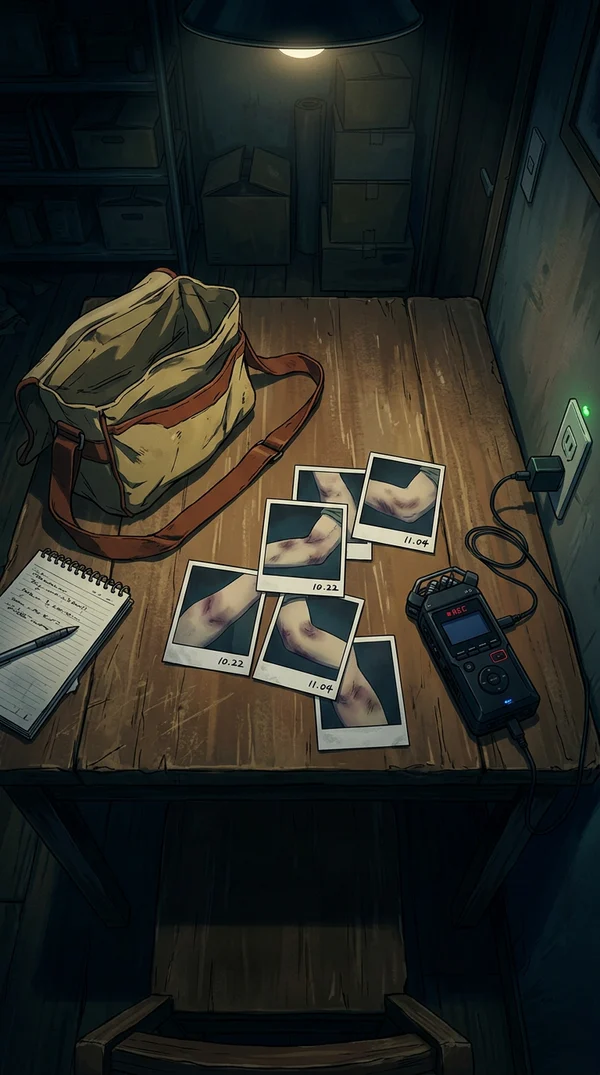
Somebody else had got into it. And the man who’d let himself into room fourteen with one of Bev’s keys hadn’t taken the cards to stop me; I had photos, he knew I had photos. He’d taken them to hold them, to rub a pinhole with his thumb, to find out whether they were his.
I went and got the envelope from card five out of my coat and held it to my face, which I would not have done in front of anyone. Lavender. Cheap and clean. Institutional size.
I thought about my mother’s hands, slick and sweet, in Denise’s lap. Oh, Tick, no, you should stay with us. I thought about room fourteen, which I’d said out loud in that same room on Friday morning, the same day an envelope with my room number on it was postmarked. I thought about Denise’s keys hitting the asphalt when I held up the first card, and how fast she’d bent to get them, so that her face was below the level of the card when Ray read it. And card three, the one nobody sent. Episode three. Between Rhonda’s sighting and the pump house. In Britt’s order, that was the stretch of the night between the truck on Dike Road and the walk home. The farm. The porch. My mother, in her robe, watching the lights go back up the dike.
Somebody had held back the card about my mother. Somebody who saw her every morning and rubbed lotion into her knuckles and didn’t want me using up her good hours.
At five my phone buzzed.
Are you all right? Ray said you looked pale this morning. Please eat something. Denise Sund
She signed every text that way. Both names. Like a letter. I’d always found it sweet.
I wrote back: Are you working tonight?
Nights this week, 11 to 7. Denise Sund
The Pellam Lutheran Home at midnight is not quiet. Somewhere a woman was calling for someone named Harold in a patient, regular voice, like a lighthouse. A TV sold a knife set to an empty dayroom.
Denise was at the nurses’ station with a jar of pens and a stack of charts. She looked up when the door from the stairwell closed behind me, and she didn’t look surprised. She looked like someone who’d been waiting for a bus for a long time and had finally seen its lights.
She’d done her makeup heavier than usual. It didn’t quite cover the mark along her jaw, below her left ear, a greenish shadow the size of two fingers.
“Hi, honey,” she said.
“It’s you.”
She put the pen down. She lined it up with the edge of the chart.
“Not here,” she said. “Kayleigh, can you watch the floor? I’m taking my break.”
The break room was a closet with a microwave and a table and a bulletin board covered in flyers for a church rummage sale. Denise shut the door. She sat down. I sat down across from her. For a while neither of us said anything, and the woman down the hall called for Harold, and the knife set got sold to nobody.

 100 to start reading with.
What did you think?