Greige, chapter 2 of Auctioned Off by My Husband
He dropped me at the end of my own drive at ten past two in the morning and did not get out of the car.
“Emmett will be here at eight tomorrow night,” he said through the open window. “If you’re not, I’ll never trouble you again. And I’ll still have had the best pie in Florida.”
Then the Bentley’s taillights went away down the lake road, and I stood barefoot on the crushed shell with my shoes in my hand and looked at my husband’s house.
Blake didn’t come home.
I should tell you about the house, because it matters later.
The Thayer house sits on the lake side of the island, south of the bridges, a white stucco box from 1987 with a barrel-tile roof and a dock and a view of West Palm’s lights across the water. Blake’s mother built it after his father died, and she did it all herself, in peach and seafoam and the kind of chintz that looks like a garden had a nervous breakdown. When I married Blake, I moved into it. I was twenty-four. I had opinions about chintz even then, and I kept them to myself, because it was her house.
She died four years ago. The week after the funeral Blake had the whole place painted, every wall, every ceiling, inside and out, in a color the paint company called Gentle Truce.
I called it greige.
Gray and beige. It’s the color you paint a house when you’ve given up on it. It’s the color that offends nobody because it has never had a feeling in its life. Blake said it was “for resale”. He never sold. We lived in it for four years, and I, who had done forty-one houses on the island in colors people still stopped me in the street to ask about, came home every night to Gentle Truce.
On the hall table, in a little Limoges dish, sat the Thayer brooch.
It was a spray of gold leaves with sapphires along the stems, and it was famous. Blake’s mother told the story at every dinner party for eighteen years, and after she died Blake told it for her: how the summer he was thirteen the brooch went missing from her dressing table, and how it turned out the housekeeper had taken it, a woman who’d been with them six years, six years, darling, and how you simply couldn’t trust anyone. Then she’d touch the brooch in its dish, and everyone would shake their heads.
I had heard that story perhaps three hundred times. I had laughed in the right places. I mention it now only so you’ll know I was there.
Blake came home at ten on Sunday morning wearing last night’s shirt and Sienna’s perfume.
Tuberose. I had recommended it to her, at a perfume counter on Worth Avenue, the first year she worked for me.
“Well,” he said, in the kitchen doorway, with his hands in his pockets. “That was a night.”
I was sitting at his mother’s kitchen table with a cup of coffee I had not drunk. “It was.”
“Ashdown.” He shook his head, half laughing. “Of all the people. You know he grew up across the bridge? His mother cleaned houses.” He said it like someone mentioning a cold. “Now his company fixes half the ships in the Gulf, and he’s a billionaire, and he still can’t stand in a room like he belongs in it. Anyway. I thought we should do this like grown-ups.”
He put an envelope on the table.
I knew what it was before I opened it. I’m a designer; I read a room before I read the furniture. The envelope was from a law office in West Palm with three names on the letterhead. Inside were a petition for divorce and a settlement, flagged in yellow where I was to sign.
“Two years,” I said.
He didn’t pretend not to understand. That was something. “Don’t look at me like that, Rain. You’ve been married to your sample books since the day we met.”
“And the auction? Was that grown-up?”
“Sienna’s idea.” He shrugged. “It was a joke. It was supposed to be a joke. If Ashdown hadn’t stood up like a lunatic, everybody would have forgotten it by Tuesday. Now the whole island’s laughing.”
“They were laughing before he stood up, Blake,” I said. “He’s the one who stopped them.”
He looked at me then, properly, for the first time in a long time, and for a second I saw something on his face I couldn’t name. Then the laugh came back down over it.
“Read it,” he said. “It’s fair. I keep the house, obviously, it’s the family trust. The joint accounts, there’s not much in them, you know how the season goes. And you get the firm.” He spread his hands. “Dufresne Interiors. All yours. Assets and liabilities. You love that firm more than you’ve ever loved me, so keep it. I’m out. I’m done picking up your fabric samples.”
He went upstairs to shower. I heard the water start.
I turned the pages.
Here is a thing about my trade. When you walk into a house for the first time, you don’t look at the sofa. You look at the bones: where the light comes from, where the load sits, which wall is lying to you. A floor plan always tells you what its owner wants to hide. And Blake Thayer had never once in his life given anything of value away. He regifted. He let other people pick up checks. He’d once returned a christening present because the baby’s parents had divorced.
He was giving me the firm.
I read the paragraph again. All assets and liabilities of Dufresne Interiors, LLC, including without limitation all contracts, accounts, obligations and claims, past, present or future.
What, I thought, is wrong with the firm?
My cousin Joanie Guidry practices family law in a two-room office on Clematis Street, and she answered on the second ring with the television on behind her.
“Reine-Marie,” she said. She was the only person alive who called me by my real name. “I saw. Mama sent it to me. Somebody filmed it. Are you all right?”
“He wants a divorce and he’s giving me the firm.”
A silence on the line, in which I could hear her switch off the television.
“Don’t sign anything,” she said. “Do you hear me? Not one page. Not a birthday card. Bring it to me tomorrow.”
“I’m not going to sign it.”
“You’d sign a ransom note if somebody asked you nicely and the stationery was good,” she said, and I laughed for the second time in two days, and then I went upstairs while Blake was still in the shower and packed.
I packed the install books first.
Twenty-two years of them, in a closet in the guest room: forty-one houses, one leather binder each, sometimes two. Every room I had ever done, photographed when it was finished, with the swatches taped in, the paint chips, the receipts for every piece, the dimensions, the notes I wrote to myself in the margins. Mrs. L hates blue but loves the sea; give her the sea. They went into the back of my car before a single dress did. Then the dresses. Then my father’s pencil, which I kept in the drawer of my bedside table, and my good scissors, and I was done.
Forty-six years old, and everything I owned that mattered fit in a Volvo station wagon full of upholstery samples.
At eight o’clock that night I was standing at the end of the drive with my sketch pad under my arm when the Bentley came along the lake road.
Ventana was dark.
All hundred windows, as promised, except one at the back, low down, where a warm yellow light was on. Emmett brought me up the drive under royal palms that had not been trimmed in years and stopped at a door you could have driven a carriage through. The house was Mediterranean Revival, built in 1927 for a man who made his money in cough drops, and I had wanted to get inside it since the first week I came to the island.
Roarke Ashdown opened the door himself, in shirtsleeves, and stood aside to let me in.
The hall was enormous and empty and smelled of salt and old cypress. Every piece of furniture in it was a shape under a dust sheet. The light I’d seen from the drive came from the kitchen, and that was where he took me: a long room with a pecky cypress ceiling and a table that seated twelve, at which there was one chair, one lamp, one laptop and one coffee cup.
“You live in here,” I said.
“In here, a study and a bedroom.” He pulled out a second chair from under a sheet in the corner and set it opposite his. “I’ve been meaning to get to the rest.”
“For ten years.”
“I’m a patient man.”
I sat down. Out of habit I put my sketch pad on the table, the cheap spiral-bound kind with my client notes on the first sixty pages.
“Five hundred thousand dollars,” I said. It was three times the most I’d ever charged anyone. I said it to watch him blink.
He didn’t blink. “Done.”
“That’s absurd.”
“So was the dollar.” He glanced at the pad. “Do you want to write the rest down?”
I looked at the pad. Then I turned it face down and laid my pencil on top of it.
“No,” I said. “My father did upholstery for forty years and never wrote a contract. He walked the job with the client, in the client’s own front room, and said out loud what he’d do and what he wouldn’t and what it would cost, and then they shook on it. He always kept one term back for the end, for the thing the client hadn’t known to ask for. He said paper was for people who were already planning the argument.” I folded my hands on the table. “I do every walk-through the same way.”
He sat back. “Then walk me through it.”
“The scope first.” I counted it off on my fingers, as I do in every front room on the island. “Where is mine. Any night, any room. How is yours.”
“How is mine.”
“That isn’t a scope of work. That’s a blank check.”
“It comes with a word,” he said. “One word from you and the check’s void. You’ll choose it.”
“I’m still choosing.”
“What do you tell a new client?” he said. “The thing you tell all of them.”
I could have said it in my sleep. “That nothing goes into a room until she’s stood in front of it and said that one. A nod’s no good. Women who nod at a swatch send it back in a month and tell their friends I talked them into it.”
“Good,” he said. “Then that’s how it’ll be upstairs. Nothing happens in bed until you’ve said that one.”
I could feel my face heating and I refused to let it. “Then nothing will happen.”
“We’ll see,” said Roarke Ashdown.
“My turn.” I put one finger on the table between us. “Every client lies about one wall. The damp one, or the crack under the wallpaper, or the one they knocked a hole in and patched themselves on a Sunday. They walk me through every room in the house and straight past it. I always find it, and it always costs more when I do.” I held his eyes. “No lying walls.”
He was quiet for a moment longer than three words needed, and I noticed, and I didn’t know yet what I’d noticed.
“No lying walls,” he said.
“And the hand-over?”
“On the thirtieth night you leave the keys on this table and walk away owing nothing. Not the fee. Not a thank-you. Nothing.” His eyes came up to mine. “You’ll want to know you can leave.”
He took a ring of keys from his pocket and slid it across the table. “Every door in the house,” he said. “There’s a room in the east wing that’s storage. I’ll clear it when you get there.”
There were thirty-eight keys on that ring. I matched them all, eventually, except one.
“And the word,” he said.
I thought about it. You only get one.
“Greige,” I said.
He frowned. “What is greige?”
“Gray and beige. It’s the color you paint a house when you’ve given up on it. My husband’s had me living in it for four years.”
And Roarke Ashdown laughed.
Not much. Not loud. A short, startled sound, a man tripping on a step he didn’t know was there. It changed his whole face. I had a sudden, absurd urge to make him do it again, and I looked down at the keys and did not look up until I was sure my face had behaved.
When I did, he was holding his hand out across the table. Not palm up, this time. Sideways, the way a man holds it out to close a job.
I shook it as my father taught me: once, firmly, looking him in the eye. His hand was warm and very steady, and he let go a little later than a client would have.
“It’s night one,” he said. “Where?”
“Here.” I stood up. “All of it. I want to see the bones.”
“Then I’ll follow,” he said, “and you’ll talk.”
So we went through Ventana by flashlight.
I talked. I couldn’t help it. A house like that is a conversation; you can’t walk through it in silence. I showed him where the original Cuban tile was hiding under somebody’s 1970s carpet, and where the loggia had been glassed in by a fool, and how the stair turned so that whoever came down it would come down into light. He followed a half step behind me, holding the second flashlight where I needed it before I asked, and said almost nothing, and listened with that same complete attention he had given to the pie.
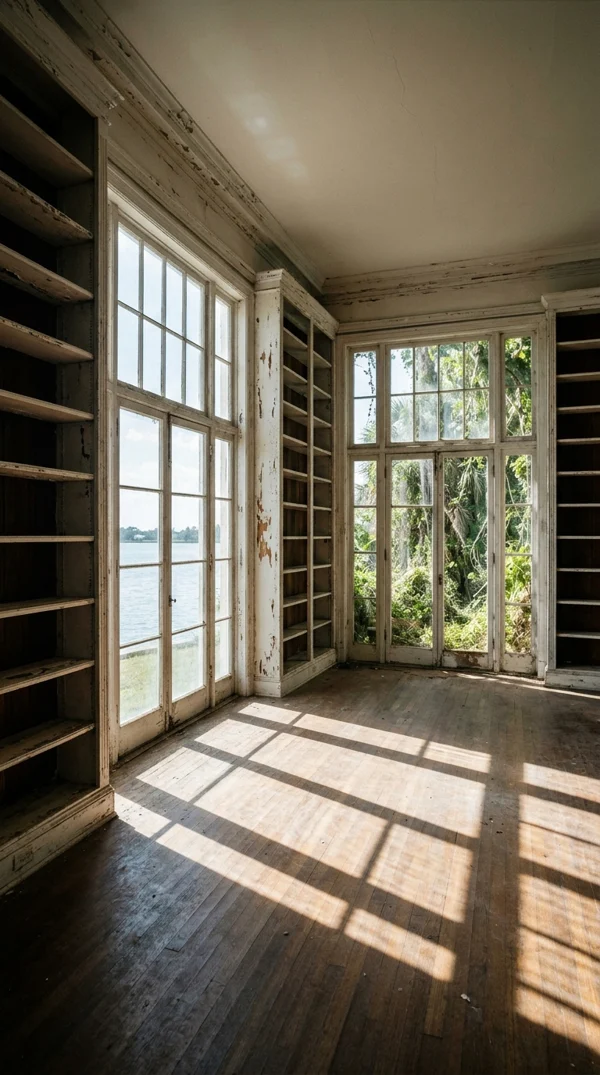
The ballroom was at the end of the south wing. It had a coffered ceiling and six French doors to the ocean, and the moon was coming through all of them across a floor of shapes under white sheets. A piano. Chairs stacked on chairs. Something tall that might have been a harp.
I stopped in the middle of it and turned the flashlight off.
“This is the most beautiful room on the island,” I said, “and you’ve let it sleep under a sheet for ten years.”
“Yes.”
“Why?”
He didn’t answer. He came and stood in front of me in the moonlight, close, not touching, and I could feel the warmth of him through the dark.
“Last night,” he said, “three hundred people laughed at you in a room you made for them.” His voice was very low. “Here is how this works, Mrs. Dufresne. While you’re under my roof, nobody on this island laughs at you where I can hear it. Not once.”
I couldn’t speak. My throat was full of something I didn’t have a name for.
“So,” he said, gently. “Where tomorrow?”
I looked up at the ceiling, at the coffers I couldn’t see, at all hundred dark windows of his house.
“Here,” I said. “I’m going to take your house apart.”


What did you think?