How, chapter 4 of Auctioned Off by My Husband
By Thursday the island had decided what I was.
Two clients called my studio to postpone. Neither said why; both said “just for now” in the same bright voice, the voice you use to a woman whose husband has left her, and I said “Of course” in mine, the voice you use back. My two juniors had been told by Blake on Monday to “give Rainey some space”, and they gave me so much of it I could have parked a truck. And at eleven in the morning somebody sent me the Island Ledger.
The Ledger isn’t a newspaper. It’s an account on the internet, run by nobody knows who, that posts photographs of the island to forty thousand people who pretend not to read it. That morning it was a picture of Roarke’s Bentley parked in the courtyard outside my studio, with Emmett leaning against it eating a sandwich. The million-dollar dinner continues, said the caption, and underneath, three hundred and twelve comments.
I didn’t read them. I read the first one. It said, Good for her honestly, and the second said, at her age??, and I put the phone face down in a basket of trim.
At noon my bank sent me a message. A wire had arrived in my personal account from Ashdown Marine: fifty thousand dollars. The memo line said Library.
I sat at my desk and looked at that one word, and then I went back to work.
Night five, I chose the Lake Trail.
It runs along the lake side of the island for miles, a narrow paved path between the seawall and the backs of the big houses, and at night it’s mostly empty except for joggers with headlamps and the occasional raccoon. I’d ridden it every evening my first year in Palm Beach, on a secondhand bicycle with a basket, because I couldn’t afford anything else and because it was the only way a girl from Lafayette could see the island’s best houses from the inside: through their back windows, lit up, like dollhouses with the fronts taken off.
I had two old beach cruisers in my studio’s storeroom, a blue one and a cream one, for the days when I had to get between three clients on Worth Avenue faster than the traffic would let me. Emmett put them in the back of the Bentley as if he transported bicycles in it every week.
Roarke regarded the blue one with deep suspicion.
“I haven’t been on one of these since I was fourteen,” he said.
“It’s like riding a bicycle.”
He gave me a look. I gave him the blue one.
“How, then,” I said.
He swung onto it. He was a big man and the bicycle was not, and he should have looked ridiculous, and he didn’t. He looked like he’d been somewhere hard once and come back from it, and had decided to find this funny.
“You ride ahead,” he said. “Don’t look back. I’ll be there.”
So I rode ahead.
I rode north with the lake on my left, black and still, the lights of West Palm smeared across it, and the houses on my right, and I didn’t look back. It was harder than you’d think. Every instinct I had said check on him, as I’d check on a client behind me on a staircase. I didn’t. And every so often I’d hear his tires on the path, or the click of his gears, and once a low laugh when a raccoon crossed in front of him and he swore at it, and I would know without turning that he was exactly where he’d said he’d be.
I rode past the backs of my houses.
The Talbott house, where I’d done the kitchen in blue-and-white tile to look like a Delft jug. The Quennells’, with the dining room in tobacco linen. Through a lit window I saw a family I’d made a room for sitting in it, a father and two teenagers and a dog, arguing over a board game on the rug I’d chosen. They didn’t look up. They didn’t know I was there. They looked like they belonged in that room, which was what I’d made it for.
I’d ridden past these windows a hundred times, at twenty-two, wondering what it would be like to live in one of them.
Now I rode past them at forty-six with a man behind me who’d paid a million dollars for my evening, and for the first time I didn’t want to be inside. I wanted to be exactly where I was: on the dark path, going fast, not looking back.
At the north end, where the trail runs out, I stopped and put my feet down and waited. He came up beside me and stopped too, and we stood there breathing with the lake slapping at the seawall.
“I used to ride this,” he said. “When I was a boy.”
“For fun?”
“Delivering.” He was looking at the water. “Ironing. In a basket on the front.”
I didn’t understand him. I thought he was joking. I laughed, and he let me, and we rode back.
Night six, he chose how before I could choose where.
A box came to the boathouse at five o’clock. It was flat and white and tied with dark green ribbon, and inside, in tissue, was a dress: a long column of heavy green silk, the deep, cool green of the library walls I had been planning on paper all week. There was no designer label. It had been made, I realized, turning it over in my hands, by a person, and quickly, and well.
The card said: How. R.A.
I stood in the boathouse with that dress against me and looked in the mirror at a woman who had not been given a dress by a man in twenty years. Blake gave me jewelry, at Christmas, chosen by his secretary. This was not jewelry. This was a man who had looked at my sketches on the kitchen table and remembered the color.
I put it on.
It fit the way a slipcover fits when you’ve measured three times. I didn’t ask how he knew my size. I didn’t want to know which of his staff had guessed it, or whether he had.
“Where?” he asked, when I came up the lawn at eight.
“The library,” I said. “There’s a corner of it that’s finished.”
There was. The green armchair and the refectory table and the two iron lamps, and one shelf, the one nearest the window, which I had cleared of its terrible white paint that afternoon down to the black cypress underneath. Roarke had put books on it. His own, from the study: old atlases, ships’ histories, a book of tide tables from 1962, a battered paperback of sea poems with somebody else’s name inside the cover.
Emmett had laid the table for two. Roarke cooked.
He cooked one thing, grouper in a pan with lime and butter and black pepper, and he did it in his shirtsleeves at the big kitchen stove while I watched from the doorway in my green silk and drank his wine, and he did it as he did everything: without hurry, without showing off.
“Who taught you?” I asked.
“My mother,” he said. “She said a man should be able to make one thing well for a woman. She said it didn’t matter what.”
We ate in the corner of the library with the lamps on. I don’t remember what we talked about. I remember that he watched me in the green dress as he’d watched me eat pie, with nothing else in the house. I remember that by the end of dinner I’d stopped being able to look at him for longer than a second at a time.
“There’s somewhere else I want to see,” I said. “For the work.”
“Where?”
“The main bedroom.”
He didn’t smile. He stood, and pulled my chair back, and took one of the lamps.
The main suite was on the second floor at the ocean end, three rooms run together, and all of it was under sheets. He’d never slept in it. I knew that before he said so; a room that’s slept in has a different air. The moon was coming in off the water through six tall windows and laying white bars across the floor, and the shapes of the furniture stood around us like guests at a party that had ended a long time ago.
I went to the window. It’s what I always do in a room: I find where the light comes from.
I heard him set the lamp down. I heard him cross the floor behind me, and stop.
“You chose where,” he said quietly, at my shoulder. “May I choose how?”
“Yes.”
His hands found the top of the zip at the back of the dress.
He didn’t pull it. He rested his fingers there, on the small metal tab between my shoulder blades, and waited until I breathed. Then he drew it down an inch at a time, so slowly I could hear each tooth let go, and the green silk opened along my spine like a seam unpicked, and the night air off the ocean came in through the gap and touched my bare back where nobody had touched me in years.
He stopped at my waist. I felt his breath, then his mouth, at the top of my shoulder. Just there. Warm, slow, certain.
My whole body went toward it.
“Tell me to stop,” he said against my skin.
I didn’t.
“Then tell me to keep going.”
And I couldn’t.
I stood there in the moonlight with my dress open to the waist and his mouth at my shoulder, wanting him so badly that my hands were shaking, and I could not make the words. They were right there. Keep going. Two words. I had said harder things to contractors. I opened my mouth and nothing came out, because some part of me, the part that had sat at table six with its hands in its lap, did not believe it was allowed to ask a man for anything and be given it. My throat had closed years ago and forgotten how to open.
He knew. Of course he knew.
He lifted his mouth from my shoulder. He drew the zip back up, inch by inch, until the green silk was closed again over my spine. Then he bent his head and kissed the back of my neck, once, just above the clasp.
“You haven’t said that one,” he said. “I’ll wait.”
“Don’t.” My voice came out rough. I was furious. Not with him. “Don’t be gracious. I can’t stand it.”
“I’m not being gracious.” He turned me around, gently, by the shoulders. In the moonlight his face was all angles and patience. “I’m a man who likes waiting for things he’s going to get.”
I wanted to slap him. I wanted to kiss him. I wanted, God help me, to be the kind of woman who could say two words out loud in a dark room.
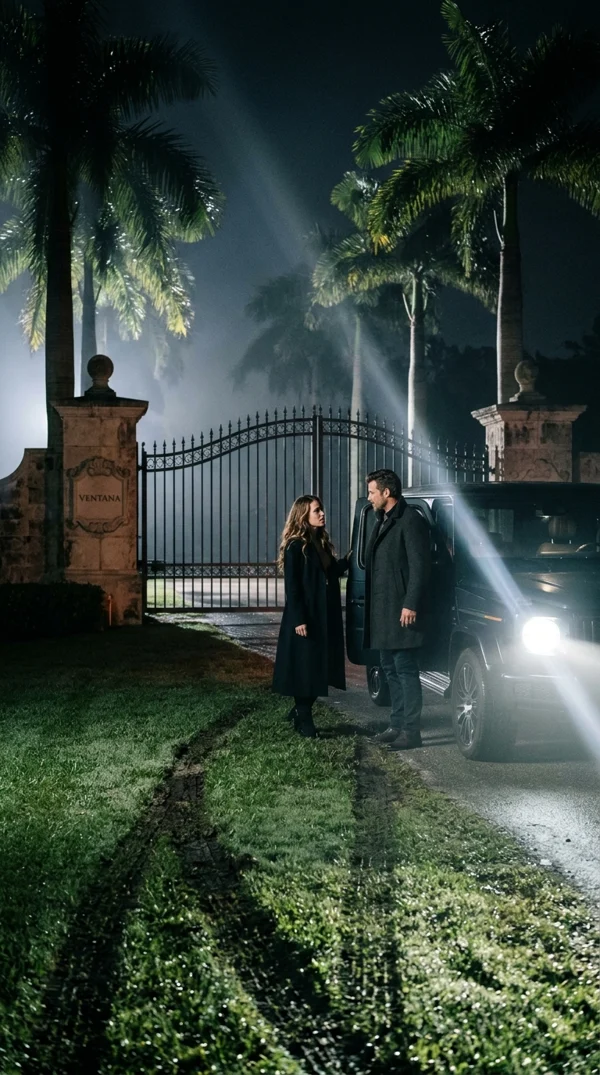
Downstairs, the gate buzzer went.
It wasn’t a polite ring. It was long and furious, someone leaning on the button and not letting go, and it echoed through all of Ventana’s empty rooms at once. Roarke’s head came up. He went to the landing and I followed him in my green dress, and in the hall below us the little screen of the gate intercom had lit up gray.
It was 11:50 at night, and my husband was on it, drunk, his face too close to the camera, his thumb jammed on the button.
“Rainey!” he was shouting. “Rainey, you come out here. You’re still my wife.”

What did you think?