Croy read the petition out at dinner.
That was Penhale’s doing, and it was clever in a way I did not see until it was over. A petition posted on a board is a piece of paper that forty people read and the rest do not. A petition read aloud over the soup is a fact the whole school has heard in the board’s own voice. Nobody could claim afterwards that they had not known.
He read it standing at the head table with the paper in both hands. His voice went flat on the long paragraphs, and his throat worked visibly between them. It took ten minutes, and the hall ate through it. Ten minutes is a really long time to sit in a room and be told that the thing you are sitting in is going. My spoon went down halfway through, and my hands stayed in my lap, cold, one gripping the other. Was anybody else’s skin crawling? Or was it just mine, and the bond, and the soup?
At page ten, half the sixth form worked out what it meant. The other half got it when the boy next to them whispered it.
At page thirteen, with the properties, Ashlin came out with it aloud: “Eleven?” Croy went on steadily, and Ashlin repeated it, louder, to nobody.
When it was done Penhale rose on the stick. The board’s petition was in the hall, she announced, and a copy in the library. The county had written that it could not hear it in the spring, as the board had hoped. It would hear it at Wexcombe at Michaelmas, on the second of October, with the board’s representations. And then, because she is not a fool:
“The school is not closing. The school is being given a document it can run on.”
The mood went four ways, and all of them were down.
The lower school did not care and were frightened. The middle school cared about the swimming place, which was item nine on the schedule. They made a joke of it for about a day and then abruptly stopped joking. The sixth form split exactly as the board is split. Fenn’s friends called it overdue and Sarratt’s friends called it necessary. About eight people who actually thought for themselves sat in the long study and were quiet.
The lower school has been in the swimming place every summer since before their parents were born. On the Wednesday a delegation of three thirteen-year-olds came to the long study door and stood there until Dido noticed them.
“Please, is the river going?” The smallest of them had his hands knotted behind his back.
Dido put her pen down. The swimming place wasn’t going anywhere, she informed them. It was on a schedule, and a schedule was a list. Ashlin reckoned a schedule was a sale, the smallest objected. Dido took them in properly then: three boys with their ties wrong, one of them still in his games shirt.
“Ashlin says a lot of things in a loud voice. Look. If the board enrols a new instrument, the eleven properties are held by the school under the new one instead of the old. Same school. Same river.”
And if the county said no? Then nothing changed, and there was no new instrument. But Ashlin —
“Ashlin is eighteen, and he’s had a bet on everything since he was twelve. Go and be frightened on your own time, lads! This is a study.”
They went. One of them muttered in the passage, not quite quietly enough, “She doesn’t know either.” Dido shut the door and stood with her palm flat on it for a second, and did not open her mouth. Did she know? Did any of us? I had read every page of the thing twice, and I could not have promised them the river.
And then there were the ones who decided it was my doing.
It came at me in the corridor, from a boy called Corrie who rows and has a frankly good opinion of it.
“You put him up to it!” His jaw was out, and his eyes were not quite on mine.
I hadn’t put anybody up to anything. Dragging the county in, he meant — that was my idea. The petition was the board’s, I reminded him, not mine. His hand moved, hunting for the word, and found another one.
“He’s your — he’s yours, and he’s the head, so it’s the same fucking thing. And now there’s a petition up calling the school’s paper spent, and half the county’s going to read it. My father reckons the fees’ll go up to pay the lawyers.”
“They might.”
“Then that’s you.” He just went. He was about a third right, which is enough to make a person unpleasant in a corridor for two weeks.
I caught Oswin Verrill in the passage on the Tuesday.
He had come up for a board sub-committee about the roof. Now he was on his way out to the car with his case and his collar up. I stood squarely in front of him. “Sir. Why did you have my father transcribe it?”
His eyes went coolly over me, then over the passage, which has nothing in it worth looking at. Because a surveyor had written unverified, he answered. Because it was his house and his name, and there was a mortgage valuation on it.
“A man who can read the middle of a charter is a cheaper way to get a mortgage than a man who can’t.” He shifted his case wearily to the other hand. “And because he was good at it, and it was the best work he’d had in six years, and he knew it. Is that a disappointment?”
It wasn’t. He just seemed to think it ought to be.
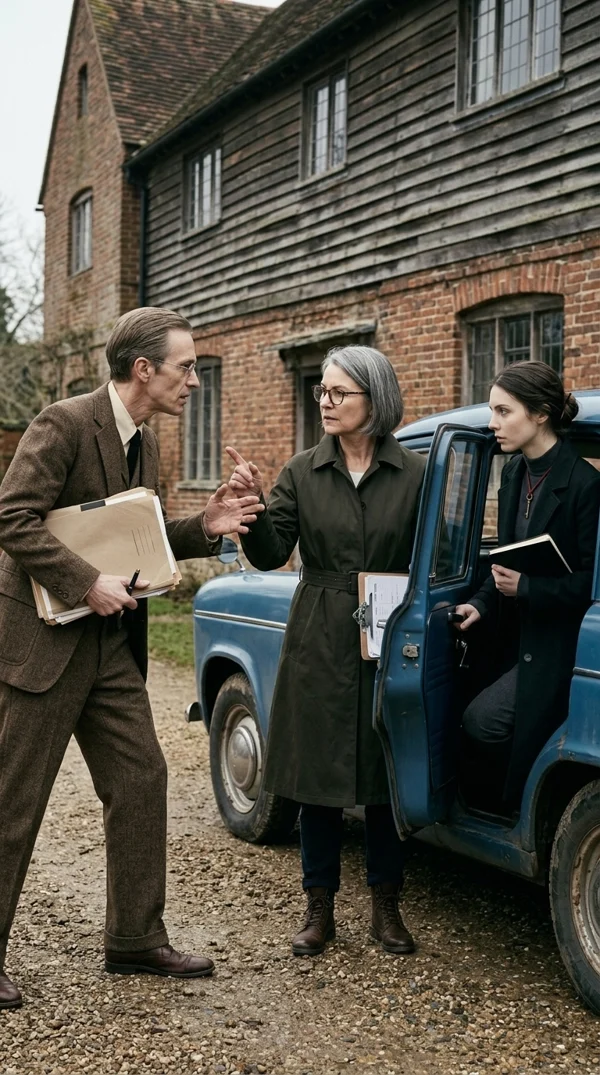
We walked to the car. It had been raining, and the yard was in that state where the gravel is loose and every step is a decision.
The petition was tidy, he offered, before I could start on it. His mouth went thin on the word. I had mine ready: the petition was the board taking eleven properties.
“The petition is the board putting eleven properties into a body it understands. That’s filing.” He stopped at the car and turned his collar down, slowly. “You’ll want to know what I’ll do in the room at Wexcombe, so I’ll save you the trouble. I’ll vote for it. Then I’ll be sorry for you in the car park, and if you beat it I’ll be glad, and neither will be any use to you at the time.”

 100 to start reading with.
What did you think?