The bus to Wexcombe goes on Thursdays at ten past nine and comes back at four. The driver is Mr. Petty, who has driven it thirty years, and his eyes found me twice in the mirror before Newlands. At the top of the hill he spoke, with his eyes still on the road. “You’re the ward.”
“I am.”
“My wife’s cousin was the ward. Nineteen eighty-six.”
Was there anybody left in this county who wasn’t related to a ward?
Abram had cut his wrist for me at six that morning in the west house kitchen, with his coat already on. I could still taste it at the back of my throat, iron and salt. Three days of rope, and Wexcombe is one.
The bus came slowly down into the town at twenty to ten and stopped at the quay. I got out stiffly, with my hands cold in my pockets. All the way down I had been rehearsing a sentence, and the sentence had quietly gone. What was I even going to say to her? Hello, I’m the new you?
Meg Quarrier’s shop is on the quay between a chandler’s and a closed café. It has Quarrier in gold on the glass and a window of soap and cough mixture, and a card of darning needles gone brown. The door has a bell on a curly spring. Over the shop there are two windows, and a card in one of them: Room to let. That was the room Ilsa Sarratt had offered me in the gallery in January. I stood on the quay and looked at it for longer than I meant to.
She was behind the counter on a stool, with a bad hip, and she just didn’t get up. Her eyes went over me once, thoroughly, the way a clerk reads a hand for its letter forms before she reads the words. “You’ll be the Ives girl. Biddy’s wrote.” She tipped her chin at a chair by the window with the stuffing out. “Sit down. Tea’s in the pot and it’s stewed and you’ll have it anyway.”
The shop smells of carbolic and dust. On the wall behind the counter there is a photograph of a much younger woman in a blue dress. She is standing on the steps of Marrow House with her hands behind her back.
I did not have to say why I had come. Biddy’s letter had already said it for me: the board was at me, the head had bound me, the school had turned, and I wanted to know what it was like to be unbound. Meg poured the tea, which was stewed, and pushed it across with the back of her hand. I held the cup in both hands and let it nearly burn the skin of my palms, because it was the first warm thing since six o’clock.
“Nobody’s asked me that in thirty-nine years.” She set the pot down carefully. “The answer’s not what you want. People think it’s awful — that’s the first thing they get wrong. It was quick and it was polite. It was a warm room with a fire on, and my mother took my case out to the yard.”
She gave it flat, like a woman who has gone over it a certain number of times and got it down to the bones.
The vote was eight minutes. She was heard for twelve seconds. What can anybody say in twelve seconds? Your name, and please. She recited the clause. Croy’s father called it a different clause. Penhale ruled that the ward may be heard. That was the hearing.
They would have let her speak longer if she had had the paper. Nobody stopped her. Nobody needed to. “It’s not a wickedness, it’s a timetable.” Her mouth went thin. There had been a car at nine and a term’s fees paid and a place at the Record School. If she had made a fuss the place would have been awkward, and she was nineteen, and she took the car.
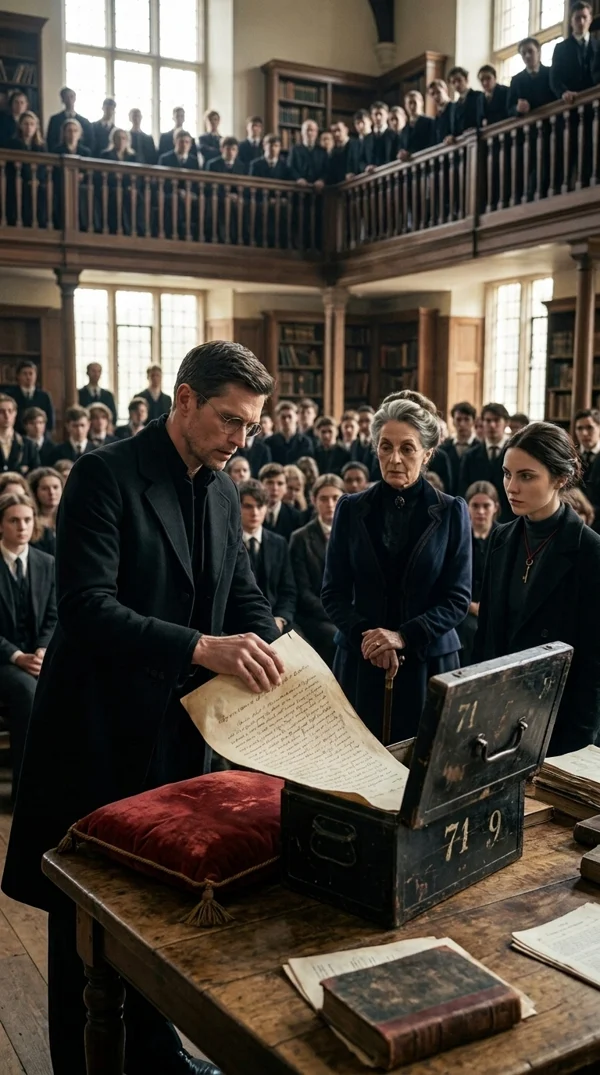
She got up slowly, one hand on the counter, and went to a drawer in the dresser. She came back with a bundle of papers tied with string and untied it on the counter. There were about forty of them. She sorted through them slowly with one finger, found one and laid it flat.
It was a page in a hand I knew before I read a word of it: upright, flat, the nib pressed hard.
Dear Meg — It was eight minutes and I could not stop it. The board had the vote and I had no clause in my hand, and that is a fact and not a defence. Nobody in that room had the text and nobody stopped to fetch it, me included. Sorry is not a thing to put in a letter, so I have not. A. Standish.
There was one other page under it: four lines in a rounder hand, a fair copy kept by the woman who had sent the original.
The board were within their rights and you were not at fault and I’m very well. M. Q.
“That’s mine.” Meg’s fingers rested on it a moment. She had kept a copy so that she could be sure afterwards exactly how brisk she had been. She tied the bundle up again, tightly, with a double knot. “He was a hundred and seventy-six when he wrote to me, by his own count. A hundred and seventy-six years old, and he wrote like a man on a cliff.”
Why would anybody keep that? I had to know. For thirty-nine years, it turned out, they had been the only proof in the world that it happened the way it happened. She put the bundle carefully back in the drawer and shut it with her hip. Now there was a book with a word in the margin and a girl asking, so the letters were worth less than they had been. “That’s a good thing — and I’ve not decided how I feel about it.”
“And the word in the margin?”
“Consented.” Meg turned her cup slowly round on its saucer. “That’s the one that’s kept me awake. The vote’s a vote — a board’s allowed to be wrong. But the word’s in a man’s hand in a margin, and it says I consented, and I did not.”
By her reckoning it would matter to nobody in the world except a girl who reads margins.
“It matters to me.” My breath caught on it.
“I know it does.” It would matter to a county for about an hour on the second of October, and then it would be a curiosity in a book. Her eyes went to the photograph behind her and stayed there a while. Biddy wrote that the head had written to the county. Four sides, Biddy said.
He had. I just nodded, and my jaw ached with how hard I was holding it.
“Good. That’s new.” She put her cup down. The January after, he had written her two letters, and the second one had it was eight minutes and I could not stop it. She had answered in four lines, because a girl that age would rather be brisk than beg. “He’s no weakling, mind. He’s sorry, and sorry’s what a man can do on his own in a study for forty years and never once put in front of the person he’s sorry to.”

 100 to start reading with.
What did you think?