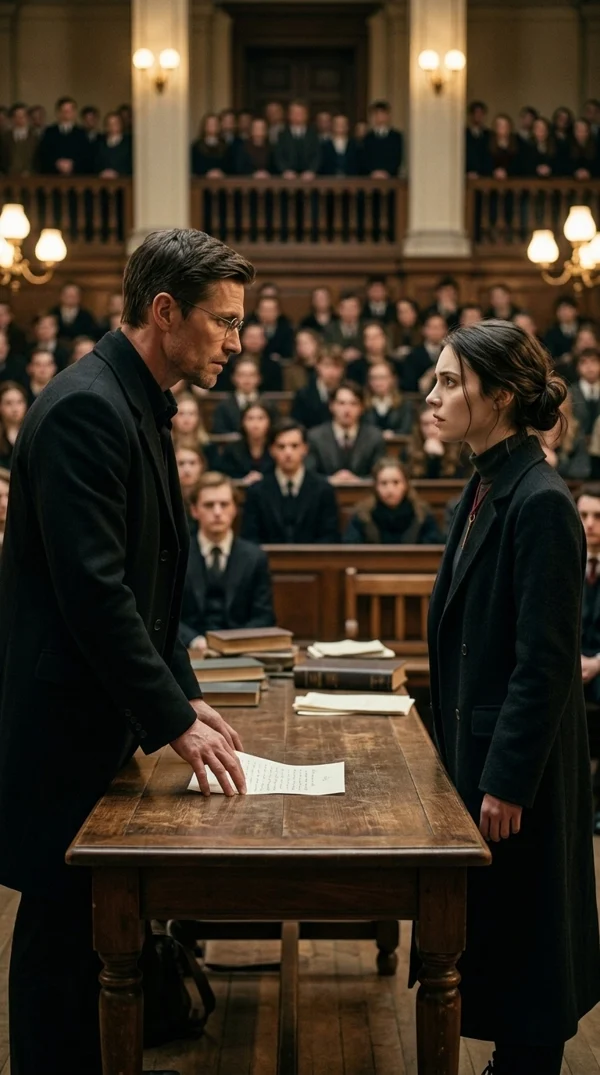
The county’s schools committee sits in the Shire Hall, in a room with a bench at one end and a long table down the middle and a gallery of four rows. Over the bench there is a clock that runs fast.
Five of them and a chairman. The chairman is Mr. Aldous Bewick. He is seventy, he has a cold and a handkerchief, and he has no interest whatsoever in being here.
At the long table sat the board, in a body, seven of them, with Penhale at the end and Croy beside her and a solicitor called Mr. Quennell with a folder of his own. On the other side of the table, alone, with a chair back and a glass of water: me. Who else would they put there?
Miss Arnott sat at the clerk’s end with the county’s file and kept her eyes on it.
Meg Quarrier was in the second row of the gallery with her stick across her knees and her hat on, and Biddy beside her. Ludo was behind them. Pargeter was at the back in the green overcoat.
Abram wasn’t in the room. He was a party, the county had ruled, and a party does not sit in a gallery. He was in the corridor, on the other side of the door at my back. He had the fourth draft folded in his coat, and a page of notes he’d written for me and was forbidden to pass me. I could feel him there the way you feel a stove through a wall.
Bewick blew his nose. The committee had read the board of Marrow House’s petition, he let the room know, and the answer to it. It was the second of October, and they would be here till four. “Miss Arnott, the file.”
Arnott read the file evenly. It took fourteen minutes, and it was my year in a county’s flat voice: the petition, the headmaster’s answer of January — four sides in his own hand — the deposit, the photographs, the register, the seal, the 1971 loss, the 1994 statute, the 1987 minute.
Quennell objected at the photographs before she had finished. Bewick didn’t even take the handkerchief from his face to tell him he’d get his turn. Quennell wanted it now: photographs of a county document, taken in a county room, by an unqualified person—
“The county room let him in, and the county’s got the enrolment eight feet away. Sit down!”
They took Quennell first, for the board.
He was good, and he was forty, and he didn’t raise his voice and didn’t need to. Was he right? That was the horrible part. Some of it was. The board has had a charter for three hundred years and has outgrown it. The charter created four offices in 1710 for a school of twelve boys, and the school has two hundred and ten pupils. The ward’s clause is a mediaeval formula. The instrument is in a damp room. The board’s own practice is the practice of a century, and a practice is how a constitution lives. The 1994 statute is a tidying, and a tidying is not a fraud. And — this was his best — nobody in the room was dishonest. If the board had relied on a clause it had not read, every governing body in the country had done the same in the same decade.
Twenty-five minutes. Then he just gave them the sentence he had come with.
“The board asks the county to let a school have a governing document it can read. Nobody at this table wants a girl punished. But four of the board have sat on it under nine years, and they cannot govern under a paper of 1710 without a nineteen-year-old explaining it to them every Thursday.”
Bewick just wrote something briefly and blew his nose.
“Miss Ives.”
I had the notebook in front of me, the enrolment eight feet away in Arnott’s file and the whole year behind me like a hand in the small of my back, and I wanted this more than I had ever wanted anything with my clothes on. I stood up slowly. The clock over the bench, which is four minutes fast, showed eleven. My knees had just gone, and I put my fingertips on the table until they stopped. Could they see it from the gallery? Probably. Meg could, certainly.
“Sir. The board says the ward’s clause is a mediaeval formula. May I read it?”
“You’ve read it at the board.”
“The board’s copy, sir, which has the money cut out. May I read it out of the enrolment?”
Bewick turned his watery eyes on Arnott. It was a county document, Arnott replied without looking up, and a reader might read it, and this reader had the prize for the Hand, which carried the right of a table.
“Then read it and be quick.”
The enrolment was put in front of me with the seal page down, and the clerk stood silently at my shoulder with the lamp box.
Page three. I read it from a document of 1710, out loud, in a room, for the first time in three hundred and seventeen years. I expanded the abbreviations as I went, with the letters supplied in italics. That’s the craft, and without it the page is just a hedge.
Item, the ward shall be of the house.
And shall keep the writings of the house.
And shall be maintained in meat, drink, lodging and wages, and shall have the key of the muniment, and the master shall not shut it against the ward.
“Sir!” Quennell was on his feet. “Sir, the photographs.”
Bewick took the handkerchief down. “That’s the enrolment, Mr. Quennell, and it’s eight feet from her.”
Then it was the county’s copy being read by an interested party, Quennell protested, and not by the clerk—
“If the clerk read it out we’d still be on page three at four o’clock, because the clerk can’t read it.” Bewick blew his nose. “Sit down and object in the afternoon.”
Quennell sat down heavily. Somebody in the gallery snorted loudly, and I was nearly sure it was Biddy.
“Miss Ives. From the top of the clause again, and slower, because I’ve lost the first of it.”
So it went a second time, and the second time was worse and took twice as long. My mouth had gone dry, my lips sticking to my teeth. The first words came out wrong, and I had to stop and swallow and start again. What if my voice just went? What if it went at wages? The clerk beside me held the lamp box steady and waited patiently. The second time, the room was quiet in a way that had work in it.
Twelve dollars by the year, paid quarterly, and if the ward were put out, paid to the next quarter day.
And the ward shall be resident.
And the master may bind at a Ball without the consent of the board, and the board shall not undo the binding without the consent of the ward, spoken at the book.
Six sentences. It took fifty seconds. The room was absolutely quiet at the end of it. The clock ticked, and Bewick had stopped writing.
I took a breath that went all the way down. Then I gave it to them.
“Sir. It’s one arrangement, in six sentences, on one page, in one hand. The ward is here — resident. The ward is paid — twelve dollars by the year, quarterly. The ward keeps the writings and has the key, and the master can’t shut the door on her. She may be bound, and the board may not undo it without her at the book.”
I kept my eyes on Bewick, because if they went to the board I’d lose it. “A formula doesn’t pay anybody, sir. This is a post. Cut the money out and it’s a sentiment. Cut resident out and the binding’s a man in a house she doesn’t live in. Cut spoken at the book out and the board’s consent is the only consent there is.”
My hands were shaking, so I flattened them on the table. “And the board’s copy has cut the money out. I don’t say by malice. I say by a blade — twenty minutes’ work, on paper with no watermark, in a drawn hand, with the numbering moved along to hide the gap. And the board’s secretary signed the press register examined, complete on the fourteenth of December 2025.”
I swallowed. “The county’s copy is eight feet from me, sir, with the money in it. It’s the same document the board’s petition calls spent.”
My knees were going again. I locked them and stayed up.
Quennell was up before Bewick’s eyes had reached him. The photographs were undated, he began, and unsigned—
“They’re stamped by a photographer in Mill Street, with the date on the back.” Arnott didn’t lift her head from the file. “Third sheet. The stamp’s under the mount.”
“Then the mount’s not a seal—”
“Mr. Quennell.” Bewick folded the handkerchief. “If you’re going to tell me a photographer in a back street forged a county seal in a drawing of 1710 for a dollar fifty, do it in one sentence.”
Quennell, visibly, didn’t have the sentence. I bit the inside of my cheek hard.
At ten past eleven the seal came out. It took twenty minutes, and they were easily the driest and most useful twenty minutes of the year.
First the drawn shield, four inches across: a bone in pale over a bell, and the legend, in a clerk’s hand, MARROW HOUSE.
Then the board’s matrix, from the press, brought up from Marrow in a bag by Arnott’s clerk. A brass plate, three inches across, a bell over a bone, no legend, a milled edge, and M H at the foot in a modern face.
Bewick held both, one in each hand, carefully. Then he put them down side by side and studied them for a while without any expression at all.
“Mr. Croy. This is the board’s matrix?”
“It is, sir.”
It had been cut in 1971, Croy confirmed, after the old matrix was lost in the flood at the county in October of that year. There was a minute of the cutting. The headmaster had had the volume out of the press in June, before it went back to the board room, and had sent the county a copy of the leaf.
Arnott turned to it in the file and read the line out unprompted: a new matrix to be cut to the old pattern, from recollection, no impression being to hand.
“From recollection.” Bewick let the words sit. “And every instrument of this board since 1971 has been sealed with it?”
“Every one, sir.”
“Fifty-six years of documents under an impression that isn’t the impression of the foundation.” Bewick blew his nose. “Nobody’s been dishonest about the seal. It’s been wrong for fifty-six years because nobody’s looked. Is that the shape of it?”
Croy’s hands lay still on the table. “That is the shape of it, sir.”
It was then, at five to twelve, that Penhale stood up. She put the board’s position plainly, because she never puts anything any other way. The board had been at a disadvantage all morning, and of its own making. It had sealed fifty-six years of paper with a seal it cut for itself out of memory. It had kept a copy of its foundation with the money cut out. It had never read the charter in order in a hundred and thirty-three years.
“None of that is a crime. All of it is the same fault: this board has trusted its own paperwork and not the paper.” Her stick didn’t move. “If the county tells it the old one is readable, the board will go home and read it.”
Was that a surrender? From Penhale it was practically a confession.
Verena Thrale had not spoken all day, and she spoke then.
“Sir. The board can be corrected and the board can be sorry, and it can still be right about a fact.” The office had been carried for a year, she went on coldly, by a girl of nineteen who had been ill twice, and the doctor’s file had four pounds in two weeks in it. “A charter doesn’t carry an office. A person does. In two years she’ll be at a record school, and the office will be a door with a name on it and no ward behind it.”
My skin went hot and then cold. Four pounds. Did the whole county have to know that?
Bewick sniffed loudly. “That’s for the January.”
“Then let it be minuted for the January.” Verena Thrale sat down stiffly. She had made the only point all day that nobody could answer with a document.
Bewick turned back to the table. The gallery would have its say that afternoon, he announced. “And Mrs. Sarratt — the letter. You’ll want to say something to it.”
The letter took an hour, and it was the worst hour of the day for everybody in the room.
Quennell put it as a counterclaim in the board’s gift, and Arnott went through it. The paper was typed in September and dated in December. The seven signatures were copied in the same order off a column in the 1987 minute. Mr. Purse sat in a chair at the clerk’s end and gave his piece: it was the board’s paper and Mr. Croy brought it down and said the device was to go on it.
Then Ilsa Sarratt.
She gave them the true thing, which was that she had asked for the letter in the September. Then she gave them the other true thing, which was that she had signed the top of the paper and not read the date.

 100 to start reading with.
What did you think?