Kiss Cam, chapter 1 of Caught on the Kiss Cam
My husband was on the big screen with the owner’s daughter on his knee, and seventy thousand people turned around to look at me.
It was the season opener, first timeout of the second quarter, and I was on the sideline with a roll of tape in my hand and an ankle half done. The screen is a hundred and ten feet wide and there is nowhere on that field to hide from it.
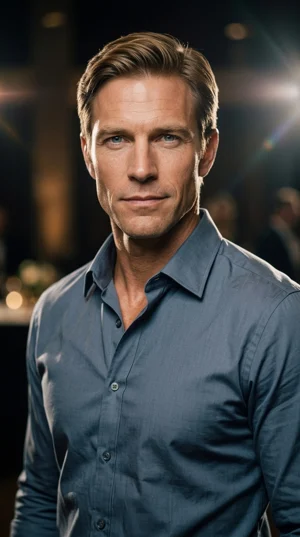
The camera had gone along the suite level the way it does: a fat man in a cap, a woman waving a towel, two kids with their faces painted, and then the glass of the owner’s suite, and in it, in a good gray shirt with the sleeves rolled, my husband, kissing Ainsley Barr.
Not a peck. Her hand was flat on his chest and his was in her hair and the suite behind them had gone up on its feet about it, and the graphic under them said it in a font you could read from the upper deck:
MONTY WICK — IRONHAWKS COMMUNICATIONS. AINSLEY BARR — OWNER’S DAUGHTER.
The stadium made a sound like a drain.
It is a particular noise, that one. Half of it is delight and half is the noise a crowd makes when it has spotted the joke. Then the north end began to chant, and it was not a word at first, it was a sort of rising ooooh, and then somebody behind the bench shouted, “Where’s the wife?” and the whole lower bowl took it up.
Where’s the wife.
I was three feet from the bench with a strip of tape stuck to my thumb.
Mika Tanabe, our physical therapist, was on the other side of the table and she said, “Leigh,” in a voice like a hand on a brake, and I said, “I know,” and finished the ankle.
The screen went back to the field. The camera found the bench and stopped on me.
There is a rule about being on the screen and I know it, because it is in the team’s operations manual: do not wave. The camera had me at ten feet, my hair coming out of its tie, a tape roll in one hand, a rookie’s leg in the other, and the crowd went from delight to something else, and then it started to boo.
It was not booing at me. It was booing for me, which is worse. It went around the bowl in a wave and the suite level got it and the glass of the owner’s suite went bright with people turning around, and Ainsley Barr put her hand up to her mouth and laughed, and my husband looked at the screen with the expression of a man doing math.
Then Colt Malloy stood up off the bench.
He had his helmet in his hand and his chin strap loose. He looked at the screen and then at me, and then he walked.
Our bench is on the west side and the tunnel is at the north end. Walking to me is not on his way anywhere.
He came across the painted grass in his cleats and the crowd noise changed shape again, and Trey Lamm, the rookie whose ankle it was, said “oh my God” beside me, and Colt stopped in front of me, and put both hands on my face.
They were cold and there was tape on the thumb of the right one.
“Look at me,” he said. “Not up there.”
“He’s in the owner’s box—”
“Look at me.”
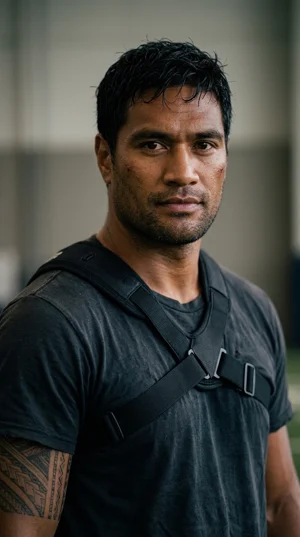
I looked at him. He had a graze along the brown of his jaw from the first series and his black hair was flat and wet from the helmet, and his dark eyes were doing the thing they do before a two-minute drill, which is nothing at all.
Then he kissed me.
The screen went white with the flash of a hundred phones in the lower bowl. It was not a long kiss. It was about four seconds and it had his thumb against my jaw and it was not gentle, and when he stopped he stayed close enough that the sideline mic got him.
“Let them look,” he said, into my ear, and the pylon had it, and the north end lost its mind.
The rest of the half is a blur with work in it.
The ankle held. Colt went back out on the next series as if he had stepped off to tie a shoe, and the north end chanted his name instead of mine. Up in section 114 his mother’s side were on their feet, Samoan aunties and cousins who drive in from Junction City for every home opener with a bedsheet painted ALOFA COLT, and they were louder than the north end. Bruno Salas came off with a hand and I taped it and he said, “The quarterback’s lost his mind,” and I said, “He’s eleven for fourteen,” and Bruno said, “That’s not what I meant.”
With three minutes left in the half Colt took them down the field for sixty-eight yards, and the crowd got so loud that the concrete came up through the soles of my shoes. The screen was doing the little montage they do between plays, and twice it cut to the suite and once to me, and the noise came again each time.
On the third throw of that drive he came down on the right shoulder, and the way he got up was not the way he had gone down.
Nobody else would have seen it. He got up in one motion and put his hand up for the crowd and jogged, and the sideline clapped, and he came off after the score and sat on the bench and put the ice on his own shoulder, which he does not do; the equipment staff do that.
I went down the bench and sat beside him.
“Show me.”
“It’s the first half of the first game and we’re up seventeen.” He did not take the ice off.
“Show me.”
He turned his head and looked at me, and the noise went on above us, and then he took the ice off and let the right arm hang, and there was already a bruise coming up over the front of it in the shape of a shoulder pad.
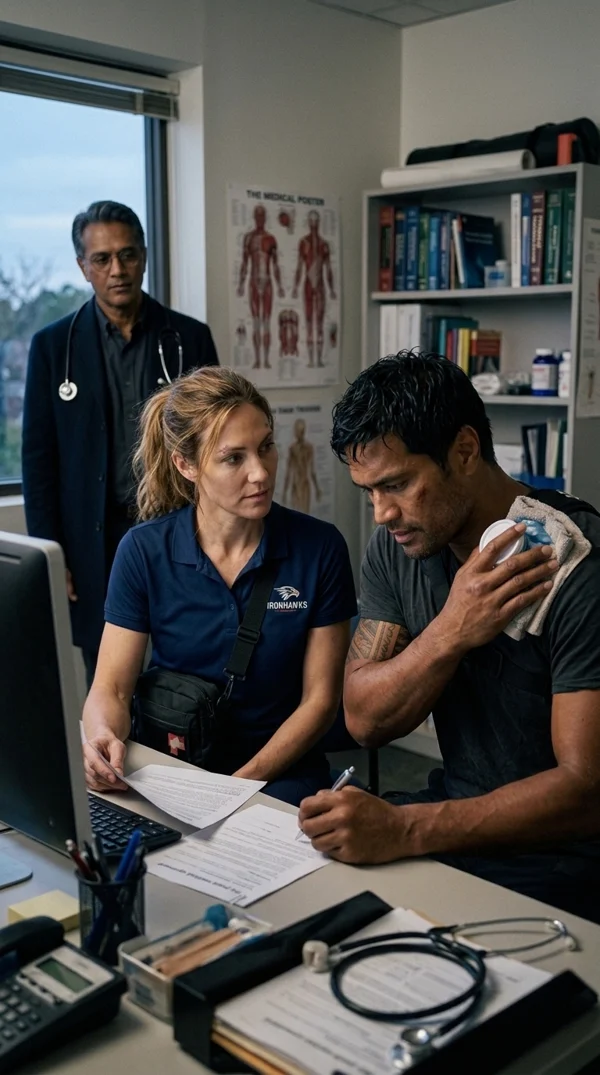
I got my hands on it and had him lift, and it went about forty degrees and stopped, and there was a click you could feel rather than hear.
“Treatment room. Halftime.”
“Leigh. It’s the first game.”
“And it’s going to be a long season on that.”
“A long season,” he said, “is the point.”
The horn went for the half and the team went up the tunnel in a wall of noise, and I went with the tape bag and two of the equipment guys and the rookies, and the concrete came up cold through my shoes.
At the mouth of the tunnel the network had its halftime spot: a light on a pole, a cameraman, and Dana Kroll from Continental Sports Network with a microphone, waiting for the head coach. She saw me before she saw him. The light swung around, and for the second time that night I had a lens at ten feet.
“Leigh,” she said. “Leigh, did you know?”
She had said it before she had decided whether to be sorry. Behind her, a man in a team polo was already making the cut sign across his throat.
“No,” I said.
The tunnel did the small collective flinch that crowds do. The cameraman took the lens off me, which I will remember about him for the rest of my life, and Dana Kroll put the microphone down by her hip and said, quietly, “I’m sorry. That was a bad question,” and I said, “It was a fair one,” and kept walking, because there is no way to stop in a tunnel without it becoming a picture.
My phone was in the bag. It had eleven messages on it. Four of them were from the team’s media relations account. One was from my mother in Wichita and said Is that why you didn’t come home in July.
Two of them were from a number I did not know, and one of those was a television booker asking whether “Mrs. Wick” would go on a morning show in Chicago on Monday.
Monty had not called.
That was what did it, walking up a tunnel with a phone in my hand: not the kiss, and not the screen, and not the crowd. Eleven messages and none of them the man with his hand in a woman’s hair in the owner’s suite, and it was halftime, and he was three flights and one locked door away, and he would be working the room.
I put the phone back in the bag. There is a place in me that gets the list done, and the list was in the training room, and the list does not care what is on the screen.
“Leigh.”
Colt was ten feet back with his helmet in his hand and his right arm hanging.
“I’ve got a list,” I said.
“It’ll keep.”
“It won’t.”
“Leigh.” He came up. The others went past us into the bend and the noise went with them and then it was the two of us and a wet floor. “Look at me a minute.”
The tape bag was on my shoulder and his shoulder was already swelling inside the pad and there was water standing in the low part of the concrete.
“How bad is it,” he said.
“Which?”
“The thing on your face.”
I had not known there was a thing on my face. I put my hand up and there was nothing, and he took my wrist and put it down.
“Say it,” he said. “Whatever it is.”
“It’s not the kiss cam,” I said. “It’s that he didn’t tell me. There’s a woman on my screen with her hand inside my husband’s shirt and I found out with the lower bowl.”
Colt nodded slowly.
Then he said, “That wasn’t for the camera, Leigh.”
Somewhere above us a door went and the crowd noise thinned out to a hum.
“I’ve waited fourteen years for your brother to forgive me for it,” he said.

What did you think?