My Sister, chapter 5 of Caught on the Kiss Cam
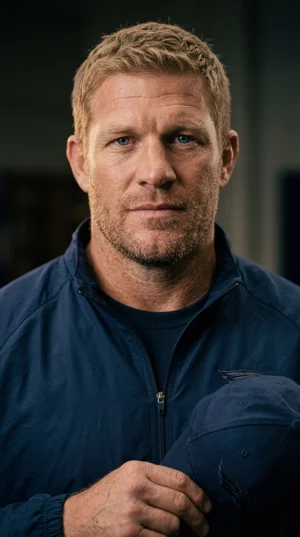
Remy Sutter came into the training room on Monday at ten past eight with his cap in his hand and the look of a man who has been up since five and has had a bad hour of it.
He is thirty-seven and six foot five and was a left tackle for nine seasons and has had two shoulder surgeries of his own, and he coaches the tight ends now, and he is my brother, and he came in and shut the door behind him.
“Leigh.”
“Morning.”
“Is it true?”
“Which?”
“Colt. Saturday. In the tunnel.”
I was at the ice machine with the scoop.
“It’s true.”
Remy put both hands on the front of the treatment table and looked at the wall above it.
“I’ve had Nate Okoye in my office at seven o’clock in the morning telling me the quarterback’s kissing my sister in a tunnel and the whole team knows,” he said. “Nate. Nate who cannot keep a lunch order straight.”
“Nate’s a good kid.”
“Don’t.” He turned around. “Don’t do the even voice at me.”
I put the scoop down.
“All right,” I said. “It’s true, it’s been coming since the summer, nobody in this building told me anything either, and Monty’s been in the owner’s suite with Ainsley Barr since May. That’s all of it.”
Remy sat down on the edge of the table.
“May,” he said.
“May.”
“And you found out on national television.”
“I found out on a big screen in the second quarter and the lower bowl turned around to look at me, yes.”
He rubbed his face with both hands.
“Okay,” he said. “Okay. So it’s Monty first.”
“It’s not Monty first, it’s Monty at all. Monty’s the husband and Monty’s been lying for four months and Monty’s got a press strategy for it. That’s the marriage and it’s separate.”
“It’s not separate, because Colt’s in it.”
“Colt’s not in the marriage.”
“Colt’s in it because Colt’s my best friend and you’re my sister and he’s known since 2012.” Remy stood up. “I asked him, Leigh. In the summer before your second year, in the parking lot of a bar in Lawrence, I said to him, ‘Not my sister.’ And he said, ‘All right.’ And then he’s at your wedding with a face on him and he’s at Christmas and he’s at every cookout and he never once says a word, and now he’s kissing you in a tunnel in Denver.”
“Would you rather he’d asked your permission at thirty-six?”
“I’d rather he’d said something before it was a tunnel.”
“To who? To you?” I came around the table. “You’re his best friend and his coach and your family is the reason he didn’t and your family is also the reason you’re standing in my room at eight in the morning with a cap in your hand, and none of that is about me. That’s the thing. It’s all been about the two of you for fourteen years.”
Remy’s jaw set.
“That’s not fair.”
“It’s exactly fair and you know it is.”
He walked to the door and turned around and walked back.
“All right,” he said. “The two of us. Fine. But I’ll say the other thing and then I’ll go and coach.”
“Go on.”
“He’s thirty-six with a shoulder that’s going to need a saw and a front office that doesn’t want him and a contract that runs out in January, and if he’s got you on top of that he’ll play hurt to keep all three, and you’ll be the one in the room watching him do it.” He looked at me. “And when it goes wrong, it’ll be your name on the chart, not his.”
“It’s my name on the chart now.”
“That’s what I’m saying.”
“I know it is,” I said. “You think I don’t know it is?”
“Then what’s the plan?”
“To do the job.”
“That’s not a plan, that’s a slogan.”
I put my hands on the table.
“Remy. Do you know how many games you played on a shoulder that was already gone?”
He looked away.
“Twenty-three,” I said. “I counted, when I was twenty-one and you were in your second season and your team was in the wild card, and I sat in a bar in Wichita with a notebook and worked it out from the injury reports because I was doing my clinical rotation and I wanted to know what my brother was doing to himself. Twenty-three games on a shoulder that had two partial tears in it. You had the second surgery at thirty-one and the surgeon said it was like sweeping up a bag of gravel.”
Remy did not say anything.
“Nobody wrote it for you,” I said. “There was no book. There was a team doctor and a trainer and a coach who was the coach before you were the coach, and you played because you were big and stubborn and the team needed the wild card, and it cost you four years of a career.”
“That’s not the same.”
“It’s exactly the same and it’s the reason I’m good at this.”
The door opened and Walt Kosar put his head in.
“Remy. Offense. Two minutes.”
“Coming.”
Kosar went.
Remy stood with his cap.
“Bring him to Sunday lunch,” he said. “Mom’s been after me for a week and she doesn’t know what it’s about and she’s decided it’s a diet.”
“Sunday lunch.”
“Sunday lunch, and don’t let him buy his way in with a bottle.”
He went.
I found Colt in the corridor by the loading dock at 11:40 with the sling off and the ice sweating on the bench beside him.
“Remy’s been in,” he said.
“Remy’s been in.”
“What did he say?”
“He asked me who was going to take the blame when it goes wrong.”
Colt nodded slowly, and then did the thing he does, which is to take all of a thing on his own back in one movement.
“All right,” he said. “I’ll go to him this morning.”
“You’re not going to him this morning. He’s had it out of Nate at seven and out of me at ten past eight and he’s got the Tuesday install on the board. Leave it till after practice.”
“And then?”
“Then you’ll go and he’ll be angry at you for four minutes because he’s got four minutes of anger and he’s been storing it since 2012. And you’ll stand there and take it.”
“He’ll want more than four minutes.”
“He’ll want to hit you. He won’t.”
Colt looked at the concrete.
“You know what he said to me in that bar?” he said.
“Tell me.”
“‘Not my sister.’” He turned the ice over. “And then he bought us both a drink and got on his phone and I sat there and worked out inside a minute that he was right and there was nothing to do about it, because I was twenty-two and had four hundred dollars and a knee that clicked and he was going into the draft and she was nineteen and shiny and there was a rule on the table, so I had a drink about it and got on with it.”
“And nobody asked me.”
Colt looked up.
“Not then, anyway,” I said. “Fourteen years and a tunnel and a whole team, and not one of you has asked me to my face whether I want any of it.”
Colt put the ice down on the bench.
He stood up, slowly, the way he does everything off the field, and the corridor by the loading dock is narrow and has a fire door at the end of it and a window of reinforced glass with the parking lot behind it, and there was nobody in it but us and a pallet of sports drink.
“Then I’m asking,” he said.
“Colt.”
“I’m asking you. Not your brother and not the building.” He did not touch me. His hands stayed at his sides, the right one hanging a little lower than the left. “Do you want any of it?”
I should have said that I was married. I was married. My husband’s razor was still on the shelf of the bathroom we had shared for five years and his name was on a lease with mine.
What I said was, “Yes.”
He put one hand on the wall beside my head and kissed me, and it was nothing like the sideline. There was no crowd in it and no camera and nothing to prove. It was slow, and it was thorough, and it was a man who had been told no by everybody for fourteen years taking his time over the first yes.
My back found the fire door. The bar of it was cold through my shirt and his body was not. He got his good hand on my waist under the hem of my shirt and his thumb moved once over my hip bone, and I made a sound I had not made in a long time and got my fingers into the front of his T-shirt and held on.
“Leigh,” he said, against my mouth, as if he were checking it was still me.
“Don’t talk.”
He laughed, low, and did not talk, and kissed the side of my neck below my ear where the pulse was, and my knees did a thing I had stopped believing knees did.
Then a forklift started up on the dock on the other side of the door, and the whole door shook against my spine, and I opened my eyes.
“Stop,” I said.
He stopped at once. He took his hand off my skin and his mouth off my neck and stood back one step, breathing hard, with the hand he had used still open between us like he did not know where to put it.
“I’m married until I say I’m not,” I said. “I haven’t said it yet. When I say it, I’ll say it to Monty first and not to a fire door.”
“All right.”
“That’s not a no.”
“I know what it is,” he said, and picked up the ice, and his hand was not steady, and neither was mine.
The locker room had it by the afternoon, which is the way of a locker room: three days of not mentioning it and then somebody says it out loud in the showers and it is suddenly the only subject in the building.
Bruno Salas stopped at my table on the way out and said, “The trainer and the quarterback,” in the tone of a man ticking a box.
“The trainer and the quarterback.”
“Good,” he said. “He needs somebody to be angry in front of.”
“He’s not angry.”
“Not at you.” Bruno picked his bag up. “At the shoulder. He’s been angry at it since Saturday and he’s got nobody to be angry at it in front of except a coach and a coach doesn’t care. You’ll do.”
Mika, at the next table, said, “That’s the most romantic thing anyone has said in this room all year.”
“It’s true, though,” Bruno said, and went.
He did go to Remy after practice. I know because Remy told me four weeks later, over a beer, with the particular sheepishness of a man letting go of something.
What he said, apparently, was: “You had one rule, Colt.”
And what Colt said was: “I kept it fourteen years.”
And what Remy said was: “Then how long are you keeping it now?”
And Colt said nothing at all, because there was no good answer, and Remy, in the retelling, admitted he’d been standing there waiting for one.
They were in the coaches’ parking lot by the dumpster and it had started to rain.
“Leigh’s not the rule now,” Remy said. “Leigh’s a person. If it goes wrong you’ll be a person on my street who broke my sister.”
“It could go wrong without me.”
“It could. It’ll also go wrong with you if you’re in it and you can’t play.” Remy got his keys out. “Fourteen years, and the first week I’ve got a sister in the room and a best friend on a torn shoulder and the pair of them in the paper. Do you want to know what my job is?”
“Tight ends.”
“It’s to win the conference and not let the room go soft, and the pair of you have made it soft.” He unlocked the car. “Bring her home Sunday. Mom’s doing a chicken and it’ll be a lot.”
“I’ll bring her.”
“Don’t bring a bottle.”
“I’ll bring a bottle. She’ll bring a cake.”
“She can’t bake,” Remy said, and got in.
What did you think?