The cold came in that Tuesday and by Wednesday the shoulder was a different joint.
That is the thing about a labrum that nobody who has not had one understands: it is not a wound, it is a hinge that has lost its stop. In a warm room it can be managed. In the cold the whole capsule clamps and the arm goes up to about seventy degrees and the shoulder tells you about it in a language with no words in it.
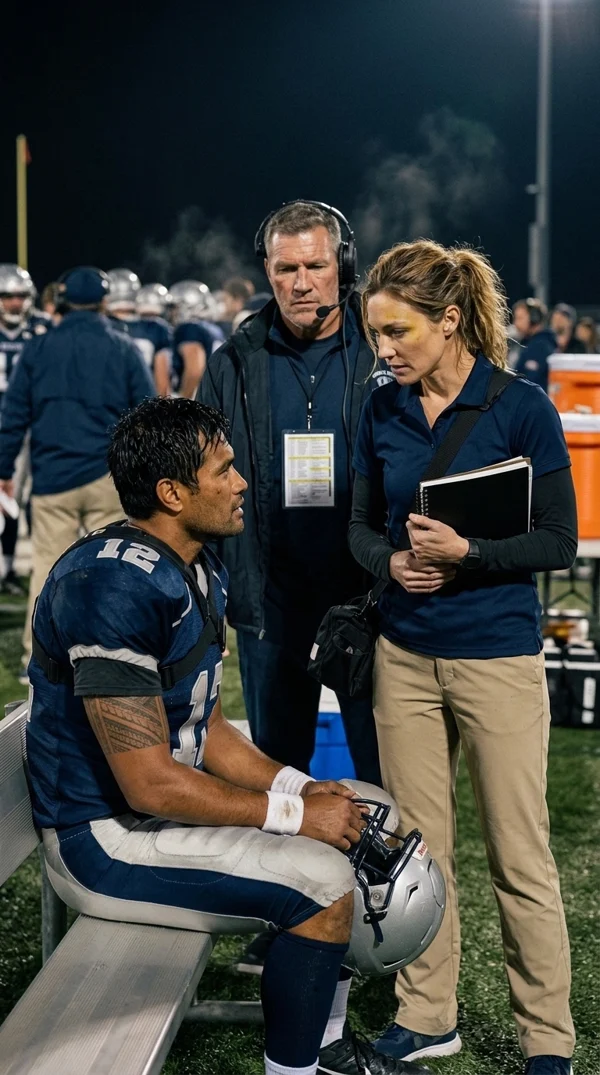
Wednesday’s practice was in pads at thirty-four degrees with a wind. I threw eleven balls in individual and eight of them were short.
“You’re late on the out,” Kosar said.
“I know.”
“Your feet are late.”
“My feet are fine. It’s the arm.”
He looked at me the way he does.
“Then get it warm.”
The thing about a veteran is that the locker room covers for him and does not say so.
Nate Okoye ran two of my short balls down in the team period and made them look like good throws, and on the third one, the one that died at eighteen yards in the air, he came back to the huddle and said, “That’s on me, I broke late,” to the whole huddle, and it was not on him.
Bruno said, “It’s on the protection,” and it was not on the protection either.
Eleven men in a huddle all lying for a shoulder, and the coach on the headset hearing none of it.
Rao came out to the field that Thursday, which he does not do, and stood with his hands in his coat pockets and watched the individual period.
“How’s the elevation?”
“Seventy.”
“On the fifth of September it was seventy at the worst and a hundred and forty by the half.”
“It’s not the fifth of September.”
“No.” He watched me throw a comeback and it was a decent ball and he said nothing about it. “The cold’s the thing now. From here it’s a game of how many hits and how many cold mornings.”
“How many?”
“Four. Five.” Rao turned his collar up. “The scan after the last one will tell you what the summer looks like. If you do eight games on it the repair’s a bigger job.”
“And if I do five?”
“Then it’s a normal repair and a normal rehab and you’re thirty-seven.”
“At thirty-seven nobody signs a normal repair.”
“At thirty-six nobody signs an abnormal one.” He went in.
Six games. There were six and then five and then four, and the count went around my head like a leak.
I did the math again at the rail of the fence by the far field, where nobody comes.
Four games at this level and the two-year’s still there. Three and it’s a conversation. Two and the team’s got a decision to make about a roster spot in December and I have seen how those go: a man is “day to day” for two weeks and then he is on injured reserve and then he is in the building at seven in the morning being polite to people who have stopped needing him.
At the far end of the field the practice squad receivers were running routes against nobody. One of them was a kid called Ellis who had been up and down twice and had a child’s car seat in the back of a very old Accord.
He would have taken my afternoon and been glad of it.
The thing I had decided was Christmas.
The Sutters’ on the twenty-third, at their mother’s in Wichita — the family does the twenty-third because their dad’s birthday was the twenty-fourth and their mother could not do both — and Leigh would be there, and Remy would be there, and there’d be a table and a bottle and the two of them in the same room for four hours.
Christmas Day is my mother’s, in Junction City: church at ten with everybody in white, and then a table that goes until dark. My grandmother, my tinamatua, who is eighty-nine and has never met Leigh, asked me on the phone on Sunday whether the girl from the big screen eats. I said she does. “Then bring her,” she said, “and we will see.”
I had the eleven months worked out for that drive home, in order, the way you script the first fifteen plays.
The Sunday after Thanksgiving last year, the suite level after a home game, the dark end of the corridor by Suite 4, and what I saw there. Monday morning in the parking garage, and Monty Wick leaning on my truck with his coffee, saying it was nothing, it was once, it was over, and then saying the other thing, the thing that worked. A Sunday in December at the team lunch when I got as far as her table and asked her to pass the salt. And every week after that, standing in her training room with the ice on, saying nothing to a married woman because saying nothing was the thing I knew how to do, and calling it decency.

 100 to start reading with.

What did you think?