I opened his letter on Saturday night in the hotel, sitting on the end of the bed with the snow coming down past the window and the mountains invisible behind it.
It was one sheet of the cream paper, folded twice, in his square capitals.
L.
Tomorrow you’ll pull me. I know you will, because you said fifty and you’ve never once said a number you didn’t keep. I want you to know before it happens that I’m not going to be angry. I’ll look angry. That’s the game. But I’ll be sitting on that bench thinking: she’s the only person who ever took me off a field because she wanted me to have an arm when I’m sixty. Nobody ever wanted that for me before. Not one coach. Not me.
Nine minutes was the length of time I could stand being in a building with you and not say anything. I’ve been timing it for fourteen years. It’s never got longer.
C.
I read it four times and then put it back in its envelope and put the envelope inside the black notebook, against the front cover, on top of the copy of the agreement of the second of September, which seemed to be where it belonged.
Then I went to bed and slept nine hours, which I had not done since August.
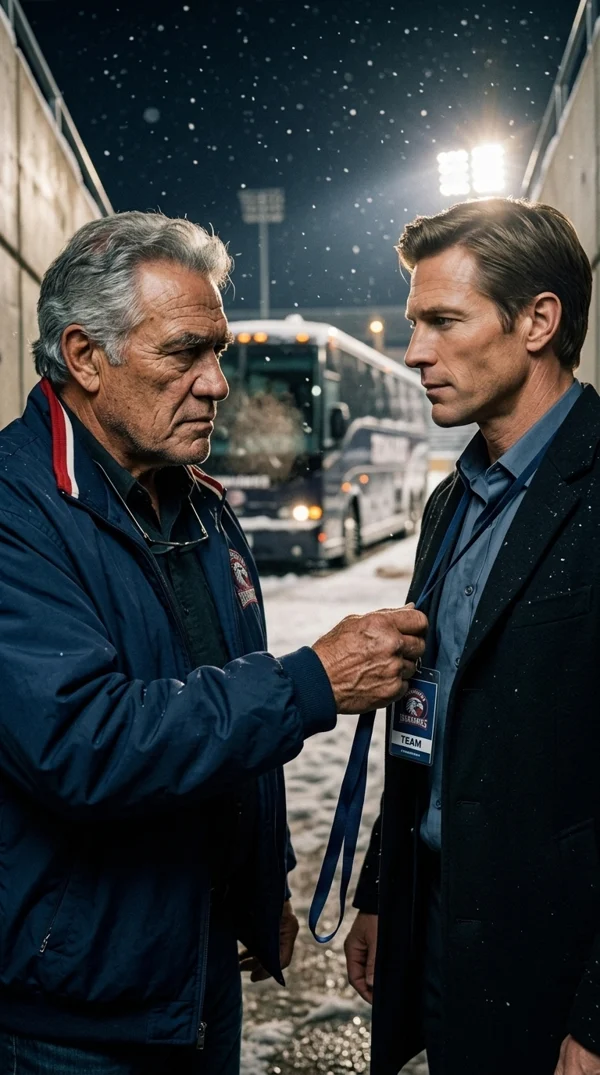
The Highlanders’ stadium in Salt Lake City is an open bowl at four thousand three hundred feet with the mountains standing over the north end like a second crowd, and it was twenty-four degrees at kickoff and snowing, and the grounds crew had the field covered to the last minute and the tarps came off at two minutes to.
The whole lower bowl was in the home team’s green and there were eleven thousand of ours behind the south goal. Somewhere in the middle of them, in a block his mother’s cousins from West Valley had bought the morning we got the sixth seed, was a red Samoan flag the size of a bedsheet.
There is a thing about an away playoff game that nobody explains to you and it is that the crowd is closer. The benches in Salt Lake are set into the stand and there is a rail and a drop and then a wall of people who have paid four hundred dollars and are not friends of yours.
Colt went out for the first series and the noise came down on the bench like a weight.
The first quarter was even and it was ugly and it was over in twenty-three minutes of real time because of the flags.
He took a hit on the second series that got him on the front of the shoulder and got up and shook it out and completed the next one to Nate for eleven.
At the end of the quarter Kosar had him on the bench with the sheet.
“How’s the number?”
“Fifty-eight.”
“Throw the out.”
It was third and six and the out was there and he threw it and it was good and Nate got nine.
The second quarter is where it turned.
Not the game; the day.
There was a timeout at 8:12 and the Highlanders’ house show ran its kiss cam, the way every stadium in the league does in a long timeout, with a red heart frame on the big screen and a camera hunting along the rows for couples.
It found two in the lower bowl, who obliged. It found an old man and his wife in the upper deck, who obliged at length and got a cheer.
Then, because a house director in a playoff game has a sense of humor and a long memory, the heart frame swung up and landed on the glass of the visiting suite.
Monty was in it alone.
He was standing at the back of the suite in a dark coat with a press-box headset around his neck, and there was nobody beside him, no owner, no guest, nobody at all, a man on his own in a box with a tray of sandwiches. The frame held on him. He looked up at the monitor and saw himself in a heart, and for one second his face did nothing at all, because there was no sentence for it.
And the south end, the eleven thousand of ours, went up.
It was not the cheer of a home bowl. It was eleven thousand people in the wrong stadium and all of them had known the clip for four months and it had become the chant and the T-shirt and the thing you shout at the away end, and the noise came off the concrete and rolled around and the green seats in the lower bowl began to turn around to look for me on the bench.
Then the booing started.
Not ours. Ours were chanting the kiss-cam chant, the one from the north end at home, and the home crowd had worked out who the man in the heart was and booed him on our behalf, cheerfully, the way a crowd boos a referee in somebody else’s game.
The camera held for a good six seconds longer than it needed to, because a house director in a timeout will hold a shot that is getting a noise. Monty did not move. Then he turned his back to the glass and took his headset off, and the frame swung away to a child in a green hat.
I was at the bench end with the bag and the chart and did not know where to look, so I looked at the field, and the whole south end chanted the name of a woman who was standing at the end of a bench in a coat.
At the two-minute warning Colt came to me.
“Fifty-six,” he said, before I asked.
“Okay. Fifty-six and it’s the half and you’re at the half and it’s low.”

 100 to start reading with.
What did you think?