Good Holding, chapter 3 of Claimed by My Father's Best Friend
Bex Alvarado has pushed container ships around San Diego Bay with a tugboat for six years, and I have never once heard her finish a sentence without swearing in it.
“I will sink his truck,” she said on Sunday morning. “I know a guy with a crane. I will lift that piece-of-shit Tacoma off the street and drop it in the bay off Harbor Island and call it a reef.”
“You can’t make a reef out of a Tacoma.”
“Watch me.” I heard her spit a sunflower seed shell. She eats them on watch, a bag a shift, and leaves a drift of shells in the wheelhouse that the day crew complains about. “Where are you? You sound like you’re in a church.”
I was on the end of Jack’s dock with a legal pad on my knees, and it was the kind of quiet that does sound like church. The gloom hadn’t burned off yet. Coronado’s bay side was soft and gray, the downtown towers across the water cut off at the knees by cloud, and the only sounds were gulls and the little slap of water under the boards.
“I’m at a friend’s.”
“Lu. You don’t have friends who have docks. I’m your friend who has a dock, and mine’s a slip I rent by the month.”
“My dad’s friend.”
There was a pause long enough to spit two shells.
“The big one,” Bex said. “The boat guy. The one from your mom’s thing who stood at the back like a door.”
“He’s not like a door.”
“Lucia Delgado.”
“I’m making a list,” I said, which was true. At the top of the legal pad, in my neatest engineering capitals, it said: 1. APARTMENT. 2. MONEY. 3. PEPPER. 4. DON’T. I’d written number four at seven in the morning, after lying awake thinking about a thumb on the inside of my wrist, and I hadn’t been able to work out what came after it.
“Okay,” Bex said. “Okay. I’m off Tuesday. I’m coming to look at him.”
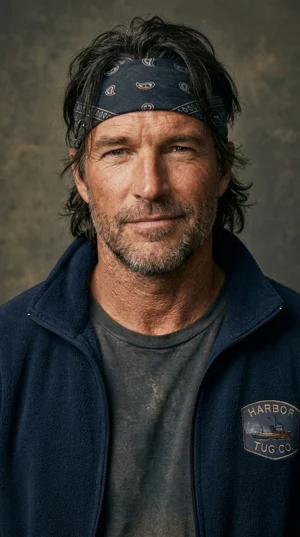
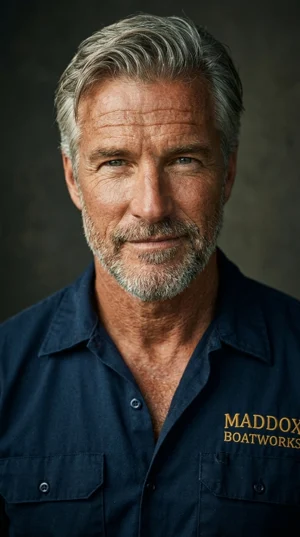
Jack didn’t come out of the house until ten. When he did, he came down the dock with two mugs and handed me one and stood at the end with his, looking at the water, like a man who stands at the ends of things.
“I’ll find a place this week,” I said. “Somewhere month to month. I’ll be out of your way by Friday.”
“You’re not in my way.”
“I’m in your guest room.”
“It was empty before.” He drank his coffee. “Couple of rules.”
I braced, I don’t know for what. A curfew. A key under a mat.
“Door locks from your side,” he said. “You don’t owe me rent. And you don’t apologize in my house for taking up room.”
“I didn’t apologize.”
“You were about to.”
I had been about to. I shut my mouth.
“That’s three,” I said after a while. “You said a couple.”
He looked down at me. He had a way of looking that took its time, like he was reading a draft mark. “I’ll tell you the fourth when I’ve decided on it.”
The gloom burned off at two, all at once, the way it does, and suddenly the bay was blue and hard-edged and full of sailboats, and the whole afternoon smelled of sunscreen and seaweed. I found two apartments online and called neither. I sat in the yard with my feet in the grass and read the same page of a book about the Titanic’s rivets seven times.
At six, Jack came out of the house in a gray sweatshirt and walked down to the boat and started taking the covers off.
“You coming?”
I should have said no. That was the whole of number four on my list. But I’d been looking at that boat for two days the way you’d look at a cake in a bakery window, and I’m only human.
Good Holding was even lovelier up close. Mahogany planking under deep varnish, bronze fittings gone the soft green-gold of old coins, a wheel of oiled teak. The pilothouse smelled of diesel and lemon oil. The engine came up with a low, steady rumble I felt through the soles of my feet, and Jack cast us off with a flick of his wrist and took her out past the moorings without seeming to steer at all.
We went north, up the bay side of the island, with the sun dropping behind Point Loma. The light did the thing it only does here and only at that hour, when it comes in flat and gold across the water and lights every hull and window from the side, so that the whole city looks like it’s been carved out of something warm. The bridge went over us, enormous, its underside lit gold. Downtown glowed. The water was so calm it held the colors.
I stood at the rail beside the pilothouse and didn’t say anything for twenty minutes, and it was the most peaceful I’d felt in a year.
When the sun was gone it got cold fast. It always does on the water in June, and I’d come out in a T-shirt like a tourist. Jack throttled back until we were only drifting, off the Coronado shore with the city lights doubling in the black, and took off his sweatshirt and handed it to me.
It came down to my thighs. It was warm from him.
“Why’d you stop?” I said.
“Stop what.”
“Calling me kid.” I pushed the sleeves up and they fell down again. “Every barbecue for six years. How’s it going, kid. Need a beer, kid. At my mother’s funeral. Last night you said Lucia, and you haven’t said it since.”
He was standing at the wheel with one hand on it, not steering, just touching it, the way you rest a hand on a dog. The pilothouse light was off. I could see the shape of his face by the city and not much else.
“You stopped being one a long time before I noticed,” he said. “Then I noticed.”
The water slapped the hull. Somewhere far off on the Navy side a horn went, one long low note.
“When,” I said.
He didn’t answer that. He said, “Your father carried me out of nothing, Lucia. I was eighteen and stupid and headed for a discharge, and he made me a sailor. And later I carried him out of a fire.” He looked down at his left arm, at the shine of the scar in the dark. “You don’t do this to a man like that.”
“Do what?”
He turned his head and looked at me.
I’m the reliable one. I’ve been the reliable one my whole life. I check things twice and I don’t take risks with structure, and I had a list on a legal pad that said DON’T in capital letters.
I put my hand on his chest and went up on my toes and kissed him.
For a second he didn’t move at all. His mouth was warm and still and surprised, and I thought, well, that’s that, I’ve made a fool of myself on a boat in front of the whole city.
Then he made a sound low in his chest, a sound I felt through my palm before I heard it, and his hand came up into my hair.
He kissed me back like a man coming in out of weather. Slow first, and then not slow. His other hand found the small of my back under the sweatshirt, bare skin, and pulled me in until I was standing between his feet with my whole body against his, and he was so big and so warm that the cold went out of me in one shudder. He tasted of coffee and salt. His beard was rough on my chin. He tipped my head back with the hand in my hair, gently, exactly where he wanted it, and kissed me deeper, and my knees went, actually went, and he took my weight without noticing, the way the boat took the swell.
I’d been kissed for five years by a man who kissed like he was checking his phone. I hadn’t known it could be like this: like being read, slowly, all the way through.
He stopped.
He didn’t pull away. He stopped with his forehead against mine and his breathing gone rough and his hand still in my hair, and stood there.
“That’s the fourth rule,” he said. His voice was wrecked. “That doesn’t happen.”
“It just happened.”
“It doesn’t happen again.” He let go of my hair, one finger at a time. “Your father’s my best friend.”
“I’m not his,” I said. “I’m not anybody’s.”
He looked at me in the dark, and I thought he was going to argue. Then he stepped back to the wheel and put the boat in gear and took us home without another word.
At the dock he held the line while I stepped off, and when I turned around he was still holding it, standing at the rail looking down at me.
“Goodnight, Lucia,” he said, like a promise he was keeping against himself.
Pacific Basin Marine sits on the bay in Barrio Logan, under the bridge, behind a fence you could stop a truck with. On Monday I badged in at six-fifteen, because the habit of being early is the last one to go. The dry dock had a Navy oiler in it, red-bottomed and tall as an office block, dripping. The cranes were working. The whole yard smelled of hot steel and paint and the bay, and the noise of it, the beeping and banging and shouting, was so familiar that I nearly cried with relief.
I took the stairs to the engineering floor with my laptop under my arm and my bandaged hand in my pocket, and I’d made it halfway down the corridor to my desk when I heard someone laugh in the glass meeting room at the end.
It was a bright, careless laugh. It went up at the end, like a question nobody needed to answer.
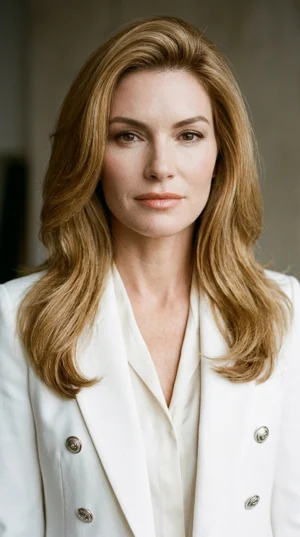
Kendall Haskell was standing at the window of the meeting room with her back to me and her phone at her ear. Senior project manager. Thirty-four. Our lead on the Harborline bid. Good blazers, always, and long nails, almond-shaped, painted the color of a peach.
“No, he’s parking,” she said, and laughed again. “He’s useless at parking.”
I stood in the corridor with my laptop and listened to the laugh I’d heard on Javi’s phone on Friday night, and I knew whose it was. I’d been sitting across a conference table from it for three years.
What did you think?