The Parkersburg lot had come back the Saturday before all that, the twelfth, two days before the van was mine. This time they’d spent real money.
Four carloads. A real thermal camera on a bracket with a pistol grip, and a drone with a second battery. A young woman in a shooting jacket, with a clipboard and a channel to put it on. They were polite and they were quick, and they had plainly decided that the ramp was a stadium. Who brings a pistol grip to a bridge?
The thermal camera is not for seeing in the dark. It’s just for seeing what is colder than what. On a span in December in the sun the deck plates take the light. The web of the truss stays shaded. The two are twenty degrees apart before anybody has done anything.
The young woman had her eyes on the deck. “Have you got anything up there?”
“It’s under. A plate forty feet in off this end, and a cap on the middle pier.”
“Under?” She put the camera up to her face. “Then we’ve got to get under!”
They had a printed sheet of the frame times and a channel name on a card. They gave the card to Ree, and Ree put it under the jar, and it is under the jar now.
The pylon was where they wanted it. A man went carefully down the ladder with the camera and stood on the walkway. The thermal gave him the pier and the water, and the wash of a boat’s motor forty feet up. The four of them crowded eagerly round the little screen and made noises. Then the drone. The drone went out and down and got properly under the deck, along the underside of the second span. It had its own light on, and the phone was clipped to the bracket in the man’s hand. They whooped—“Oh my God, look!”—and put it on the channel. It was the best quarter hour of their month. It found the worst fucking thing on the span.
At the tenth minute the drone came back along the stringer bays. The light went across the underside of the deck, and on the stringer at bay 6 the top flange had a bloom on it.
A bloom—not a stain. The drone’s light does what a lamp does. It goes across a surface and picks up the difference in the texture, and the camera is a phone, close, looking up at an inch. There was a rust bloom the size of a handprint on a fifty-year-old top flange, with a rim of loosened flake round it. The head of a bolt through it had gone to a stump.
The girl with the clipboard put her finger on the screen. “Oh, look at that! It’s all bloomed out.” It was his word, the one he’d put in my ear a week ago in a vault, said by a girl who didn’t know she’d said it. The skin went cold all down my arms.
“Give me that.”
“Here—” She handed me the phone. I ran it back and stopped it on the frame, and the bloom sat there blue-gray in the drone’s light with its flake rim and the stump of the bolt.
“What’s the stringer?” Her breath fogged the screen. “Is it a big one?”
“It’s the widest thing under the deck.” I gave her the phone back. “It’s the beam the deck sits on, and the deck is what the cars are on. It rusts on the top, because the salt comes through the grid and lies on it.”
Her eyes went up to the grid, then down to the phone again. “And you can’t see it from the top?”
“Nothing under a grid deck can be seen from the top. You could just stand on it in your boots for a year and never know.”
I got under it at ten past two with the mirror, the flashlight and the four-pound hammer.
The stringer is a rolled beam. The top flange is six inches wide, and the mirror goes on a stick, and the stick goes between the deck plates. From an inch the bloom is bad country. From six inches it is worse.
The pinhole had gone clean through. That is not rust, that is really a hole. Just a hole, with daylight in it. Where a pinhole goes through under a load the flake comes with it, and there was a quarter inch of hairline running out of it into the web.
The hammer settled it. A good top flange gives a hard flat note. Bay 6 gave a dull one with a rattle on the end of it, and the rattle is a flake lifting. Well, shit.
I put my palm flat on the cold web and spoke to the stringer, out loud, because nobody else was under there. “Columbus is going to want this. Aren’t you lucky?”
I went down to the vault at four and gave him the stringer.
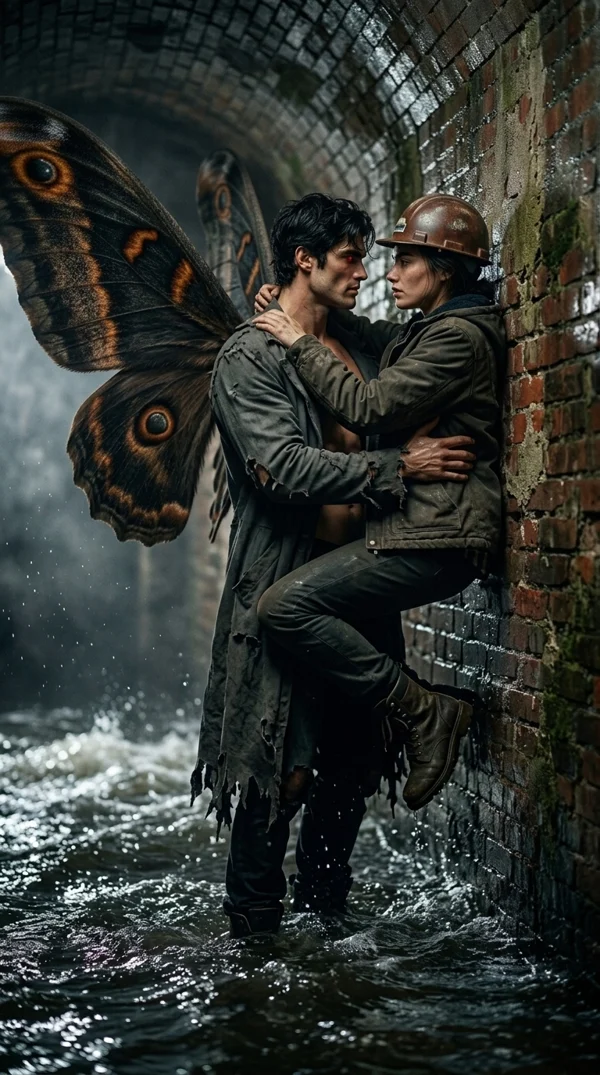
He was at the back with the wing nearly closed. I gave it to him quickly, the way I give Lodie a bill. He listened to all of it with his red eyes on my mouth, and he did not make a sound until I got to the bay number.
“Six.”
“Six. On the upriver line, under the second span. There’s a pinhole through it and a hairline off the pinhole into the web. The flange has lost a handprint of section and the bolt head’s a stump.”
“Sixth bay’s the worst bay.” His jaw worked. “Salt’s there. Off the crown of the road.”
“Then you knew? This whole time?”
“Eaten against it.” He came out with the lamp. “When?”
“Ree’s on at the diner about a walk for the town on the span, the Saturday before Christmas. There’s a man coming from Columbus inside two weeks. That’s four hundred bodies on it for a photograph, if Ree gets her way.”
He went to the mouth of the vault and put the lamp up at the underside of the deck above the door. He stood there a long time with his throat working, studying the bays along the west line.
“Depends on the walk.”
“On what?”
“Spaced.” The fronds lifted. “Or all at once.”
I went out to the walkway and got up under bay 6 myself and laid my palm on the top flange over the bloom. The bloom came off on my palm in a smear. Under it the metal was rough, and the rough was soft. Soft. Since when was steel soft?
His voice came up from below me, quietly, through the gaps in the boards. “Anything on it now?”

 100 to start reading with.
What did you think?