Aldric — Monday 21 December, 3 a.m.
The paper has been out of the coat tonight, in under the straw—and it was wrong to have it there.
It has been in the coat since that September, and open on two palms once. Now it is read. I am not carrying it any more. She has it, and what she has goes to Columbus. The easy words are in the throat. The one that is wanted is not.
The hunger has a hinge in it now. It sits behind the jaw and comes and goes with the water. It is worse on a low river, because a low river means a dry chord bay.
Bay L0 to L2 is spent and freckled. L3 is the plate, and the plate feeds nobody. L4 to L5 is the splash. The bloom there is thick, and under the bloom the section has gone. It tastes sour, then iron, then nothing. Nothing has a taste of its own, a flat one like a cold key on the tongue, and there is a body’s worth of it at L5 now. L6 to L8 on the west line is only dry dust, with nothing in it at all.
That is the larder, and she has the measure of it now: a plate cracked six and a quarter inches, and a hole through a top flange. The eating has gone on for ninety-five years. The page in her hand says the bridge was passed as specified by a man who knew perfectly well it was not.
Before that, at half past ten on the Sunday night, there is a car on the ramp with the engine going and the dome light on. Two men sit in it with a laptop and a thermos.
They are clearly not the drone men. They have a form and a clipboard, and one of them has the county’s bound inspection book in a bag.
The one with the clipboard gets out and comes to the booth. “Lem Osbey, weights and measures.” Then, to her: “The book’s for the inspector’s reference. If it leaves the booth before nine, then it’s on you. Got it? Sign here.” She signs. He goes back to the car, and the car goes.
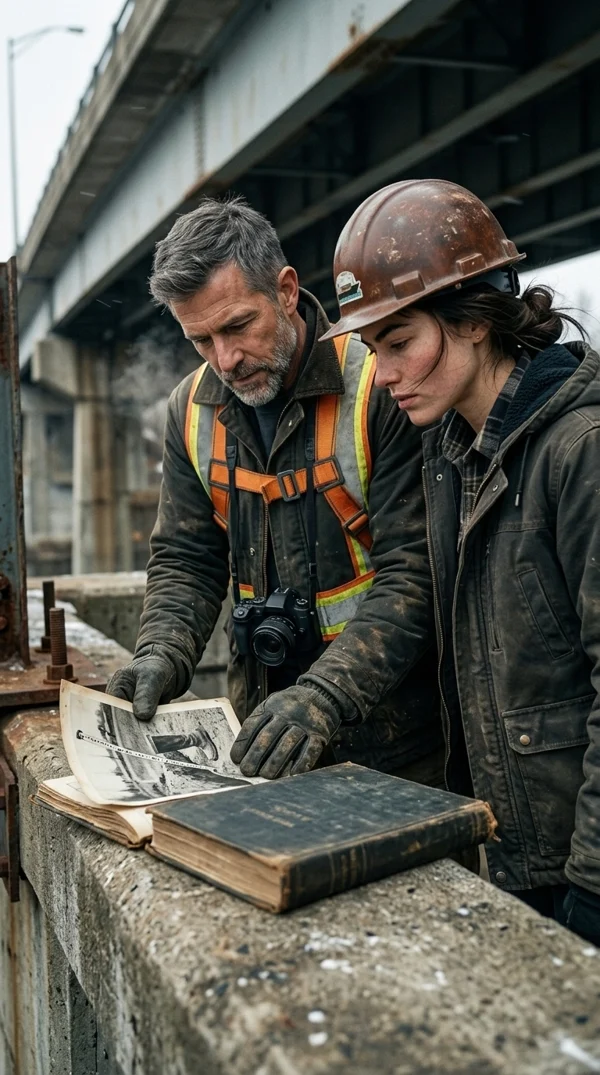
She brings the book down the ladder carefully at eleven. It is bound in buckram and four inches thick, and the pages are foxed at the edges. The desk is the straw. The lamp is the ledge.
Her breath is quick. “The footings are in it. The as-built photographs, 1931, on page sixty-two. They pinned them in! Can you believe that?”
The book smells of a wet vestry. She is at page sixty-one, and the 1931 sheet is in it—the same typing, the same struck crest, the same copperplate, and my name under it. The fold in the original is a pale line across the copy.
The as-built photographs on page sixty-two are four. There is a rod in them, and the rod is at five oh nine and a half, and a man’s boot is at the bottom of the rod for scale.
She reads them, and her hand stops on the boot. “They had a man standing in it with a rod and a boot. They photographed the number. And then nobody in ninety-five years has put the two pages side by side. Ninety-five fucking years.”
She does. She lays the sheet and the photograph side by side on the straw. The straw shifts, and she puts a nail down on each page to hold them and presses her thumbs flat on the creases. Her lips move on the numbers.
“Five one one five.” Then, slowly: “Five oh nine five.” Her eyes come up to mine.
“You’ve known all this since 1931? And it’s two pages of one book in a bag on the back seat of a Malibu, and a man on the ramp in front of it with a thermos who has never once opened it.”
“Yes.”
“Say something else.”
I open my mouth. There is nothing behind it but the hunger, and it comes up past the hinge and goes to the nearest word. The word is a bad one, the worst I have, and I just give it to her as if it were her fault.

 100 to start reading with.
What did you think?