Doss’s second day was the Wednesday. It was the underside of the deck all morning with a boat and a ladder, bay by bay, east line and west line. At twelve he came up and sat in his car with the heater on and the engine going, and did not eat.
At half past twelve he came to the booth with a paper cup and put it on the counter, and then just stood outside in the cold to drink it.
“Rusk’s come round to it.” He drank. Rusk would have the order drafted by Friday, and it would be an April date. If spring came early it was a freshet in March. And the day it went, it would be a Friday afternoon with the bank running and the school on it. “What’s the tonnage since the walk?”
“Nine hundred and forty.”
“On three ton.”
“On three ton and under, and a van of children twice a day.”
Doss kept his eyes on the water a while, his cup going cold in both hands. “The van. How heavy?”
I gave him the weight exactly: eleven thousand four hundred pounds, on a post of three ton. The school’s carrier would not certify, and the company ran it at the operator’s risk.
“That’s five point seven ton. Near twice the post, every day, twice.” He got his notebook out and put it back. If he wrote the vehicle in, it was a vehicle over a posting under the county’s own order, and a paragraph in his report. A good paragraph. “If I don’t write it, it’s a van of children on it and nobody in Columbus knows.”
The paragraph went in. It is at the bottom of page four, and it says: a fifteen-seat school vehicle of 11,400 lb gross is in daily use across the span, twice in each direction, in excess of the posted restriction and without certification.
Bay six has a chalk number on the chord under it now, and a piece of card behind the chalk with the date and the time and the rule. The county’s way is a number, and the number is nothing without a card.
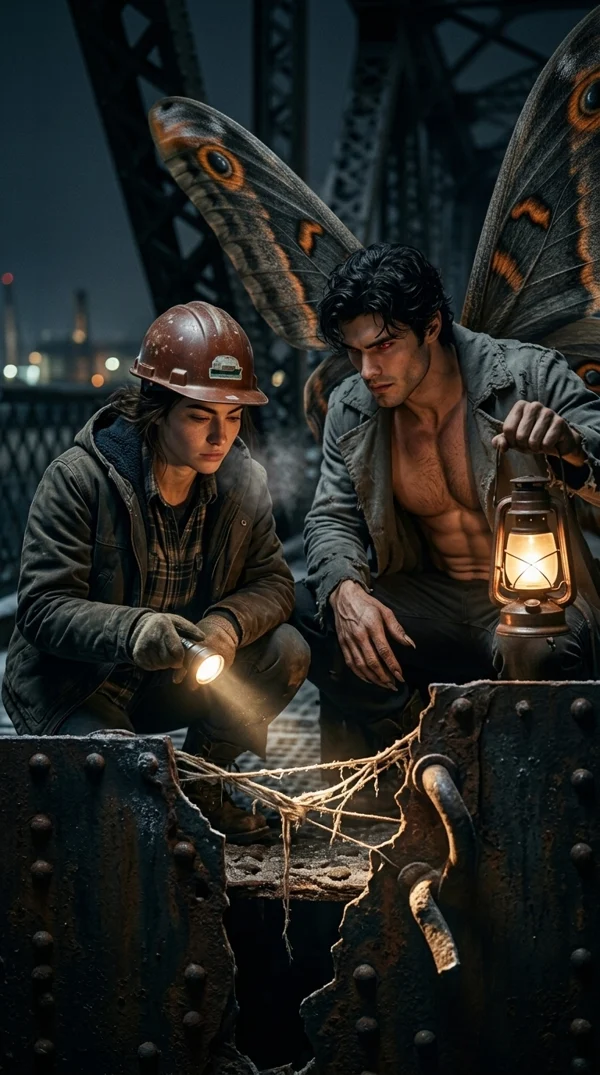
It took Doss nineteen minutes. I was at the west end with the mirror when he came up the staging and put his lamp back on the stringer at bay six. He said absolutely nothing. Was that good or bad? With Doss there was no telling. I went along and got down carefully beside him. The top flange was gone to a lip along its full length, eaten thin, and the web under it was blooming out in scale a quarter inch thick.
He got the folding rule in the section and held it perfectly still. His eyes went to the number, then to the print in his hand, then to the stringer. His face did something I have never seen a face do in this county.
He barely breathed it. “Off by a third! On a stringer. And the plate’s the one they all talk about.”
My face had gone hot. “It’s in my book from the day of the drone. Didn’t anybody read it?”
“I know it is.” He got his thumb under the scale, and it came off in a plate the size of a saucer. “The county’s got four pages on a gusset and nothing on the first thing that holds the deck up. Everybody looks at what’s famous.”
At twenty past two he put a county chain in my hand down at the cap, with a plate on it that says P.3 CAP — DO NOT REMOVE. It was the first county thing on the pier in ninety-five years. He clipped it back. I pointed at the tell-tale.
“There’s a tell-tale and a chain, and none of them is a level, and there’s no money for a level. It’ll be a number in a report. It’ll be the last useful thing in it.”
At three he stood at the booth with his coat on and his collar up and the case in his hand. He kept his voice low. “Off the record, and my own opinion.” Two of the last four counties he had been in had a plate like ours. Both of them had a man who had known since a letter and done nothing, and both of them had a father in the file. “Call it continuity. A son does not open the file on his father in a room with a portrait on the wall.”
I would not let him have that one, not about Rusk. “Rusk’s opened it.”
“Rusk’s opened it because a girl of nineteen opened it in front of sixty people.” Doss put the case down heavily. “So he’s better than two of the last four. He won’t bring it forward past April, and that’s not cowardice.”
Then what the hell was it? I bit my tongue and didn’t ask. He got a card out of his pocket and wrote on the back of it with his own pen, and laid it on the counter. ODOT structural, records: a name and a number. There was a 2024 letter in this county’s file with this bridge’s name in a list of four, and a note on it that the county’s inspection cycle was over twenty-four months on all four. It would be in the annex, in a binder, and nobody would have looked at it since it came. “It’s the only document in this county with the county’s own laziness on it, and it’s worth more than the plate.”
“How much more?”
“It’s worth a liability. A liability is what a commission moves for. A plate is what it argues about.” He picked the case up. I was to ask for the file, and ask in writing: the 2024 correspondence and the inspection cycle for the last six years. The clerk, not Rusk. “Be a nuisance about it. And do it now, a week before the meeting—at the meeting you’ll be offered a wage, and you’ll want the file in the same week, not after.”
The card went in the visor next to the check. It is the wrong place for a card that matters, and the only place in a company truck that is not a pocket and not the floor.
The written request went in at a quarter past four, eleven miles inland. It was on the booth’s letterhead pad, because the booth is where the company’s letterhead lives—two hundred words and not a county form.
To the clerk of the board. Under the public records act: all correspondence between this county and the Ohio Department of Transportation touching the Nine Mile Bridge from January 2022 to date, and the county’s inspection cycle for all bridges in the county for the same period.
The clerk is a woman called Rosalee Vint, Ovid’s second cousin. She took it off me at the counter and read it carefully and put it down. “You’ll want it stamped.”
“I’ll want it stamped.”
She stamped it firmly. “It’s three days, and it’s a fee if it’s over a hundred pages, and it will be.” She wrote the date on the corner. “And Ovid says you’re to have the binder, so it’ll be Monday after Christmas and back Tuesday.”
“Then Monday.”
“It’ll be Monday if it’s Monday. Don’t be down here at nine on Monday tapping the counter.”
Me? Tapping a counter? She had me dead to rights, and her mouth knew it.
At five the light went off the water. The ramp lamp came on, and the pylon had two red points on it.
I got the mirror and the rule and went over the top rail at bay six instead of down the ladder. The rail was cold enough to nearly take the skin off my palm. The deck’s underside came up at me out of the dark, and the lamp beam went along it and found the staging. He was on the staging.
He had clearly been there a while. The lamp was hooked on the bottom chord and turned down low. The bloom was eaten off the web in a stripe across the section loss, six inches of bright eaten steel. The lips of the scale at the edges stood up where his mouth had been. The proboscis was still out, folded back along the underside of his jaw where the fronds are, and there was scale on it.
“Nineteen minutes. A man from Columbus found it in nineteen fucking minutes, and he’s got forty-one other bridges and a car with a heater!”
He shifted silently along the staging to give me the place. I put the rule in. It was just the same number Doss had had, and it was no better for being mine.
The flange was bright where he had been. Nobody in this county has said it out loud in ninety-five years, and the inspector said it at half past one without knowing he had. The bridge thins where the bridge is eaten. And the thing eating it is the only thing on this river that has ever wanted it. So what was I supposed to do with that?
“Say it. Say what you do.”
He put his hand out flat on the web above the bright part and just left it there.
“I eat the bloom.” The fronds stirred. “Clean under.” A beat. “Thin under.”
“Then you thin it.”
“Yes.”
“And if you stopped?”
“Rust goes in.” His hand stayed flat. “Swells. Flakes it off.” The fronds lifted and settled. “Ten years. Not ninety.”
Ten years, and a man from Columbus with forty-one bridges and a card in a visor. “Then it goes in the record. Not by your name and not by a picture. Section loss, top flange, bay six, one third, with active surface corrosion removed. Ninety-five years of nobody watching, and it goes in the county’s own file as a mouth.”

 100 to start reading with.
What did you think?