Hinge 9 was a pig.
There’s no other word for it. I’ve tried. I spent nine hours on the outside of the Ring on Hush 317 trying to think of a better word, hanging under its housing with my arms over my head and my blood in my boots, and I came back in with a list, and the list was all words my mother would have washed my mouth out for, and the best one was still pig.
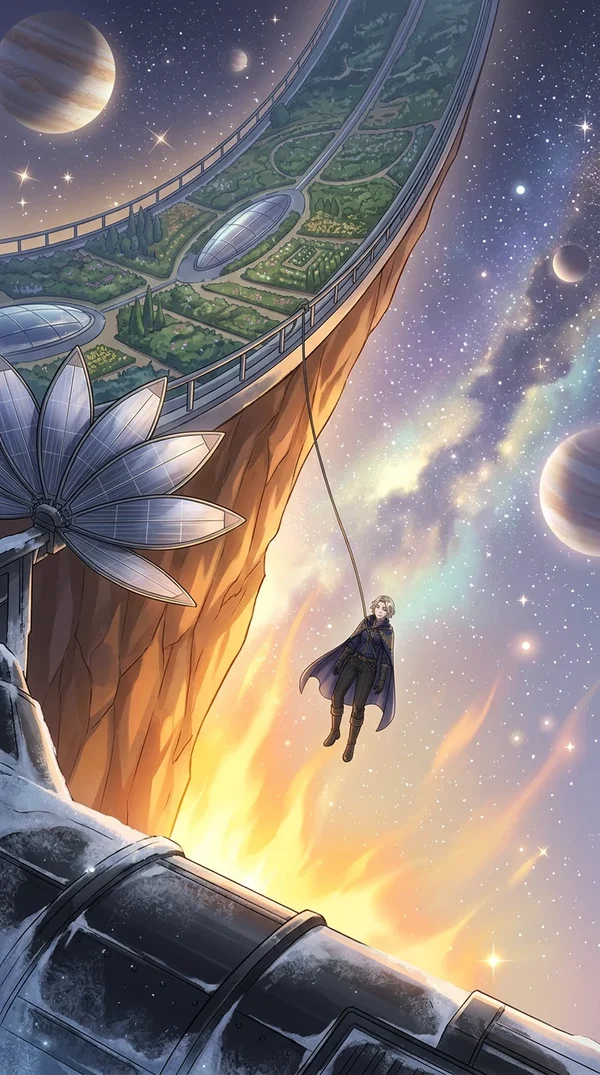
It had been hit. Sometime in the last century, a grain of comet stone moving faster than anything has a right to had punched into the gear housing and left a crater the size of a fist, and the cold had got in through the crater, and the grit had followed the cold, and the whole bearing race had packed solid like a drain nobody’s cleaned since Year 40. Hinge 4 had been grit. Hinge 9 was grit and damage and spite.
“I could weld a plate over the crater,” said Silas, “and then we could pull.”
“Then we’d be pulling on a race full of rock.”
“So we clear it first.”
“With what?”
“With you,” he said. “You’ve got small hands.”
“I’ve got normal hands. You’ve got shovels.”
“Your hands,” said Silas, “are perfect,” and Tully said, on comms, “Oh my sky, I’m still here, I can hear all of this,” and I laughed so hard I fogged my visor and had to hang there blind for half a minute while the suit cleared it.
So I cleared it. Through the crater, with a pick and a torch and a little vacuum line he’d brought out on the sled, a handful of grit at a time, while he hung beside me holding the light and passing me tools before I asked for them, the way he always had. He knew what I’d need next. He’d always known. I’d forgotten what it was like to work with someone who could see the job the same shape I could, and it was like putting down a load I’d been carrying so long I’d thought it was part of my back.
Saffron came up under us and went down, came up and went down. Two hundred times. More. I stopped counting. My fingers went numb in the gloves and then stopped hurting, which is worse, and I knew it was worse, and I kept going.
“Hands,” said Silas.
“Fine.”
“Show me.”
I flexed them in front of his visor. He took one in his, on the outside of the world, and held it between both of his gloves and squeezed, slowly, and the blood came back into my fingers like knives.
“Ow.”
“Good. That means they’re still yours.” He let go. “Twenty minutes in the warm and we come back.”
“I’m nearly there.”
“You’ve been nearly there for three hours.”
“That’s what nearly means,” I said, and went back in.
At the end of the ninth hour, the race was clear. We pulled on the barrel together, timing it to the turn, the way we had at hinge 4. It ground. It screamed, a noise I felt in my teeth through two layers of glove. It turned.
Up the cliff above us, two kilometers of mirrored petal lifted from the plate, the width of a hand, and settled back. Two hinges down. One to go.
Neither of us laughed this time. We just hung there off the rail, side by side, our helmets touching, breathing, while the sun went round and round under our feet.
Isla wrote snow the next night.
The Ring gets snow in Hush, sometimes, if the Almanac’s in the mood, but it hadn’t been in the mood for nine years. Isla said it was a present: to the Meadow, for standing in the frost to watch the test; to the Wildwood, for what she was going to ask of it on Stillday; and, she said, staring at me across the Fallow table, to certain people who never came up from underneath to see anything.
“That’s emotional blackmail,” I said.
“It’s a forecast,” said Isla. “Seventy-eight percent chance you’ll love it.”
So I came up.
He came with me. We stood on the Long Meadow at ten at night in borrowed coats, with half of Coldharbor and most of Sweetwater, everyone with their faces turned up. The Lamp was at its night setting, a long dim silver thread down the middle of the sky. And out of the dark around it, the snow came.
It came out of the whole sky at once. That’s the thing you can’t imagine until you’ve stood in it. On a flat world, I suppose, snow comes down out of a lid. Here it came down from everywhere: from the Orchards hanging overhead, from the lake, from the Terraces climbing the far wall, all of it falling inward toward us, toward the floor, on a long, slow slant, drifting antispinward as it fell, so the whole sky seemed to be turning, very gently, like a gear train running in oil. Tiny white flakes in the Lamp’s light, millions of them, all leaning the same way. It landed on my face and in my hair. It landed on his eyelashes. Children ran about catching it in their mouths and their parents shouted at them and didn’t mean it.
I stood there with my head back.
“Dess,” said Silas.
“Don’t talk.”
“All right.”
“I mean it. I’m having a feeling. If you talk I’ll lose it.”

 100 to start reading with.
What did you think?