Absalom Pike delivered the vial himself, the morning they left.
He found Kit in the stable yard among the grooms and the baggage, bowed, and pressed a small wrapped parcel into her gloved hand as if it were a love token. Through the paper she felt the shape of a stoppered glass, a little bigger than her thumb, and the needle beside it.
“From a friend,” said Pike, in his soft hinge of a voice. “Who understands you’ve lost your own.”
Then he was gone into the crowd, and she was standing there holding enough quickgall to ruin a kingdom, wrapped in brown paper with a bow.
She put it in the inner pocket of her riding coat, beside the ledger and a clean handkerchief. She had planned the handkerchief.
Kestrel Lodge was two hours north in the beechwoods, and Kit spent all of them on a horse.
Lady Katrine had grown up in the Fens and could presumably ride. Kit Haddow had grown up on Gall Street and had sat on a horse twice, both times by accident. By the end of the first hour she had stopped feeling her legs.
Casimir rode beside her on a tall grey that he handled without seeming to think about it. He watched her with polite sympathy for three miles. Then he leaned over without a word, took her reins, shortened them, moved her hands down and her heels down, and rode on.
“Your father was famous for his seat,” he said gravely.
She threw a beech nut at him.
The lodge was a long low house of grey stone with a round tower at one end, and the tower had a stair that went up the outside of it, a stone ribbon spiralling round and round to the hawks’ mews at the top, with a parapet on the outer edge no higher than a man’s knee. Kit saw it from the drive and knew it at once. She had seen it pinned to his wall, every step numbered.
He did not look at it. He looked at it the whole time.
The lodge was small and the court was large, and the flustered chamberlain put the prince and his betrothed in the same room as though it were the most natural thing in the world. “As is customary, Highness. At the lodge.”
“Is it?” said Casimir.
“Since your grandfather’s time, Highness.”
“How old-fashioned of him,” said the prince, and every courtier in earshot heard a lie and smirked.
There was one bed.
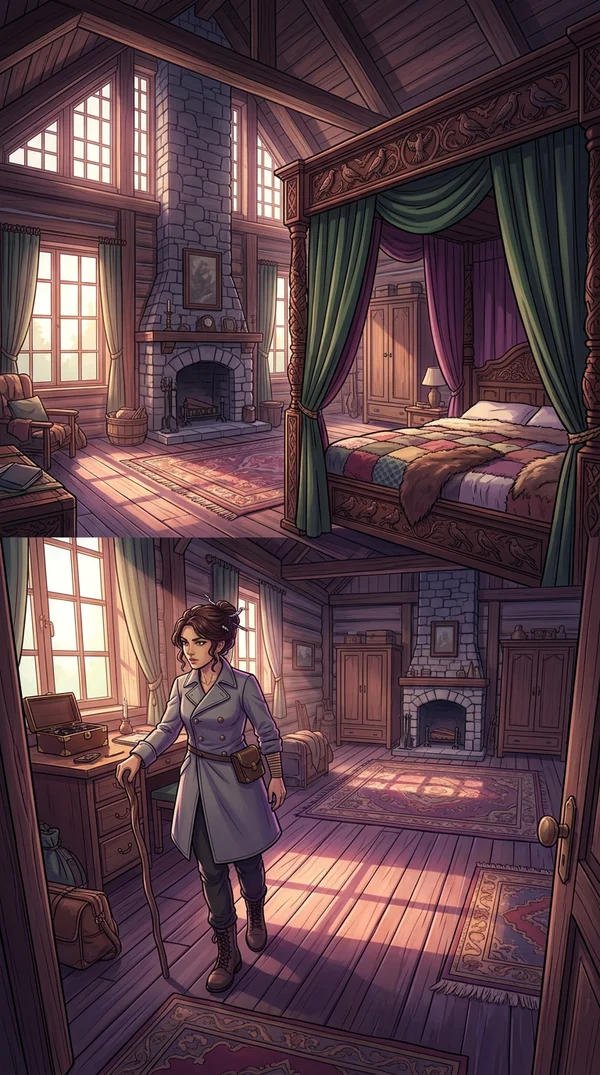
It was a big bed, at least, with posts carved into rooks and curtains of faded blue, and the fire had been lit, and somebody had put a jug of wine and two cups on the chest at the foot. Casimir looked at the bed, then at the floor, then took a blanket off the chest and began laying it out on the hearth rug with great dignity.
“Don’t be stupid,” said Kit, from inside the curtains.
“I’m being a gentleman.”
“You’re being a draught. It’s a big bed and you run hot as a bread oven and it’s freezing in here.”
There was a pause.
“Those are three very good reasons,” he said, and blew out the candle.
He lay down on the far side of the bed on top of the covers, with the whole width of it between them, and she lay on her side in Lady Katrine’s nightgown and looked at the dark where he was. She could feel his heat across the gap. Like lying near a hearth with your back to it.
“Tell me about him,” she said. “About Halvard.”
“You won’t believe me.”
“Tell me anyway. I’ll sort it out.”
So he told her, in the dark, quietly. Hal teaching him to swim in the lodge pond by throwing him in. Hal at twenty-two, who could sit a horse like a centaur and drink the Thessane envoy under the table. Hal who was going to be a great king. Hal who’d started having secret meetings in the last year, and coming back from them pale and lit up at once, like a man with a fever.
Every word of it went into her crooked. Lying beside him in the dark she could hear him loving his brother and her ear told her it was all invented, and it was unbearable, and she said, “Stop.”
He stopped.
“I can’t,” she said. “I’m sorry. I can hear you, and I can’t.”
The silence went on long enough for the fire to settle.
Then the mattress shifted. She felt him find her hand on the coverlet in the dark, and turn it palm up, and hold it in his, very lightly.
His fingertip touched the centre of her palm and moved.
A line down. A short line across the top and the bottom. I.
She went still.
He wrote slowly, so she could follow. Each letter in its own space, his finger warm and dry and deliberate on the skin of her hand, the way you would write in sand. D. I. D. A pause, his thumb pressing the heel of her hand for a space. N. O. T.
She felt the word come up her arm before she had finished reading it.
K. I. L. L. H. I. M.
There was no hesitation in it. There was no catch, no stop, no lifted pen. It was just a hand, writing, and she believed it so completely that her eyes stung.
She took his hand. It was bigger than hers and she had to spread his fingers to find the palm. She wrote back on it, one letter at a time.
I K N O W.
His breath went out of him in the dark.
He didn’t let go of her hand afterwards. After a while he wrote again, on the inside of her wrist this time, just above the band of fifteen lines, where the skin was thin and every stroke went through her like a plucked string. She couldn’t read it. She didn’t think it was meant to be read. She lay there and let him write it, whatever it was, over and over, until his hand slowed and stopped and he was asleep, and she was not.
In the morning he took her up the Kestrel Stair.
It was worse than the drawings. The steps were worn into hollows in the middle and wet with dew, and the parapet came to just above her knee, and below it there was nothing but air and the stone flags of the yard getting smaller. Kit kept one hand on the tower wall. He walked on the outer edge, as if daring it.
At the third turn he stopped on a broad step, a landing where the stair widened.
“Here,” he said. He didn’t say anything else. He put his left hand flat on the parapet, exactly as if steadying something, and then looked up, and she followed his eyes to the next landing, two turns above. Then he took his hand off the stone and looked at his palm, as though something would be written there.

 100 to start reading with.

What did you think?