Corran would not let Lady Katrine Aubery past the ferry steps.
“Orders, my lady,” he said, and he looked wretched about it. “Nobody to the prince. Chancellor’s seal.” He turned the visitors’ book so she could see. “Charity’s allowed. Low Cells. That’s all.”
So she went down to the Low Cells, with the vial and the needle and two pages of fast quickgall under her bodice, and found her brother sitting up.
Fen was still thin and still bright with fever, but he had been playing cards. There were three turnkeys round his plank bed on upturned buckets, and a pile of dried beans in the middle, and every one of them was losing to him and every one of them was laughing.
He looked at her face and put his cards down.
“Lads,” he said. “That’s my sister. Don’t argue, she is, I know what the book says.” He stood up, swaying, and put a hand on the youngest turnkey’s shoulder, a freckled lad called Bram. “Bram. You know the prince’s cell. She’s his girl. It’s his last night before they take him up to the Hall. Two minutes.”
“Fen, I can’t,” said Bram.
“I let you win the last six hands,” said Fen. “You know I did.”
Bram looked at the beans. Then at Kit. Then he picked up the lantern.
At the door she turned back. Fen was watching her with his hand pressed flat over the debt-mark on his wrist.
“I owe you something,” he said. “Let me start.”
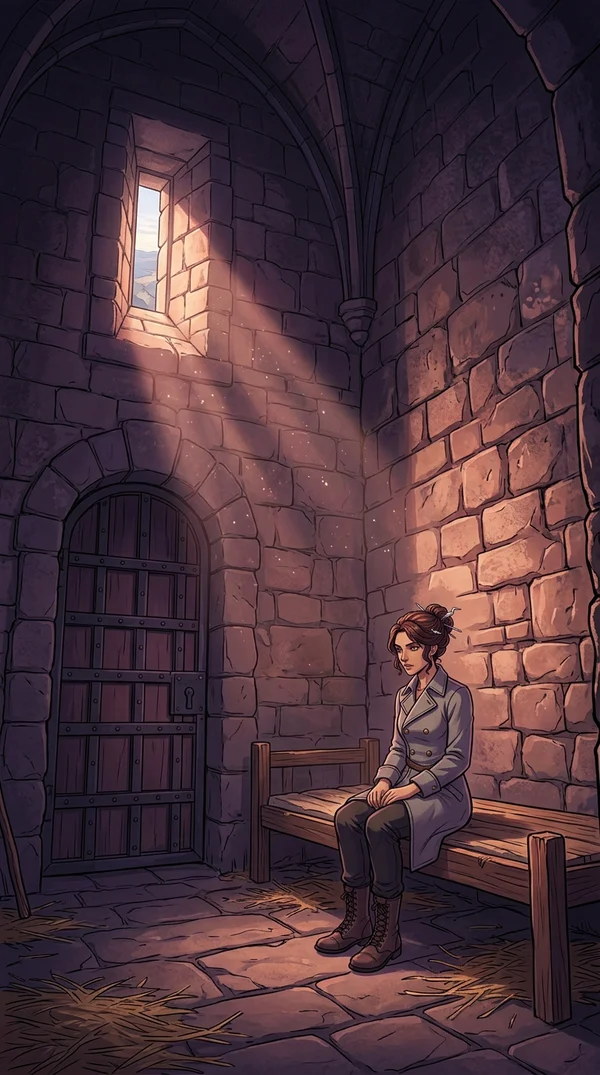
They had put Casimir at the top of the tower. Bram unlocked the outer door and stood on the stair with his back to them, very pointedly.
He was at the bars before the lantern was through the door. Someone had taken his coat and his boots. There was a bruise along his jaw. When he saw her his face came open, just for a moment, like a letter with the seal broken, and she put her hands through the bars and he took them.
“You’re here,” he said. “You’re mad. You’re here.”
“I need you to write something.”
She gave him paper, and Pike’s vial, and the needle. He looked at them, and at her.
“The true one,” she said. “Everything you saw. In your own hand. Cut the ink with your own blood. Sign it.”
“And then?”
“And then trust me.”
He looked at her through the bars. She knew what he was asking without asking. Which one. Which lie. She had decided in the draper’s attic at four that morning, and she was not going to tell him, because he would argue, and she would do it anyway.
“Cas,” she said. “I can’t prove it to you. I’m asking you to believe me.”
Nine years went across his face. Then he took the needle and drove it into the ball of his left thumb without looking, and squeezed a dark bead into the vial, and the gold in it swam.
He wrote it against the wall, standing.
I, Casimir Corvane, confess that I stood on the third landing of the Kestrel Stair and watched Odile Sarrow put her hand on my brother’s back. I confess that I was too slow to reach him. I confess that I have told the truth about it every day for nine years, and that no one has believed me. C.
He gave it to her through the bars. Their fingers touched on it.
“Whatever you’re going to do,” he said, “I believe you.”
It rang false as a cracked bell. She laughed, and her eyes were wet, and she said, “Write it down later,” and he kissed her through the bars, hard and quick and hot, and Bram coughed on the stair, and she went.
The Lantern Hall was the wyrm’s skull, and on the night of the Vigil it was full of light.
Lanterns hung from every ridge of the old bone, hundreds of them, until the great vault glowed like the inside of an eye. The Council of Seals sat at a long table under them: seven seal-holders in black, Sarrow in the middle. Before them on a cushion lay the crown. Beside it, on a reading stand, lay a page sealed in green wax.
The court filled the galleries. They went quiet when Lady Katrine Aubery walked in alone.
“I have a document,” Kit said, “for the Lord Chancellor.”
She crossed the floor. She held out the confession. Sarrow looked at it, and at her, and took it.
The moment it touched the Chancellor’s hands, the last line on Kit’s wrist burned. Not with the nettle sting of the clause. It burned clean and bright, like a fuse, gold, and went out. Her wrist was bare. On the inside of Sarrow’s own wrist, under her black cuff, something flared and faded too.
Sarrow read it. Her mouth tightened at third landing, just once.
“A confession touching the death,” she said quietly, for Kit alone. “In his hand. With his blood.” She laid it down, very precisely, on the table. “You’ve saved your brother, Miss Haddow. And you have changed nothing. A true confession from a man no one believes.” She lifted her voice to the hall. “The prince has sent us his account of the Kestrel Stair. Again.”
A murmur in the galleries. Somebody laughed.
Kit laid the second page on the Council table between Sarrow’s hands and smoothed it flat.
“This was written nine years ago in quickgall,” she said, loud enough to reach the back of the skull, “by a dawnwriter called Maud Haddow. My mother.”
The word went round the hall like a dropped tray. Dawnwriter. Old Dame Hollis, at the end of the table, leaned forward and peered at the page through her bottle-glass spectacles. The Lord Marshal half rose.
“I’m her blood,” Kit said. “I’m going to strike it.”
She took out the vial. Sarrow didn’t move to stop her. She leaned back in her chair, and when she spoke it was low, almost kind.
“You know the price. One of your own for one of hers.” The pale eyes went to Kit’s bodice, where the corner of the Greywater deed showed. “Strike the mill. A small thing. Nobody here even knows it was a lie. Keep the name. Keep the betrothal. Walk out of here at dawn as Lady Katrine with a prince who can be believed, and be queen by midsummer.” The smallest pause. “I had the contract brought up so that whatever you chose, you would choose it in front of them. Be the dawnwriter on the throne, Miss Haddow. Go on. Prove me right.”
Kit stood with the needle in her fingers and wanted it. That was the worst of it: how much. His finger in her palm, keep the name, marry me as Katrine. The blue bed. The rooks. A whole life already written, waiting only for her signature.
And under it, every morning of that life, a dead king who had wept for a friend she’d made up. A court that loved a bride because a page told it to. A husband who had never once been allowed to choose her, because she had chosen for him, in his father’s hand, before she’d ever seen his face. And a queen with a vial in her dressing case, who would tell herself on some bad night that one more small lie hardly counted.
Sarrow was watching her with something very like hope.
Her mother had written one line to keep her children safe, and paid for it with every word she said afterwards. Kit had been paying for that line her whole life. She was not going to hand it on.
She turned her back on the Council table and walked across the floor of the Lantern Hall to the reading stand.

 100 to start reading with.
What did you think?