Onboarding, chapter 2 of Fired by the Hero, Hired by the Demon King
The first member of the Demon King’s household Margo met fainted.
He was a goblin footman in a velvet coat, waiting at the foot of the great stair of Castle Gloam with a lantern at five in the morning, and when his king walked through the gate with a human woman behind him he said “Your Dread Maj—” and went down like a folding chair. The lantern rolled. Margo caught it.
“Pulse is fine,” she said, crouching. “Breathing’s fine. He’s just out.”
“They do that,” said Rhydian.
He said it quietly, without self-pity, as if remarking that the stairs were steep. He had walked the whole way from the hollow, four hours across the heath, on a flank she’d put thirty-one heals into, and he had refused her shoulder twice. Not rudely. He had simply looked at her offered shoulder as though it were an expensive gift he couldn’t accept and said, “You should not have to.”
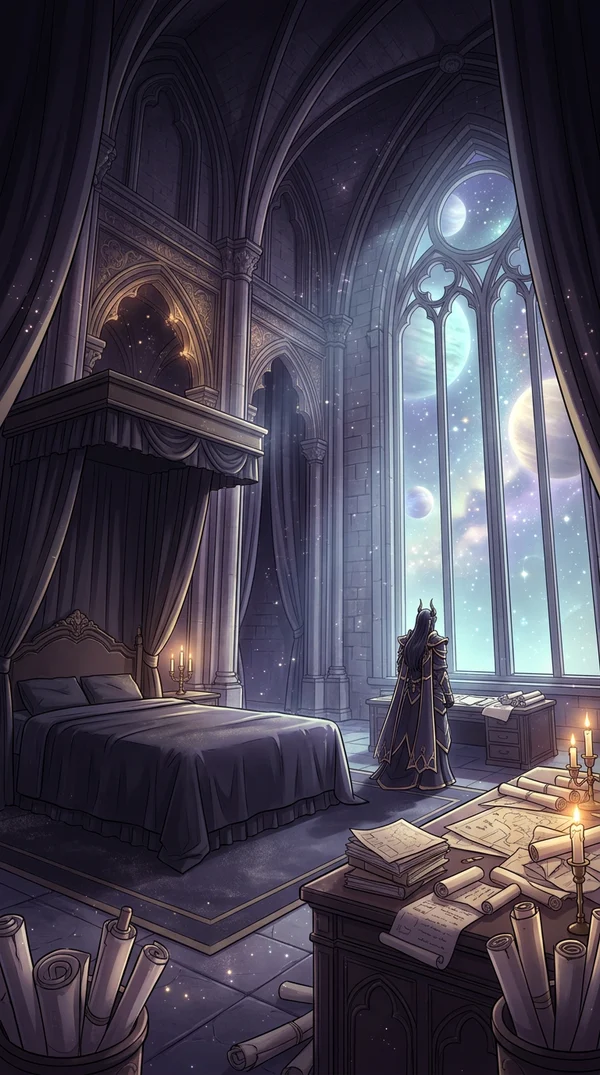
Castle Gloam was not what the Church’s sermons had promised. No skulls. No rivers of fire. It was a tall, black, narrow castle on a crag, with a great many windows, all of them lit, and ivy that bloomed in the dark with small pale flowers like moths. It smelled like rain and woodsmoke and old paper. It looked, she thought, like a place where someone had been staying up too late for a very long time.
Inside, a second footman fainted. A maid in the gallery saw the king, dropped a stack of linen, and fled with a sound like a kettle. In the hall a large shaggy dog lay down flat and put its paws over its eyes.
“Is it always like this?”
“Since I took up the Ward,” Rhydian said, which meant nothing to her yet. “Most of them can work in the east wing. The ones who cannot bear it at all have gone home. I don’t blame them.”
“Who does the work in the west wing?”
He paused on the stair. It was the pause of a man who had never been asked and was working out how to say it without sounding as if he wanted something.
“I do,” he said.
She learned the shape of it by noon.
The Chancellor of the Duskmarch was a lich called Ossery, who had been dead for about nine hundred years and was the most organized person Margo had ever met, including the woman who had run the pharmacy at St. Agnes General with a laminator. He was a tall skeleton in a dove-gray robe and half-moon spectacles, which he did not need, having no eyes, and he met her in a study full of pigeonholes with a stack of papers already squared on the desk.
“Form One, Statement of Employment,” he said. His voice came from somewhere in the vicinity of his jaw and sounded like a cello being polite. “Form Two, Disclosure of Prior Allegiances. Form Seven, Declaration of Non-Assassination Intent.”
“What happened to three through six?”
“Superseded. Sign here, here and,” a bony finger, “here.”
Margo read Form Seven. It was two pages long and astonishingly thorough. It had a clause for poison, a clause for curses, a clause for “persuading another party to undertake any of the above,” and a clause that said “or anything, really, Madam, we trust you take the point.”
“Has anyone ever signed this and then tried to kill him?”
“Four,” said Ossery. “Over the centuries. We keep their forms.” He tilted his skull. “You are not afraid of me.”
“I’ve worked with surgeons.”
The skull considered this. Then the lich made a small creaking sound she would later learn was laughter, and stamped Form Seven with a seal shaped like a moth.
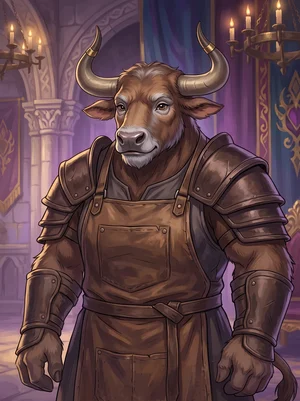
The general came in without knocking. General Hilde Ironhorn was a minotaur, eight feet tall with silver in her brown coat and brass caps on her horns, and she wore a leather apron over her armor because, she said, she had been helping in the kitchens, because nobody else would go into the kitchens since the cook had moved to the east wing. She looked Margo up and down with enormous gentle eyes and then bent and smelled her hair.
“Hm,” said Hilde. “Ohio.”
“How can you possibly—”
“No idea. But you smell like a place called something like that.” She straightened up. “You touched him.”
“I’m his physician.”
“You touched him on purpose.” Hilde’s nostrils flared. “Ossery. She touched him on purpose.”
“I heard her, General.”
Nobody explained why that mattered. Margo let it go, and filed it with Warden, with the asterisk, with the way he’d drawn a line in the air an inch from her sleeve.
The page was an imp called Nib. He was about the size of a cat, red, with leathery wings and a pointed tail and a quill behind each ear, and he told her within thirty seconds of meeting her that he was a hundred and forty years old and had been a spy. Then he hid under Ossery’s desk when the door opened, because the door opening meant it might be the king, and came out again when it wasn’t, and didn’t seem embarrassed at all.
“You get used to it,” Nib said. “Not the fear. The hiding. It’s a very good desk.”
The benefits meeting happened in the king’s study at two in the afternoon.
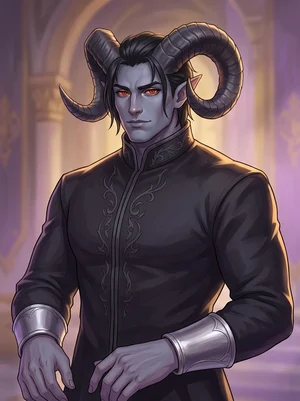
Rhydian had changed into a black coat with high collars and silver at the cuffs, and it did nothing to make him less alarming. He sat behind a desk that was buried in papers: tax rolls, grain counts, a petition about a bridge, three letters from somewhere called the Lower Fens that all began Your Dread Majesty, with the utmost respect, the frogs. He had a pen in his hand. Margo got the impression he had not put it down since the hollow.
On the corner of the desk, squared like a holy relic, was a small brown book. The Considerate Employer: A Handbook for Merchant Houses of Good Standing. There were ribbons in it.
“It came from a caravan,” he said, following her look. “Twenty years ago. The merchants abandoned it when they saw me.” He touched the spine. “It is very good. Chapter four, on fair wages. Chapter nine, the dignity of rest.” He hesitated. “I have not been able to implement chapter nine.”
“Tell me about chapter nine.”
“It says that every worker should have one day in seven.” He turned the pen over. “Your list.”
She had written it on the back of Form Two.
“A room with a door that locks from the inside,” she said. “Eight-hour shifts. If I work over, it’s my choice and it’s paid. One day a week off, and on that day nobody asks me to look at anything. Meals I don’t eat standing up. And dental.”
He wrote it down. All of it. In beautiful, careful handwriting, slanting slightly to the right. Then he looked up.
“I do not know what dental is.”
“Teeth. Somebody who looks after my teeth.”
“Hilde,” he said, not raising his voice, and the door opened at once, because Hilde had been listening, because of course she had.
“A tooth-priest,” Hilde said. “There’s one in the town. She’s a gorgon. Very gentle.”
“A tooth-priest,” Rhydian wrote, and underlined it. “Is there anything else?”
“No,” said Margo. Then, because it was on the back of the form and she had written it at four in the morning and almost crossed it out: “Actually. Yes. When I tell you to do something, medically, you do it.”
He set the pen down.
It was the first time she had seen his hand without it. It lay on the desk, large and long-fingered, and she saw now that the knuckles were swollen and that there was a tremor in it, fine as a hair. Overuse. Fatigue. She’d seen it in residents at the end of a thirty-hour stretch.
“Within reason,” he said.
“Within my reason.”
A long breath. “Yes.”
“Good. Give me your wrist.”
He looked at her. She held out her hand, palm up. He looked at that.
Then, slowly, as if lowering something heavy onto glass, he laid his wrist in her palm.
He was very warm. She felt the pulse first, fast for a man sitting down, eighty-eight, ninety. She counted it against the clock on the wall. She did not need to count. She could have opened Triage and read it off his window. She counted it anyway, because counting a pulse is a way of telling someone I am here and I am paying attention to you, specifically, and he was the sort of patient who needed to be told.
He had gone completely still.
Not tense. Still, the way people went still when they were trying not to scare off a moment. His eyes had dropped to her hand on his wrist and stayed there. Around them the room changed. The cold weight she’d felt in the hollow, the one Night Shift kept sliding off her, eased. Out in the corridor a maid who had been flattened against the far wall for an hour said, in a puzzled voice, “Oh,” and walked past the door without running.
“How long,” said Margo, “since someone touched you?”
“Hilde headbutts me,” he said, after a moment. His voice was very even. “On my birthday.”
“Not what I asked.”
He looked up at her. Red eyes, gold-ringed, and something in them that was not the Demon King at all.
“There was a healer,” he said. “Before you. A hundred and twelve years ago. She managed to take my pulse twice before she resigned.” He was quiet. “She was very brave about it.”
Margo kept counting. She got to sixty and kept going, past where she needed to, past where she could pretend it was clinical, until the second hand had gone around twice and his pulse had come down to seventy-two.
“That’s better,” she said, and let go.
He took his hand back and put it in his lap, under the desk, as if he were keeping it somewhere safe.
She went to bed in a room in the west wing with a door that locked from the inside, which somebody, probably Nib, had polished until it shone. She did not sleep. She lay in the dark listening to the castle: the creak of old wood, wind in the ivy, a clock somewhere. At midnight she heard a door open down the hall and footsteps that were too heavy and too careful to be anyone else’s.
She was on duty. She told herself that, getting up. Patient with a flank wound wandering at midnight. You checked.
She followed him down the back stair, through a postern gate, and out across the dark crag behind the castle, where the heath ran east for a mile and then simply stopped.
That was the Edge. She had heard it called that and thought it was a figure of speech.
The world ended. Not at a cliff. It just ended: grass, stones, and then a grayness that was not fog and not sky and not anything, that took the color out of the stars above it and the sound out of the wind. Looking at it made the back of her eyes ache. And between the world and the gray stood a wall of light the color of the last minute of sunset, violet and rose and deep gold, miles high, running north and south as far as she could see. Here and there along it the light was thin. In one place, near where he stood, it had frayed to almost nothing, and the gray was pressing through like a thumb into wet paper.
Rhydian stood in front of the thin place with both hands raised.
He did not do anything dramatic. He didn’t shout. He just set his palms against the light, and leaned, the way a man leans on a door that someone is pushing from the other side. The frayed place thickened. The gold came back into it, slow, like color returning to a face.
His window was open over his head. He had forgotten, or he didn’t care, or he had no idea anyone was watching.
[Rhydian | HP 2,980/4,600 . . . 2,410 . . . 1,875] [Ward: holding.]
She watched his health drain into that wall like water into sand, and understood, all at once and far too late, what she had been hired to keep alive.


What did you think?