Margo woke up because she had finished sleeping, which had not happened to her in nine years.
She lay there trying to work out what was wrong. Nothing hurt. Nobody was calling her name. No bell, no pager, no alarm. Light was coming through tall windows in long gold bars. She was in a very large bed with very good sheets, and the sheets had military corners on the side she wasn’t on, and on the side she was on there was a Demon King.
He was asleep.
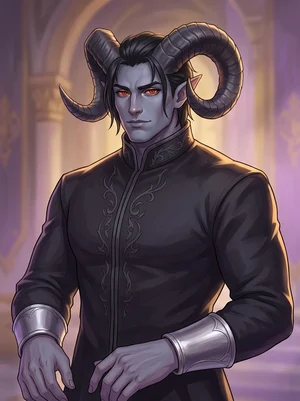
He was asleep on his back with one arm flung over his head and the other arm around her, and his mouth was open a little, and he was snoring. Not loudly. A low, steady, contented sound, like a large cat. His hair was a disaster. There was a pillow crease down one cheekbone.
She opened his window, very quietly, because she couldn’t help herself.
[Rhydian | HP 4,410/4,600 | Status: Asleep] [Mana channel scarring: 41%.] [Dread Aura: faint.]
Then she opened her own.
[Margo Kaminski | HP 88/88] [Sleep debt: 2,919 hours.]
It had gone down. On the night of the eclipse it had touched two thousand nine hundred and ninety. Seventy-one hours. She did the math, slowly, still half under, and then lay staring at the canopy.
“Three days,” said a voice from the doorway. Hilde was standing there with a tray, in her apron, with her shoulder bandaged and her eyes wet, as usual. “You’ve been out for three days. So has he. We had a vote about whether to wake you and Ossery made a form about it and the form said no.”
“Three—” Margo sat up. “The Ward—”
“Is fine. Is better than fine.” Hilde set the tray down. “Eat. Then come and look at the board.”
Rhydian made a sound in his sleep and tightened his arm, and then opened his eyes, and looked at her, and for a moment he simply didn’t seem to know where he was, or when.
Then he smiled.
She had never seen it before. All the way. It went up one side of his serious mouth and then the other and then all the way up into his eyes, and it was so unguarded and so young and so completely unlike the Demon King of the Duskmarch that Margo forgot entirely what she’d been about to say.
“Good morning,” he said, hoarse with sleep.
“Hi,” said Margo.
Hilde made a strangled noise, and went and stood in the corridor for a while.
The board was in the great hall, where the assignment board had been. It had grown.
Ossery had taken her chalk rota and done to it what he did to everything, which was make it permanent, beautiful and slightly frightening. It ran the length of the wall now in neat columns, with moth seals at the top of each, and a heading in Margo’s own capitals that someone had copied out very carefully.
THE WARD OF THE EDGE: SHIFT ROTA.
Three shifts a day. Eight hours each. Nights belonged to the Hero: from ten until six, Dashiell would take his half of the sky so that the Warden could sleep. The other half didn’t thin when the Warden’s grip loosened in his sleep, because it wasn’t in his grip: the night volunteers carried it between them, five percent apiece, until he woke and took it back. Days and evenings belonged to the Warden. Under both ran a column of five-percent volunteers, and the volunteers’ column was full: goblins and gorgons, the cook, the under-butler who recited his will, the troll fiddler, three of the knights who had ridden west to stop the singing, Brother Lucent (mornings only, after prayers), and Corisande, twice, because she said she wanted the practice. Twice a day, at handover, the party leader rebalanced the shares, the way you rebalanced patient assignments when somebody called out. The party leader’s name was written at the top of the board. It was hers.
There was a handover time printed at the top of every column. There was, she noticed, no COVER column at all.
“I took it out,” said Ossery, who had appeared at her elbow with his hand reattached and a bandage around the wrist bone. “Madam. On your behalf. If you wish to argue, there is a form.”
“I’m not going to argue.”
“I have the form regardless,” said the lich, with deep contentment.
Dashiell was on the late shift. That was his column, with SIR D. VANTOR, HERO (RELIEF) chalked at the top, every night, and a small gold star beside it that he had clearly drawn himself. He was sitting at the long table under the rota, eating porridge, with a gray look around the eyes that Margo recognized immediately: it was what people looked like after their first week of nights.
“It’s a lot,” he said, when he saw her looking. “The sky. It’s very heavy.”
“It is.”
“He did it alone for three hundred years.” He put his spoon down. “Margo. I don’t think I’ve ever been sorry before. Not properly. I don’t think anyone ever gave me the chance.”
“Well, now you have the chance,” said Margo. “Eat your porridge. You’re on at ten.”
He’d brought the Contribution Board. She didn’t know why. It was propped against the wall by the fireplace, gilt frame and all, and when he saw her looking at it he got up and tapped it with his spoon, and it lit up gold, as it always had, with the party’s numbers for the last quarter.

 100 to start reading with.
What did you think?