The Rules, chapter 2 of Forty Nights of Yes
Room 1107 had one bed, one armchair, one desk, one lamp with a pleated shade, a luggage rack, a long low dresser, and two pillows in white cases so pressed they had corners.
I counted them twice. I sat on the end of the bed in my coat with my music bag on my knees and made an inventory of every piece of furniture in the room, because apparently that was what I was now, and you might as well know your own kind.
At 1:10 in the morning my phone lit up on the desk. Keith.
I let it ring four times. Then I picked it up.
“Leese? Where the hell are you? It’s one in the morning.”
“I’m at the Belcourt,” I said. “With my one glass of white wine.”
There was a silence on the line. I had never in my life heard Keith Gorski be silent. He talked through movies. He talked through my recitals, back when I had them, and through the eulogy at my mother’s funeral.
I hung up before he could fill it.
He called back nine times. I turned the phone face down on the desk, and lay on top of the bedspread in my clothes, and did not sleep, and did not cry either, which surprised me. Around four I realized my right hand was playing the opening of the Appassionata on the bedspread, very softly, over and over, the way it did on the bar.
I went home in the morning because my students were coming at four, and because I wanted to see if the house looked different.
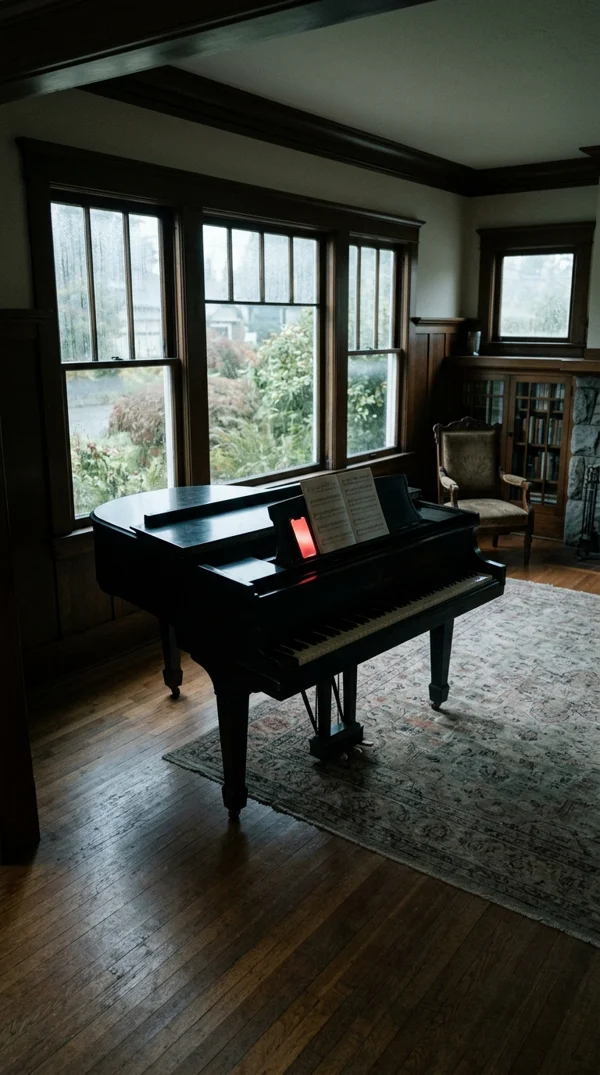
It didn’t. That was almost the worst part. The house in Ballard was my parents’ house: a 1912 Craftsman on a street of Craftsmans, with a deep porch my father built the railing for and a front room with three tall windows, and in that front room my mother’s grand piano, the one she bought with eleven years of lesson money. I grew up under that piano. I learned to play on it. In 2009, when the recession nearly took Keith’s stores, I mortgaged this house to save them, and the bank put his name on the title next to mine, and I signed where they showed me.
Keith was in the kitchen in his robe, eating cereal standing up at the counter.
“Okay,” he said, when he saw me. He put the bowl down. “Okay. So. Brooke told me.”
“Told you what?”
“That some woman in the bar was, I don’t know. That the guy threw them out.” He scrubbed his face with both hands. “Look. She shouldn’t have read that stuff out loud. That’s on her. I’ve told her that.”
I waited.
I had a student once, a boy of eleven, who could not stand a rest. Wherever the music said stop, be silent for one beat, he played something. A grace note, a little extra chord, anything. He couldn’t bear the gap. I used to make him sit on his hands.
Keith couldn’t bear it either. He never could.
“And I mean, come on, Leese,” he said, into the silence. “You can’t be surprised. Honestly. You can’t stand there and act surprised. Everybody knows you’re cold. Ask anyone. Ask Leif.”
“I’m not going to ask our son if I’m cold, Keith.”
“I’m just saying. Twenty-four years. Do you know what it’s like being married to somebody who never wants anything?”
“Did you ever ask?”
He looked at me as if I’d spoken in Norwegian.
“I’m going to stay at the hotel for a while,” I said.
“The Belcourt? On what money?”
I didn’t answer. I went upstairs and packed a suitcase: underwear, two skirts, three cardigans, my good black dress, my mother’s pearls. In the front room I took my Beethoven down from the shelf, the old blue volume with my teacher’s pencil all over it, and put it in my music bag.
Keith had followed me as far as the hall. He watched me zip the bag.
“Don’t do anything stupid with the house,” he said.
That was what he chose to say. Of all the things.
“We’ll talk when you’ve calmed down,” he said, and went to get dressed for work.
“I am calm.”
“Yeah,” he called down the stairs. “That’s the problem. You’re always calm.”
My four o’clock was Maddie Okonjo, who was eight and played everything as fast as she could so it would be over.
“Count out loud,” I told her, as I told her every week.
“I’m counting in my head.”
“Out loud. If you don’t say it, it didn’t happen.”
She rolled her eyes and counted out loud, one and two and, and the minuet came right, the way it always does when they say it, and I sat on the bench beside her with my phone propped on the music stand recording the lesson, as I had recorded every lesson for fifteen years, so she could hear herself at home. I record everyone. Their mothers love it. I had never once recorded myself.
If you don’t say it, it didn’t happen. I had said it ten thousand times. It was the first time I heard it.
At half past six, when the five o’clock had gone, I called a cab and carried my suitcase down the porch steps my father built.
At five to nine a woman in a gray suit met me at the concierge desk of the Belcourt. She was about sixty, with reading glasses pushed up into short silver hair and the posture of someone who could run an aircraft carrier and would prefer not to be thanked for it.
“Ms. Bjornstad. I’m Mrs. Thornbury, the general manager.” She looked at me, and at my suitcase, which a bellman was already taking away. “He’s expecting you. If you’re expecting him.”
“I don’t know what I’m expecting.”
“That,” she said, “is the most sensible thing anyone’s said to me this week.”
Behind the desk was a brass door I had always taken for a service closet. She opened it with a key on a long chain. Inside was a small elevator lined in old walnut, with one button. She turned the key in it, stepped out, and held the door with her hand.
“Only this key goes up,” she said. “Or his. Nobody else.”
The doors closed. The elevator rose fourteen floors in a long smooth breath, and opened on him.
He was standing in the middle of a room so large it took me a moment to understand it was a room. Windows ran the length of it, and beyond them the whole of Elliott Bay lay black and gold, the ferries moving across it lit up like birthday cakes. There was a long table of dark wood with nothing on it but a single sheet of paper. There were two chairs by the windows. And at the far end, beside the glass, there was a piano.
Not a new one. A big old grand, its black finish gone soft and brown at the edges, the kind that used to sit in hotel tea rooms in the twenties under potted palms.
“It came with the building,” he said, following my eyes. “It was in the Palm Court. Nobody’s played it in eleven years. I don’t play.”
“Then why keep it?”
“Because it was here first.”
He looked at his watch. It was 8:59. He waited, without moving, until the second hand came round, and at nine exactly he took the watch off, wound it, and put it back on. I watched him do it. It took eleven seconds, and he gave it the whole of his attention, the way he’d given it to the button on my coat.
“Every night?” I said.
“Every night. Sit down, Ms. Bjornstad.”
I sat at the long table. He didn’t. He stood across it, on the other side, as far from me as the table allowed, and slid the sheet of paper over.
It was Belcourt letterhead, heavy and cream, with the little crest at the top. It had been written on in fountain pen, in a square, upright hand that didn’t slope in either direction.
Forty nights. Nine o’clock. This floor.
- You will say what you want, out loud. If you don’t know, you will say that.
- You will not apologize in this room.
- Nothing will happen that you have not asked for. I will ask anyway.
- Each night begins with one piece of music. You choose it. I will not speak until it ends.
- You will not pretend. Not pleasure, not comfort, not that you are all right.
- You will sleep in your own room unless you ask to sleep in mine.
- Your word stops everything, at once, with no explanation owed. The word is ____________.
- I will not lie to you.
- Outside this room, your life is your own. I will not touch it.
And under the empty tenth, smaller: The last rule is yours. Write it when you know.
“Read them to me,” he said.
“You wrote them.”
“Rule one. Out loud.”
So I read them. My voice did the weather thing again for the first two and then cracked on the third, and I cleared my throat and went on. When I got to the bottom he said nothing at all, and I understood that I was supposed to say something, and that he would stand there until I did.
“Three,” I said finally. “Nothing happens unless I ask.”
“Yes.”
“What if I never ask?”
“Then you’ll have had forty nights of being left alone by a man who would very much rather not leave you alone.” He said it without any change in his voice at all. “There are worse ways to spend October.”
My face went hot. I looked down at the paper.
“And ‘I will ask anyway’?”
“Because people say yes to things they don’t want. You’ve had a lot of practice. I’ll check.”
I put my finger on the blank in rule seven. “What do people usually choose?”
“There aren’t usually people.”
I looked up. He held my eyes and didn’t explain, and rule eight sat on the paper between us, I will not lie to you, and I decided to believe it.
I thought hard about the word. Stop was too plain; I’d said it to a hundred children and it meant nothing. Red was a traffic light. I thought about what a musician writes when she means the end. When you’ve gone back to the beginning, the way the music tells you to, and played it all through a second time, and come to the place where it’s over.
“Fine,” I said. “Not like fine. The Italian. Fee-nay. It’s written over the last bar, where a piece stops.”
“Fine,” he repeated, properly, in an accent I could hear for the first time. He took a pen from his inside pocket, uncapped it, and wrote it in the blank in his square hand. Then, under rule five, he added a line.
Which means you will never again say fine to me to mean you are all right.
“I say it fifty times a day,” I said.
“Not here.”
He capped the pen. “Four,” he said, and looked at the piano.
I walked the length of that room with my heels loud on the floor and sat down at an instrument nobody had played in eleven years, and lifted the lid, and put my hands on the keys, and could not think of a single piece of music.
Not one. Twenty-five years of teaching and a conservatory and the whole blue volume of Beethoven in the bag at my feet, and my mind was as empty as the long table.
So I played a C major scale. Two octaves, hands together, up and down. The first thing I teach an eight-year-old.
The piano was terribly out of tune. The F was flat, and the top C rattled.
He stood by the window and listened as if it were Chopin. He didn’t move and he didn’t speak, and when I lifted my hands, he waited until the last of the sound had gone out of the strings before he said anything at all.
“The F is flat,” he said.
“It’s the piano.”
“I’ll have it tuned.” He came back to the table and turned the sheet toward me, and set the pen beside it, and put one finger, very lightly, on rule nine. “That one I’d like you to hear me say. Outside this room, your life is your own. I will not touch it. Not your marriage, not your house, not him. Whatever you decide out there, you decide.”
“And in here?”
“In here,” Maxim said, “you ask.”
I signed it. L. Bjornstad. The B was very decided. He signed underneath, M. Ardelean, in the same upright hand, and blew on the ink, and folded the sheet once and gave it to me to keep.
“Then for forty nights,” he said, “you’re mine to ask, and nobody else’s.”
He didn’t come around the table. He didn’t touch me. He stood there with his hands at his sides and his watch ticking, and I stood there with the rules in my hand, and I wanted him to ask me something. Anything. My name again. What I wanted. Whether I’d eaten.
I had no idea how to ask him to.


What did you think?