The Furniture, chapter 4 of Forty Nights of Yes
He kissed me the way he wound his watch. As if there were nothing else in the building.
That was the first thing I understood, standing there with my face tipped up and his mouth on mine: he had not touched me anywhere else. He was kissing me with his hands hanging open in the air beside him, like a man who’d been told to keep them where they were and was going to, if it killed him.
I pulled back an inch. “You can touch me.”
“Where?”
Nobody had ever asked me that. I had no vocabulary for it. I stood there with my lips buzzing and my mind full of the word where, and finally I took his left hand, the one with the scar across the knuckles, and put it on my waist, over the gray cardigan.
“There.”
“And?”
I put his other hand on my back, between my shoulder blades.
“There.”
He drew me in by those two places, slowly, until there was no room left between us at all, and kissed me again, and this time it was not polite. It was not polite at all. I had been kissed, in twenty-four years of marriage, perhaps eleven thousand times, and I would have told you I knew what a kiss was, and I would have been wrong. This was a question being asked over and over in a language I’d forgotten I spoke. His mouth was patient and certain and in no hurry whatsoever. Somewhere in it I heard a sound, low and surprised, and realized it was me.
He stopped.
He stepped back, one pace, and let his hands fall, and looked at me with his breathing not quite even, which pleased me more than anything had in years.
“Ask me for something else,” he said. “Tomorrow.”
“Why not tonight?”
“Because tonight you asked for one thing and got it. Go to bed, Lise. Your own. Rule six.”
I went down to 1107 in the walnut elevator with my hand pressed flat against my own mouth, and lay awake until three wanting things I had no names for, and it was the best night’s sleep I hadn’t had in my life.
In the morning I found him in the lobby.
He walked the whole hotel every morning at seven, Mrs. Thornbury had told me, floor by floor, and ended in the lobby, straightening things that did not need straightening. I found him by the unplayed lobby piano, moving a vase of white lilies one inch to the left.
He didn’t look surprised to see me. He looked as if he’d been waiting since six.
“It’s not nine o’clock,” I said. “Does it count, out here?”
“Ask, and find out.”
“I want a moving truck.” My voice came out higher than I meant it to, and I cleared my throat and said it again, the way I’d said kiss me. “I want a moving truck. Saturday at nine in the morning. Four men. And one who’s careful with pianos.”
He took out his phone. “Address?”
I gave it to him. He typed it without asking a single question.
“Don’t you want to know why?”
“Rule nine,” he said. “Outside that room your life is yours. You asked for a truck. You’ll have a truck.” He put the phone away. “Is that all?”
It wasn’t. I knew it as soon as he said it.
“I’ll need somewhere to put a piano,” I said. “And somewhere to teach. My students come on Monday.”
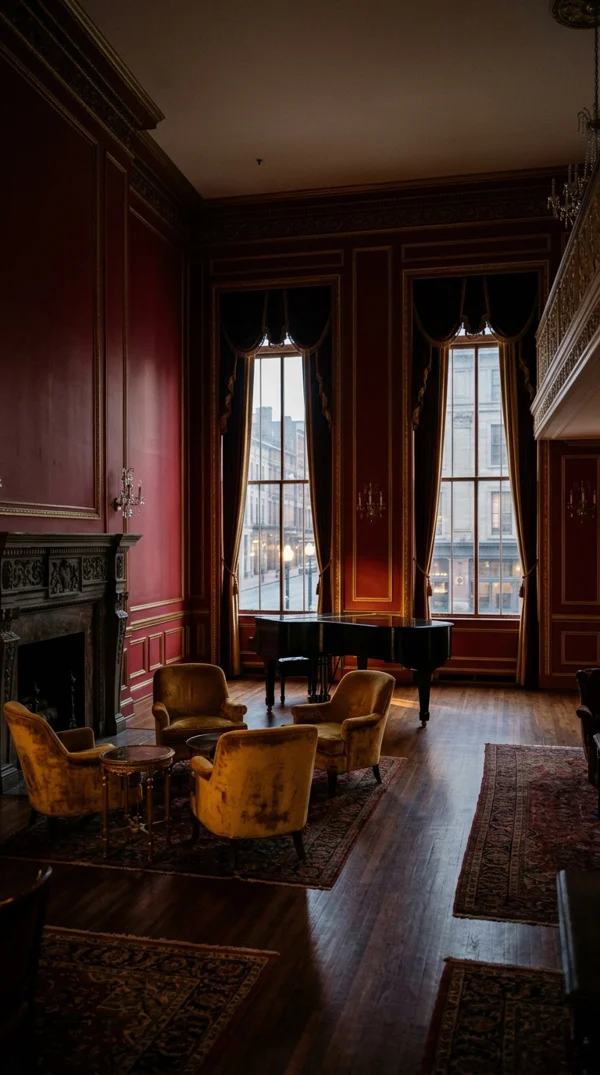
He looked at me for a moment. Then he turned and walked me up the curved marble stair to the mezzanine, past the old telephone booths, to a pair of double doors I’d never noticed, and opened them on a room the color of a pomegranate. Dark red walls, cream plaster ceiling, two tall windows onto Fifth Avenue, a fireplace, and nothing else.
“The Garnet Room,” he said. “It was the ladies’ writing room in 1924. Nobody’s used it since I bought the building. I never knew what it was for.”
“It’s for a piano,” I said.
“Then it’s yours.”
I texted Dorothea from the cab on Friday. Is furniture money?
She called me back in under a minute.
“Most of what’s in that house came from your parents, yes? Then it’s yours, and he’ll have to prove otherwise. Make a list. Photograph everything. Leave him a bed to sleep in.” A pause. “Actually, don’t. Take the good stuff, Lise.”
On Saturday, October 17, Keith was in Lynnwood all day for the Fall Into Sleep Sale. There were radio ads. He’d done the voice himself. This weekend only, fall into sleep at Gorski’s!
At nine o’clock a truck the length of my street pulled up outside the house, and four men got out of it, and a fifth, an enormous gentle man with forearms like hams who called my mother’s piano she and wrapped her in quilted blankets as if she might catch cold.
I took my grandmother’s drop-leaf table, which had come from Bergen in a crate in 1951. I took the sofa and the two armchairs and the rugs. I took the dresser and the nightstands and the lamps, every lamp. I took the kitchen table and its six chairs, and the pots, and the dishes, and the good spatula. I took my father’s tool bench out of the garage and my mother’s piano out of the front room.
I took the bed.
“The bed too, ma’am?” said one of the movers, a young man with a beard, looking at the king-size mattress Keith had brought home from the store eight years ago and told me was the best one money could buy.
“Especially the bed.”
By two o’clock the house was bare to the walls. I walked through it once, alone. Every room rang. My footsteps came back at me off the floorboards as if the house were a concert hall and I were the only person in it, and I stood in the empty front room where my mother had taught for thirty-one years and my piano had stood for all of mine, and I sang one note, an A, just to hear it.
It was a good room for sound. It always had been. There had just always been too much in it.
I left Keith three things. His golf clubs, standing in the hall. His old sleeping bag from the garage, rolled up in the corner of the bedroom. And a note, on a sheet of Belcourt letterhead, in the middle of the bare floor of the front room where the piano had been.
You said sleeping with me was like sleeping with furniture. So I took the furniture.
At a quarter past six I was sitting in the back of a black car across the street.
I had asked for that too. I’d found him in the lobby again on Friday afternoon and said, before I could lose my nerve, “Will you come with me tonight? I want someone to see it.” And he’d said yes. Only that.
So we sat in the dark, in the back of his car, with his driver Emil reading a paperback in the front seat and the rain coming down soft on the roof, and I watched my house.
I’d left the ceiling light on in the front room. Through the three tall windows you could see straight in, all the way to the back wall: bare boards, white walls, nothing. It looked like a stage before the set goes up.
At 6:40 Keith’s car pulled into the driveway.
He got out. And then the passenger door opened, and Brooke got out too. She was holding the handle of a small pink suitcase on wheels.
I heard myself make a sound.
“Do you want to go?” Maxim said quietly.
“No.”
They came up the porch steps my father had built, Keith with his keys out, Brooke bumping the pink suitcase up behind her one step at a time. The front door opened. The light from the empty front room fell across the porch.
They stopped in the doorway.
I watched Keith walk into the middle of that room and turn all the way around, slowly, once, with his arms a little out from his sides. I watched him go to the doorway of the dining room and look in, and come back. I watched Brooke stand on the threshold with her pink suitcase and her mouth open.
Then she saw the note.
She bent and picked it up off the floor. I couldn’t hear her. I didn’t need to. I could see her lips move through the window, reading it aloud in that voice made for it.
Keith snatched it out of her hand.
Beside me, in the dark, Maxim Ardelean laughed.
It was one low sound, quickly over. I don’t think he meant to do it. I turned and looked at him and he had his hand over his mouth, and above it his eyes were creased up at the corners, and he took his hand away and composed his face and said, “Forgive me.”
“You’re not allowed to apologize,” I said. “Rule two.”
“Not in that room.”
“And rule five.” I couldn’t stop smiling. My face hurt with it. “You’re not allowed to pretend you didn’t enjoy that.”
“I enjoyed it enormously,” he said. “Did you?”
I looked back at the window. Keith was on his phone now, pacing, and in my coat pocket my own phone began to buzz. I let it buzz.
“I enjoyed it more than anything I’ve done in twenty-four years.”
“Emil,” Maxim said. “Home, please.”
The voicemail, when I played it in the car, was forty seconds long and began Leese, what the HELL, and I deleted it before it got to the part about lawyers.
At eight o’clock, my son called.
“Mom.” Leif’s voice was doing something strange. It took me a second to understand he was laughing so hard he could barely breathe. “Mom. Dad just sent me a picture of the living room. Is this real? Did you take the bed?”
“Especially the bed.”
He laughed until he started coughing. Then he went quiet, and said, in the voice he’d had at nine years old when he found me crying in the laundry room, “Are you okay, though? Like actually?”
I opened my mouth to say fine. I felt it sitting on my tongue. I thought of rule five, and the line Maxim had written under it.
“I’m good,” I said. “Honey, I’m actually good.”
At nine I played Scarlatti, a little sonata in D major that runs barefoot up and down the keyboard, and I played it laughing. When the strings went quiet I stood up from the bench and turned around.
I had worn my good black dress. I’d packed it for no reason I’d let myself name.
“I want you to take off my dress,” I said. “Slowly. And I want you to tell me what you’re doing while you do it.”
He came down the room to me without hurrying. He stopped close enough that I could feel the warmth of him through the silk, and looked at me for a moment, and said, “Turn around.”
I turned.
“I’m going to open the zip now,” he said, low, behind me. “All the way down.”
He did. I heard it, a long soft tearing sound in the quiet, and felt the air on my back where the dress parted, and his knuckles, just his knuckles, all the way down my spine.
“Now I’m going to take it off your shoulders.”
He did that too. His palms barely touching, the black silk sliding, the dress loosening and falling and catching at my hips and then falling the rest of the way, and pooling at my feet. I stood there in my slip in the lamplight with the whole black bay behind the glass, forty-eight years old and shaking, and he came round in front of me and looked.
He looked for a long time. He didn’t say a single thing about my body, and I was more grateful for that than I can tell you, because every inch of it was being told by his face.
“What next?” he said.
I wanted everything next. I wanted it so much I could hear it, the way you hear a chord before you play it. And something in me that had said yes to everything for twenty-four years said, very clearly, for the first time in my life, the true thing instead.
“Not yet.”
He smiled. The real one, the first I’d seen, and it changed his whole face.
“Good,” he said.
Then he knelt down in front of me, and picked my dress up off the floor, and stood, and laid it carefully over the back of the chair, smoothing it once with his palm, as if it mattered. As if I did.
“When you want the rest,” Maxim said, “you’ll ask me for it. And I’ll make you ask twice.”

What did you think?