Mrs. Thornbury had the invitations printed by Wednesday.
They were cream card, heavy as the rules, with the Belcourt crest at the top in dark red ink, and they said:
Lise Bjornstad, piano. Sunday, the fifteenth of November, at seven o’clock. The Rainier Room, the Belcourt. Bach. Chopin. Debussy. Beethoven.
I had not seen my name on anything like it since I was twenty-two. I’d forgotten that it looked like that, printed, like the name of someone you might go and hear.
I sent them to all thirty-one families, and to Mr. Akers and his wife, and to my mother’s best friend, who was ninety-one and wrote back that she would come if she had to be carried, and to Dorothea, who framed hers and hung it in her office between her law degree and a photograph of her late husband holding a very large fish.
I didn’t send one to Keith.
Leif called on Thursday night. “I got the thing,” he said. “The card. I’m coming.”
“Honey, you work nights. You don’t have to fly up for—”
“Mom. I’ve never heard you play. Not properly. Not like a, you know. A concert.” He was quiet a second. “I’ve heard you play scales for other people’s kids my whole life. I’m coming.”
I sat on the piano bench in that red room after he’d hung up, and didn’t play anything for quite a while.
I practiced every evening after my last student. Notes were never the trouble with the Appassionata; I’d known every one of them since I was twenty-two. The trouble was the seventeenth bar, and every bar like it, the places where Beethoven stops whispering and brings both fists down.
Alone in the Garnet Room with the doors shut I could play them now. Not fortissimo. Call it a firm forte, loud enough that the old windows hummed, and I’d sit there afterward with my ears ringing, astonished at myself.
Then one evening a bellman walked past the double doors pushing a luggage cart, whistling, and my hands stopped dead an inch above the keys.
Just the whistle. Just the idea that someone might hear.
I sat there with my hands in the air until the cart had gone all the way down the mezzanine and around the corner. Then I put them in my lap, and laughed at myself, and didn’t feel like laughing at all.
Upstairs, things were different. Upstairs I’d stopped being careful.
I slept in his bed every night I asked, and I asked every night. I learned what he looked like asleep, which was like himself, only with the frown let out. I learned he took his coffee black at five-thirty and read three newspapers before seven and folded each one back into its creases when he’d finished, so you couldn’t tell it had been read. I learned that he could make a gin and grapefruit better than Radu, and that Radu knew it and minded.
One night, after my piece, I sat him down on the bench beside me and tried to teach him a C major scale.
He was hopeless. He was the most hopeless student I’d ever had, and I’d had a boy once who played with his elbows. His big scarred hand landed on the keys like a man setting down a briefcase. He couldn’t pass his thumb under. He kept stopping to stare at his own fingers.
“Count out loud,” I told him.
“I’m counting.”
“Out loud, Maxim. If you don’t say it, it didn’t happen.”
So he counted out loud, one and two and, in that level voice, very seriously, and played a C major scale up one octave so badly that I put my head down on the music desk and laughed until I couldn’t breathe, and when I lifted it he was looking at me in a way nobody has ever looked at me in my life.
“Again,” he said. “I want to get it right.”
On the twenty-fifth night, which was Halloween, he took me to the symphony.
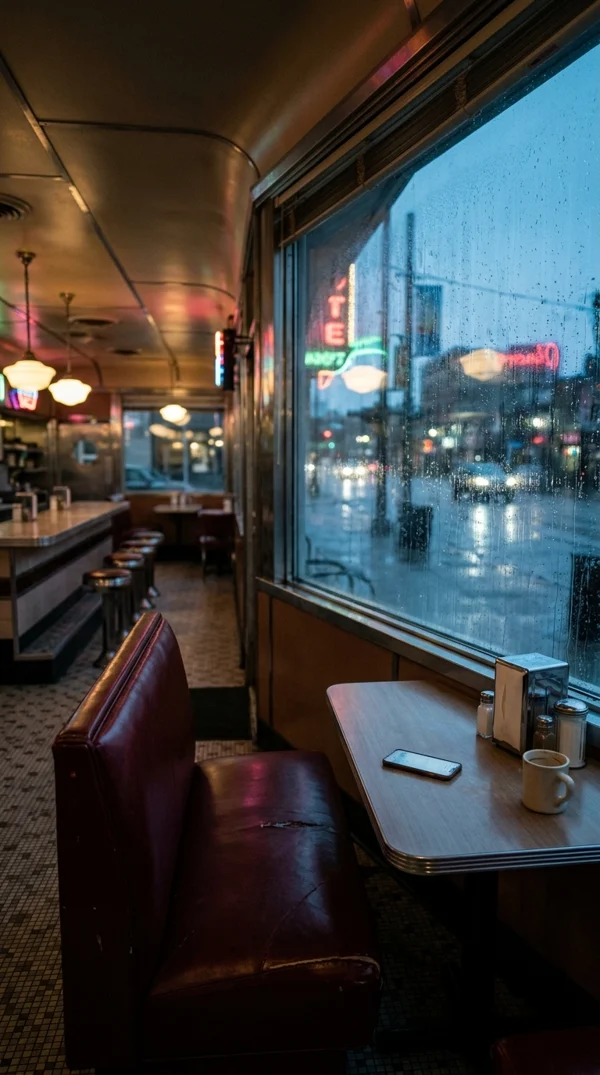
It was the first time we’d been anywhere together outside his building. I wore the good black dress and my mother’s pearls. Emil drove us four blocks in the rain, and the sidewalks downtown were full of people in costumes, a woman dressed as a lobster and three men dressed as one horse and a very small man dressed as a hot dog, who held the door of the concert hall open for us and said, “Evening, folks,” with tremendous dignity.
They played Brahms and Dvořák. I don’t remember much of it. I remember his hand on the armrest between us, and how halfway through the slow movement of the Brahms I put my hand on top of his without asking anybody, and he turned his over and held on.
Afterward it was pouring. He put up a big black umbrella on the sidewalk outside the hall and held it over me, and the crowd went past us on both sides in their wet coats and their costumes, and I looked up at him under the umbrella with the rain coming down all around us in silver strings, and I kissed him.
Out there. On a sidewalk on Third Avenue, in front of half of Seattle and a hot dog.
When I let him go he was looking down at me with rain on his eyelashes.

 100 to start reading with.
What did you think?