There was a dish of almonds on the dressing table in the little room behind the Rainier Room. I hadn’t asked for them.
I sat in front of the mirror at twenty to seven in my good black dress and my mother’s pearls, with my hands in my lap, and looked at the almonds, and knew who’d put them there, and didn’t eat one, because my stomach was somewhere around my knees.
Dorothea came in without knocking.
“A hundred and sixty,” she said. “Every chair. They’ve had to bring more from the Garnet Room. Your mother’s friend has arrived in a wheelchair with an oxygen tank and a hip flask, and she’s told Mrs. Thornbury she intends to use both.” She looked at me in the mirror. “You look terrifying. Good.”
Leif was behind her. My son, six foot two, in a tie he’d plainly bought at the airport, with his father’s hair and my mother’s chin, and he put his arms round me from behind and held on.
“All the families came,” Dorothea said. “All but one. The Haugens. I’m told they’re in Maui, so we’ll forgive them.”
I nodded. I wanted to ask the other thing. I couldn’t.
Dorothea knew. She always knew. She looked down at the program in her hands, not at me, while she said it.
“I didn’t see him,” she said. “There’s no chair with his name on it. The staff are all along the back wall. Radu, Mrs. Thornbury, the driver. Not him.”
“That’s all right,” I said. “That’s his to decide.”
It was true. I’d written what I’d written, and given it to Radu, and that was the end of my part in it. Whatever he did with it was his. I had asked. I’d learned that much, in forty nights: that you could ask, and mean it, and still not know the answer.
At seven o’clock Mrs. Thornbury opened the door and said, “Ms. Bjornstad,” and I stood up and walked out into the light.
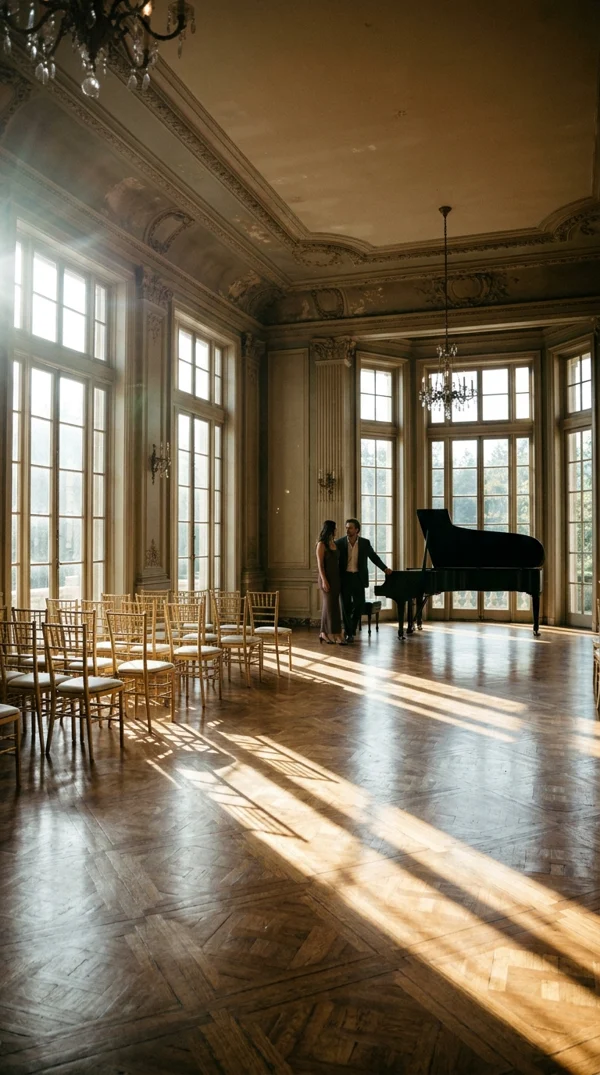
The Rainier Room was white and gold, with three chandeliers and a sprung dance floor from 1924, and the nine-foot piano stood at the end of it with its lid up like a black sail. A hundred and sixty people stopped talking when I walked out. I saw the gold chairs from the Garnet Room at the end of every row. I saw Maddie Okonjo in the second row in a velvet dress, swinging her feet. I saw Mr. Akers and his wife holding hands. I saw my mother’s friend in her wheelchair on the aisle, with her oxygen and a program on her knee, giving me a thumbs-up.
I saw the back wall, where the staff stood in a row in their dark uniforms. And the double doors beside them, closed.
I sat down. I played.
Bach first, a French suite, because Bach is like a cold glass of water and steadies the hands. Then the Chopin nocturne, the one everybody’s grandmother knows; I heard a woman in the fourth row sigh when it started. Then Debussy. I played them well. I played them the way I’d always played, beautifully and carefully, every note in its place, nothing too loud. The applause was warm and kind and polite, the applause you give a piano teacher you’re fond of.
At the interval I looked at the double doors again. They were still closed.
Keith was waiting by the coat check.
I’d gone out to the corridor for a glass of water, and there he was, in his blue blazer from the commercials, standing under the brass lamps holding a bouquet in cellophane. Grocery-store carnations, some of them dyed blue. The price sticker was still on the plastic. Twelve ninety-nine.
Maddie’s mother was at the coat check. So was Benji’s father. They both turned around.
“Leese,” Keith said. “Hey. Wow. Hey.”
“You weren’t invited.”
“I know. I know I wasn’t. I saw it on the music-shop board.” He held out the flowers. I didn’t take them, so he held them against his chest. “I just. I had to come. I had to hear.”
“And?”
He looked at me. He looked worse than I’d ever seen him. His tan was gray at the edges, and the blazer hung off his shoulders; he’d lost weight in a week, and his eyes were wet.
“Brooke left,” he said. “Did you know that? Wednesday. She took the coffee machine. And then there’s the bank, and the stores, and that guy holding my paper, and I’m sleeping on a floor model in the Lynnwood store because there’s nothing in the house, Leese, you know there’s nothing in the house.” He laughed, a terrible little laugh. “I’m sleeping on a floor model.”
I didn’t say anything. I let the rest sit.
“I didn’t know you could play like that,” he said. “In there. I’ve been married to you twenty-four years and I didn’t know you could do that. I didn’t know you were like this.”
“You never asked,” I said.
He stared at me.
And then Keith Gorski got down on his knees.
Right there on the carpet of the Belcourt, under the brass lamps, in front of the coat check and Maddie’s mother and Benji’s father and a girl from the catering staff holding a tray of champagne. He knelt, with his grocery-store carnations, and the cellophane crackled, and he said, “Come home. Please. I’ll be different. I’ll be so different. Just come home.”
I looked down at him for a while.
Twenty-four years. I thought about the glass of white wine he’d ordered for me on the first night, and every glass after it. I thought about ice queen, and furniture, and it’s just a house. I thought about a booth in a diner and a little red light. I waited for it to hurt, and it didn’t, quite. It was like looking at a photograph of a house you used to live in.
“Get up, Keith,” I said. “You’ll ruin your knees, and you’ll need them. Go back in, and sit down, and listen. It’s the one thing you’ve never done.”
A bell rang for the second half.
I walked past him, and back down the corridor, and through the little door behind the Rainier Room, and I didn’t look to see if he’d stood up.

 100 to start reading with.
What did you think?