Forty-One, chapter 2 of He Would Rather Starve
The crypt was under the east wing, down a stair so narrow that Hester’s shoulders brushed both walls, and it was the first room in Wintersend she liked.
It was honest. It was cold because it was underground and made of stone, not because something in it was wrong. It was a long barrel vault with a flagged floor and a smell of damp lime, and set into the walls on either side, at the height of a man’s chest, were the tablets: forty-one of them, Blackfell gritstone, each the size of a tea tray, every face dressed smooth and blank. Somebody had done the dressing well. She ran her palm across the nearest and felt not a ripple in it.
At the far end, under a holland sheet, lay one more slab on a pair of trestles.
“Not that one,” said Mrs. Bell, from the foot of the stair. “The master said.”
“What is it?”
“Not yours.” Mrs. Bell set down the coal scuttle she had carried, which had a brazier’s worth of embers in it, and tipped them into the iron basket by the wall with a hiss. “You’ll want warmth for your hands. Toby keeps the hoist, if you need a stone shifted. You’ll not need one shifted.”
The hoist stood near the stair, a timber frame with a chain and a hook, for lowering slabs down the light well from the yard above. Hester looked at the chain the way she looked at all chains, for rust, and found none.
“Mrs. Bell,” she said, “has anybody ever told you that you’d make a wonderful undertaker?”
Mrs. Bell looked at her for a moment with no expression at all. “Breakfast is at eight,” she said, and went up the stair.
The list had been left on the trestle beside her tools, folded in three. Hester unfolded it in the brazier light.
It was in his hand, the long s’s and the bell-rope g’s. Forty-one lines. Each line held a name, a place, a date and a few words. The first was so old the date was in a style of reckoning her father had used only for churches.
Matthias Reay, carter, of Blackfell. In the long gallery. The winter I came home. He brought my mother a letter and I was hungry.
The second:
Ann Reay, his wife, who came looking for him. The same winter. She did not scream. I have always wished she had screamed.
Hester read the first twenty without stopping. Then she had to stop, and stand with her hands over the brazier, and look at nothing for a while.
They were not all from the first winter. The first winter held eleven names, and the next nine years held eighteen more, and then the dates spread out, decades apart, and the lines changed. A man who came to kill me and very nearly did. I should have let him. And: A drover lost on the moor in the snow of that year. I found him before the house did. I was not kind. And a long gap, and then three in one bad winter, and another gap of nearly a century.
None of the lines said I am sorry. She found that she respected him for it. A stonecutter learns what people put on stones when they want to look sorry. They put Thy Will Be Done. They put Not Lost But Gone Before. Forty-one lines and not one of them asked to be forgiven.
She did not read the last page. She told herself it was because the light was going.
She chose Matthias Reay to begin with, because a job should start at its beginning, and chalked his name onto the stone in Roman capitals an inch and a quarter high. She snapped a line for the base of the letters. She set her chisel to the first upright of the M.
The sound in the crypt was enormous. A clean bite, the dust curling away. It went up the vault and came back, and in the corners of the dark she would have sworn something listened.
She worked until the light well went from grey to blue to nothing and the brazier was the only light, and then she lit her lantern and worked on. Her father had worked by lantern every winter of his life. MATTHIAS was done, and REAY, and she was laying out the second line when the cold changed.
She knew it before she turned. It was like a door opening onto snow. The flame in the lantern leaned away from the stair.
He was standing at the foot of it, in the dark, the whole length of the crypt away.
“Miss Vane.” That voice. “May I come in?”
“It’s your crypt.”
“It is your work.” He did not move. “I prefer to ask.”
“Come in, then. Mind the brazier. I’ve only just got it civil.”
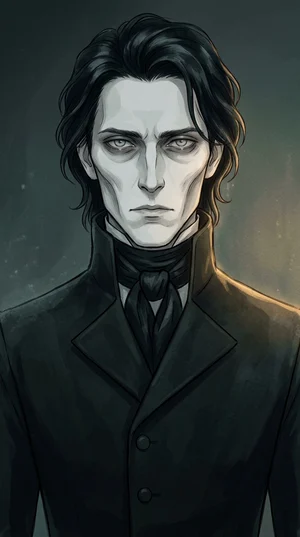
He came about halfway and stopped beside the tablet nearest the stair, and stood looking at her across twenty yards of flagstones and a great deal of dark. In the lantern light he looked worse than he had at the table. There were shadows under his cheekbones that had nothing to do with candles.
He looked at the cut letters until the brazier spat.
“His name was Matthias,” he said. “He had a red beard. He brought my mother a letter from my regiment saying I was dead. She was reading it when I came in at the door behind him.”
Hester set down her mallet.
“I had walked from the coast,” he said. “Six weeks. At night. I had not understood yet what I was. I thought I had a fever.” He looked down at the cut name. “You have made him very clear.”
“That’s the job.”
“Yes.” He was quiet. “Read me the next one.”
So she read him the next one. Ann Reay, who did not scream. And he told her that Ann Reay had kept bees on the south side of Blackfell and sold the honey at Cold Ashby market, and that for a hundred years afterward there had been wild bees in the wall of the long gallery, and he had never had them smoked out.
She read him the third, and he told her about the third.
It went on like that. She did not cut any more. She read, and he answered from the dark, and his voice was the same courteous voice, unhurried, and every story ended with the same thing: a person in a room, and the room, and him. He did not make himself sound terrible and he did not make himself sound sorry. He made them sound like people. That was the worst of it.
At some point she realized she had sat down on the step of the trestle with the list in her lap and her hands under her arms for warmth, and he had sat down too, on the floor against the far wall, with his knees drawn up, like a boy who had been told to wait outside a room.
“Why do you want them cut?” she said. “They’ve waited all this time.”
“The house keeps its dead until they are named.” He said it simply, as he might have said the house had damp in the west wing. “A name cut in stone lets them go. I have wanted to let them go for a very long time.”
“You could have done it yourself. You’ve had a while.”
“I have tried.” He held up his hands. They were long, white hands, and they did not tremble. “I cannot hold a chisel to a name I took. The letters come out like my mother’s.”
“Nobody’s letters come out like your mother’s,” Hester said, before she could stop herself. “That’s a gift.”
He laughed. It was short, and hoarse, as though it had not been used, and it went up into the vault and came back to them, and somewhere in the house above a bell began to ring.
It was the last bell. She knew it the way you know a death knock. Twelve strokes, slow, from somewhere high in the west tower.
“Miss Vane,” said Lord Severn, getting to his feet, “how fast can you climb a stair?”
“Rule two,” she said. “Abed by the last bell. What happens if I’m not?”
“The house walks.”
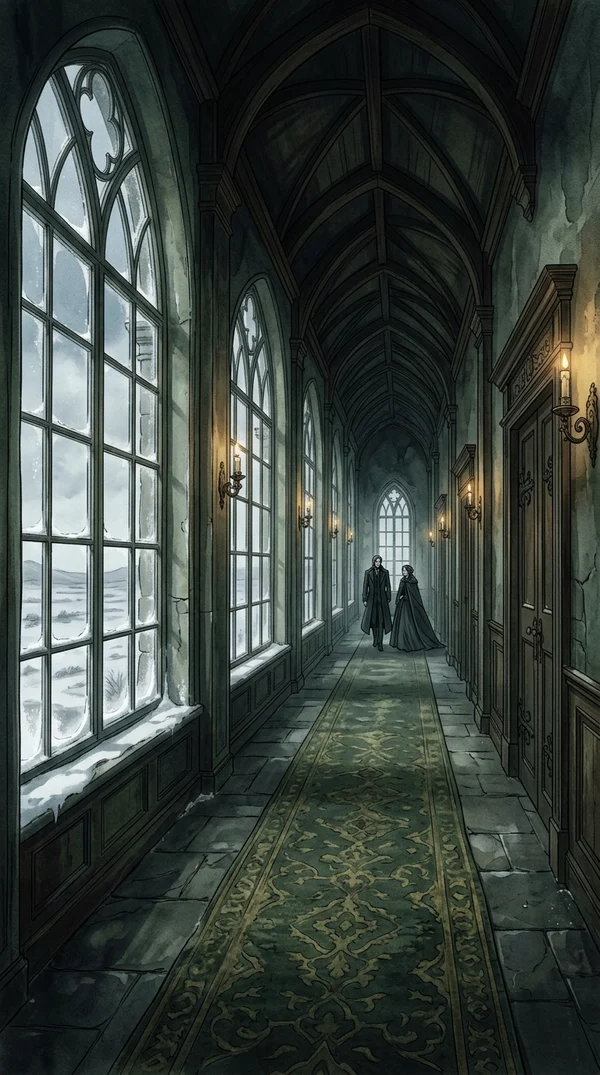
She took her lantern and climbed the stair fast, and at the top of it there was a corridor that had not been there that morning.
It was the same corridor, she told herself. The same floorboards, the same cold. But the door at its end, which that morning had opened onto the great stair, now opened onto another corridor, and that one turned left where it ought to have turned right, and when she went back, the crypt stair had become a cupboard full of linen.
She stood very still with her lantern. She was not a fanciful woman. She charged by the letter. She did not believe in houses that moved, and the house moved anyway, quietly, all around her, the way a sleeping dog shifts its weight. A door that had been on her left was on her right. A portrait-hook on a wall with no portrait swung gently, as though somebody had just walked past it.
“Do not run,” said his voice. “Turn round.”
She turned round. He was at the end of the corridor, with a candle in his hand, at least twenty feet away.
“I am going to walk in front of you,” he said. “Keep exactly this distance. Put your feet where I put mine. If you lose sight of my candle, stand still and say your name aloud, and I will come back.”
“You can’t just take my arm?”
The candle flame was perfectly steady. “No,” he said. “I can’t.”
So she followed him.
She followed him through corridors that unfolded and refolded around them like a letter being read and put away. He did not look back. He told her where to put her feet: there is a step down here; the third board creaks and the house dislikes it; turn now. His voice was very calm. Once a door opened beside her on a room full of moonlight and dust sheets and she smelled roses that had not grown in a hundred years, and he said, without turning, “Not that one,” and she shut it.
She could see his back, black against the candle. She could see the line of his shoulders under the coat, and the back of his neck where the dark hair lay against it, and his free hand, held a little away from his side, as though he were walking beside something he must not touch.
She kept the distance. Twenty feet. She had never in her life been so aware of twenty feet.
Her door came up out of the dark. He stopped well short of it and stood aside, against the far wall, to let her pass.
“Thank you,” she said.
“Turn the key.”
“You keep saying that.”
“I shall keep saying it.” The silver had come back into his eyes, just a little, at the edges. He was looking at her throat. She did not think he knew he was doing it. “Your heart is very loud, Miss Vane. Everything else in this house is quiet.”
She went in and turned the key.
Then she sat on the bed in her coat, by her candle, with the list still in her pocket, and because she could not sleep, and because she did not want to think about twenty feet, she took it out and read the last page.
The final name on the list was written more carefully than any of the others. The hand had pressed so hard that the nib had cut the paper in two places.
Lenora Bell, aged twenty-two. At the chapel step. Candlemas Eve, eleven years ago. I found her in the snow and I drank. Her mother keeps my house.
What did you think?