For ten days she cut, and he did not come down.
She cut faster than she had ever cut in her life. She cut the bravest fool, Absalom Pryce, and gave him a deep, square line that would hold its shadow for three hundred years. She cut the drover with the dog. She cut a girl named Patience Orrell who had been nineteen and a housemaid and the first of the dead to be written in a hand that was already sorry, and she cut her badly, the first bad letter she had cut since she was nine, and had to dress the face down a quarter inch and begin again.
Eighteen names. She counted them every night.
The house was very quiet without him. That was the strange thing. She had not known how much of the creak and shift of it had been him, moving about in the dark above her, until it stopped. Now Wintersend lay around her like a held breath. In the evenings she went into the library at dusk out of habit and sat in the twentieth chair, which was where she had got to, and looked at the chessboard at the halfway mark, where his queen still stood on the square where he had left her.
Mrs. Bell brought her dinner on a tray. Toby brought her tea. Neither of them said anything about the east tower, and she did not ask.
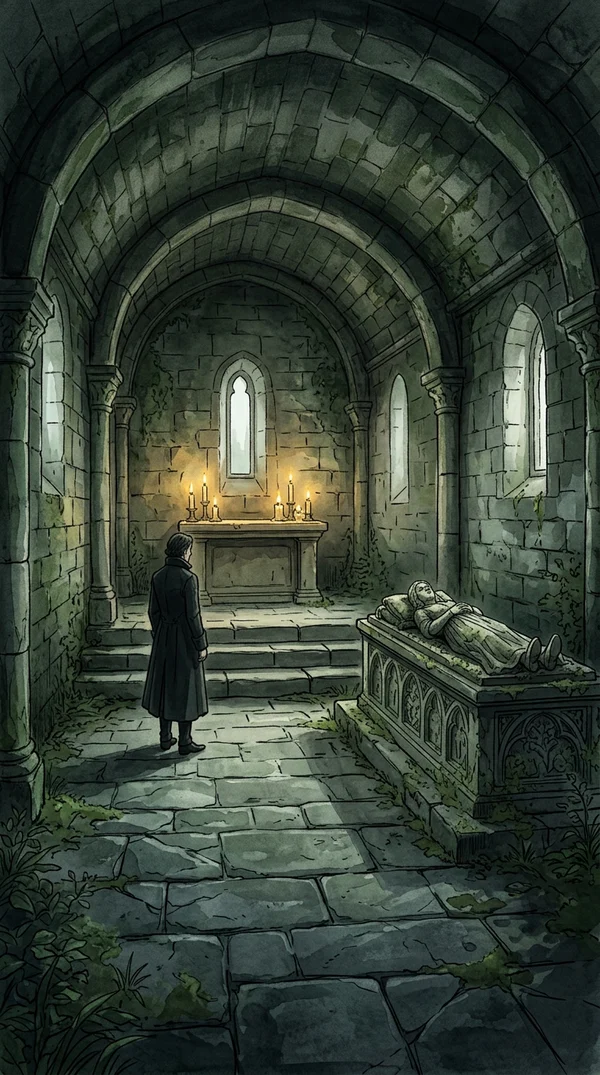
On the eleventh morning she went down to the crypt alone, early, before either of them was up, which she had promised not to do. She did it because she wanted, for one hour, not to be watched. She lit the brazier. She stood in the honest cold among the dead she had named and the dead she had not, and her eyes went, as they had a hundred times, to the slab under the holland sheet at the far end.
Not that one. Not yours.
She had been told. She had kept the rule.
She went down the crypt and took hold of the corner of the sheet and pulled it off.
It was a slab of the same Blackfell gritstone as the others, but larger, the size of a door, and lying flat on its trestles the way a stone lies when it is waiting to be laid over a grave. It had been dressed with more care than any of the tablets in the walls. Somebody had spent days on it. The face was as smooth as a still pond, and there was not a mark on it anywhere.
On top of it, weighted at one corner by a chisel she recognized as one of her own, was a sheet of paper folded in three.
She knew the hand before she unfolded it. The long s, the bell-rope g.
Ambrose Severn.
And under that, in the same hand, a little smaller:
Leave the dates. Nobody will know them.
She did not remember climbing the stair. She remembered the kitchen, and Toby at the table cleaning tack, looking up with his easy face, and her own voice saying, “Is it his? The stone under the sheet. Is it for him?”
Toby set down the bridle.
“Ah,” he said. “You weren’t supposed to look at that.”
“Toby.”
“Sit down, Miss Vane. You’ve gone the color of the wall.” He pulled out a chair for her and she did not sit in it. He sighed. “All right. It’s his. Everyone in Cold Ashby knows the old story. My gran used to tell it. They can go a long time without, his kind, years and years, but not forever, and not through a spring. When the thaw comes, when the beck runs, everything on the moor wakes up hungry. Every root and every badger and every lamb. And a starved one wakes up the same, only worse.” He picked up a rag and turned it in his hands. “A starved one at the thaw either feeds or burns. That’s what my gran said.”
“Burns.”
“Goes out in the sun.” Toby did not look at her. “He’s been starving eleven years, Miss Vane. He’s picked his spring. He told Mrs. Bell and me at Michaelmas. Had a lawyer up from Cold Ashby last summer to see to the will; the house goes to the two of us, share and share.” He shrugged, not unkindly. “You were wondering why he wanted his dead all named by the thaw. That’s why. He wants it tidy before he goes.”
Hester looked at him.
“He hired me to cut his gravestone,” she said.
“He hired you to cut forty-one gravestones,” said Toby gently. “The forty-second’s a gift.”
The east tower door was at the top of a stair she had never climbed. It was black oak with an iron ring, and when she put her hand flat on it, it was cold. So cold her palm stuck for a moment, the way a wet hand sticks to iron in January. There was frost on the inside of the keyhole.
“Lord Severn,” she said.
Nothing.
“I’ve been in the crypt. I’ve taken the sheet off. I’m sorry. I’ve never been sorry I broke a rule in this house before, so you can have that one for nothing.”
Nothing. But she thought, on the other side of the oak, something moved.
“Toby told me about the thaw,” she said. “He told me about the sun. I’d like to hear it from you, if it’s all the same, because Toby’s gran also told him a man could cure warts by burying a potato, and I’d like to know which kind of story this is.”

 100 to start reading with.
What did you think?