Five Fifty, chapter 1 of Kept in the Lighthouse
The ice house key hung on hook nine, and the sheet hung under it on a bulldog clip. At 05:38 on a Tuesday in November I wrote my name next to the number and the hour, in the office hand, and took the key down.
The Two Sisters wanted her bait at six. My brother Aaron was on her, and Aaron has never signed for anything in his life. So it was me on the pier in the dark, in my mother’s boots, under the co-op’s one outside light. It lit the bollards and nothing else, and it lit them badly.
My father left when I was nine and has been a postcard at Christmas ever since. I have filled in every form in Vellick properly since then, so nobody has to look twice at a Rune. That was all I really wanted from the harbor: just a paper in my hand, taken as true. My mother’s rule was there too, in the hour. Don’t walk the pier in the dark. That morning she was not there to say it.
There was a van on the pier with its lights off. Vans on that pier at that hour keep their lights on, or they end up in the bollards. So who was sitting out there in the dark, and why didn’t he want to be seen?
Then a voice I knew spoke a name, quietly, like an answer.
“Tad.”
Two shots. Flat and small, like a pair of hands clapping at the far end of a shed, and nothing after them. The key’s tag went cold in my fist, and my breath stopped somewhere under my ribs. Fuck. That was all my head had in it, one word, and not an office word.
A man came down between the bollards with his coat open and a book inside it. He got four steps. The book came out and he went down on his knees, then on his side, and his hat rolled and stopped against the ice house step. It was Tad Spargo, the co-op’s fuel clerk, and the book was the co-op’s day book. He had a pen clipped to his coat, ready for a meeting.
Nevin Kell walked out from behind the van with the gun down by his leg. He stood over Spargo the way a man stands over a job he’s finished.
Then he turned his head along the pier and found me. “Morning, Nia.”
My head did the right thing, late. Call somebody. Call who? The county’s deputy for Vellick is Obed Chalk, Fenella Kell’s nephew, whose boat had lain alongside Kell’s fuel dock twice that week. His number was on a card in the office drawer, behind a locked door.
There was blood on the ice house step, and Spargo’s hand lay open on the flags, the skin of it already gone the gray of a cold mantle.
Kell put the gun in his coat and came over and did the things a man does, quite calmly. Was I all right? Spargo had come at him over the fuel account. “You’re white as a gull — sit down.” His hand settled on my shoulder, warm and perfectly steady, the hand of a man in every photograph of that harbor. I’d just watched that hand shoot a man. I wanted to scream it into his face, and I sat on the bollard where he put me.
The pier filled up. Emlyn Gobie came first, in his longshoreman’s apron with his boots half on, and somebody behind him up at the co-op door was shouting Christ! Oh, Christ! at nobody. Dunc Chalk sat in the van’s seat with the door open, and his face was the worst face there, white and young.
At the back, by the diesel filler, a man stood with a drum of kerosene on a hand truck. He had come for his oil at six and stopped dead where he was. Both his hands lay flat on the drum’s lid, very still, the knuckles split and dark, and my throat went tight and stayed tight. The whole harbor knew him by his boat and his drum: Lorne Hobie, the keeper off Sallow Point, who came in for oil and spoke to nobody. His eyes went once to the van and once to me, and then to nothing at all.
The ambulance came quickly, at ten past six, with the siren going for nobody. Somebody put the co-op’s kettle on, because somebody always does.
That is what a harbor does at a killing. It makes tea, and it gets the ice out.
The board met on the pier at twenty past seven. Osgood Cusk’s view, on the telephone at six, was that a board that waits is a board being managed.
Forty people. The fleet stood at the back in its oilskins, and the keeper stood behind the fleet with his drum. Cusk took the chair, which was a fish box with a cushion on it. Perla Noyce sat beside him with the office ledger open on her forearm.
Noyce is the harbor master, fifty-eight, with a hand like a door latch, and she taught me the columns at seventeen. She gave me one glance before we started, the glance of a woman doing sums behind her own eyes.
“Right.” Cusk put his hands on his knees. “The clerk’s got something to say, and then we’ll have it out of the way.”
I gave it exactly as I had given it to him at six. The times first, because the times were the only part I was sure of. 05:50, or two minutes either side. Two shots from behind the bollards. Mr. Spargo down. Mr. Kell’s van with its lights off.
Cusk listened with his hands flat on the fish box. “Perla. The sheet.”
Noyce turned the ledger round so the pier could see it and put her finger on the line. “Office copy says 04:38.”
“Four thirty-eight.” Cusk let it stand, the way you let a figure stand in a column to see who argues.
The pier made the noise a pier makes. He waited for it to stop.
“Four thirty-eight is an hour before. A clerk who took that key at four thirty-eight was gone before there was a soul on this pier. So a clerk with it in her fist at ten to six has had a shock and muddled her hours — and no harm in that. Then we can all go and have our breakfast.”
I stood there with the key in my fist and my mouth open. “I wrote five.”
“You wrote what the office says, girl, and that’s nothing to be ashamed of.” Cusk was not unkind. That was the trouble with it. “Four thirty-eight’s in the ledger in the office hand, and the ledger doesn’t tell lies.”
“I wrote five! It’s on the hook sheet, out there on the clip.”
“Then fetch it. We’ll see it, and then we’ll have our breakfast.”
Dunc Chalk went quickly. He passed me without meeting my eyes and came back with the sheet, and he did not let go of it until Cusk took it.
Cusk held it out at arm’s length and turned it to the light. He turned it again, and his thumb moved slowly over the number.
“Perla. Come and see this.”
Noyce came round the box, and her eyes went to the sheet, then to me. Her jaw worked once on the left side, the side she chews on. “Four thirty-eight.” But she said it slowly.
I got across the pier and put my hand under Cusk’s and turned the paper to the co-op light, like a column that will not add.
It said 04:38. It said it in my own hand — my N, my R, my four figures and my two — and it was wrong. There had been a five on that sheet when I hung it back under the hook. There was a four on it now, in my hand. How? How the hell was it a four?
I wanted them to believe a five. I wanted it so badly my teeth hurt, and I pressed my lips shut on whatever was coming up behind them. Every one of them already had their breakfast in mind.
“Give it here.” Cusk held on a second. “Board’ll want that.”
“Board can have it Friday.” I took it out of his hand, folded it once and put it in the inside of my coat. Forty people on that pier watched me do it, and Dunc Chalk’s ears went red. Was I shaking? Of course I was. Was I giving it back? Like hell.
At the back, past the oilskins, the keeper’s head came up off his drum.
They went through the rest of it while I stood there.
Mr. Kell gave his account plainly, his hat on his knee. He had been at the fuel dock since a quarter past five, seeing forty gallons into the Ada Chalk, and Dunc had the slip for it. Spargo had come down about the fuel account, and they had had words. Spargo had put his hand in his coat in the dark. The gun was in the van, and it had gone off twice.
Nobody asked whether Spargo had a gun on him. Then Emlyn Gobie did.
Kell turned his hat over on his knee. “He had the day book. He was going to wave it at me.”
Somebody laughed at the back. It was true and it was funny, and those two together do a lot for a man.
“Where’s the day book now?” Emlyn’s voice was mild. It was not on the flags and not in the ice house, and Dunc had not seen it. Emlyn studied the blood on the step for a while, then Kell, and then he sat down.
Cusk got up off the fish box. “Right. Board’s view is that the clerk saw a man shot and had the fright of her life, and she’s one hour out in the times. That’s no reflection. Perla’ll take a written statement off her Friday, and the board’s satisfied the pier was in order.”
“I saw it.”
Nobody claimed I hadn’t. They just didn’t need me to have. That was the worst of the morning. The board was satisfied, the kettle was on, and there was ice to get out.
Kell stood and put his hat on, and finished it.
“She’ll want looking after, the week.” He turned it to Noyce, warm as a stove. “There’s counter work at the chandlery while this settles, out of the weather. And she can have the van home.”
“That’s decent of you, Nevin.”
“Decency’s for Sundays. This is a Tuesday.” The pier laughed, and he turned to me with the hat on. “Come on, girl. Throw the key in and I’ll run you up.”
The key. Four hundred pounds of herring in the ice house, Aaron on the Two Sisters waiting for his bait, and the whole pier had forgotten the fucking key.
I threw it in at the ice house door. It landed on the step in the wet where Spargo’s hand had been.
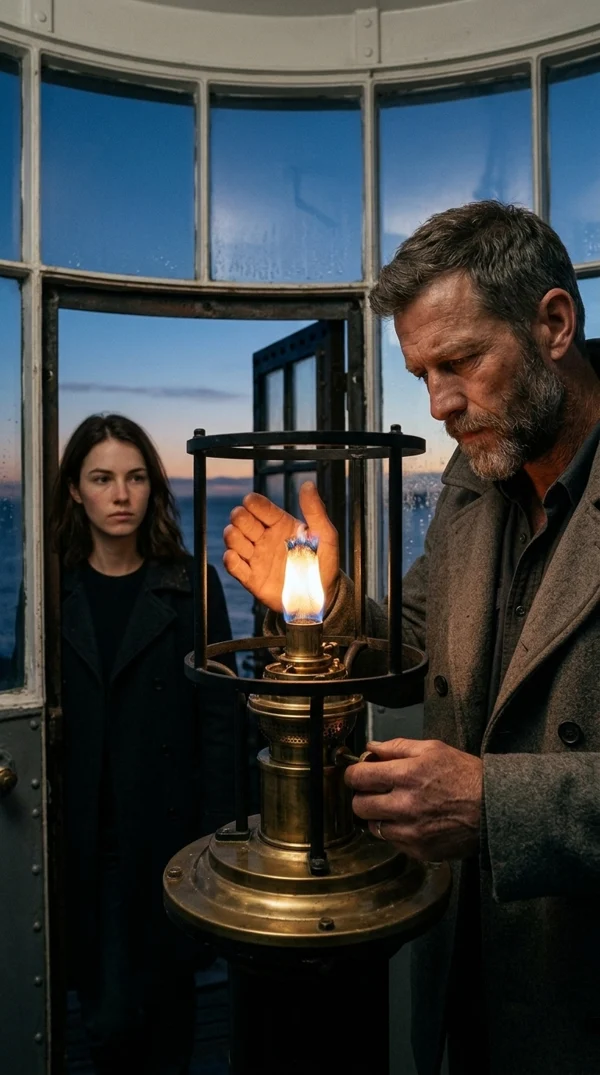
The keeper came down the pier then with his hand truck. Coat the color of a wet stone, eyes near enough the same, beard gone gray at the jaw, forty-four or thereabouts. Up close his hands were worse than I’d thought, burned across the knuckles, the skin there shiny and pulled tight, and my breath went short for no reason I had a column for.
He did not look at Kell. “She’ll come up the point with me.”
Kell’s hat tipped a quarter of an inch. “For how long, Lorne?”
“Till the board’s put the dates straight. That’s February.”
“That’s eleven weeks.”
“That’s what it is.”
Cusk spoke in the voice of a man taking inventory. “She’s got a job offered and a mother in town.”
“She can have them both. I’ve got a telephone.”
Nobody argued with him, not even Noyce, who had just put four thirty-eight in front of forty people. His family has kept the light on Sallow Point since 1859, and not one of them has ever sat on a committee.
He took an oilskin off the handle of the truck, his own spare, and held it out and simply waited. What was I going to do instead? Stand behind Kell’s counter and sell him his own rope?
I took in the pier one last time. Dunc Chalk with his ears red. Emlyn Gobie’s apron. Spargo’s hat against the step.
“Tell my mother,” I said to Noyce.
“I’ll tell her.”
I put the oilskin on. It smelled of kerosene and cold and of him. In my coat the sheet said four thirty-eight, in my own hand, and I walked down to the slip behind his hand truck in my mother’s boots.
Kell came to the edge of the pier above us, his hands loosely in his pockets. “She’ll be all right, Lorne.”
Lorne bent to the chain on his boat and did not look up. “She’s mine to keep till this is done.”
What did you think?