Terms, chapter 3 of Kept in the Lighthouse
I had counted the flash at the loft window to past two hundred before I slept. He had me up at six to put the light out. It took four minutes, and I got the glass wrong.
“You’ve got your fingers on it.”
“You said don’t put the wick past the line. You never said about the glass.”
“I did say about the glass.” He took my wrist, lifted my hand off and set it back flat against nothing. “Half an hour before you light it, and again in the morning, the inside of the glass gets done. Fingers on a cold lamp leave a mark. A mark makes a shadow, and a shadow’s a bad light.”
He showed me the cloth and the inside of the glass, and how to put the hand in through the frame so the shoulder follows and the elbow stays down. “Now you.”
I did it badly. He watched patiently and did not say so. Was there one thing on this point I was going to get right the first time? Then he just took the glass out and did it himself and put it back, and spun the frame and put the lamp out. The sun came up over the Bell Rock — orange and low and brief — and the sea was the color of a knife.
The work of a light is all in the order of it, and the order is short, with no room in it.
Reservoir filled from the brass pot, and the pot filled after from the pump, and the pump’s handle wiped. Mantle tested on the spare stem. Wick trimmed to the line with the little shears. Glass, inside and out, the outside from the gallery with the rail at your hip. Oil in the pot for the night. The weight cranked at the half hour. The bell’s spring wound every twenty minutes in fog, and once a watch in clear weather to keep it honest. The log at the lighting and the log at the putting out, and the weather in between. The pump’s leathers. The brass. The floor.
At nine he took his coat off to do the brass. I was on the floor with the broom, and he stopped and watched me for a minute. “You’re holding that like a pen.”
“It’s a broom.” I had been sweeping floors since I could hold a broom, thank you.
“It’s a brush, and you’re holding it like a pen. Get your hands round it and stand back off the head.” He took it and swept four strokes, and the dust came away neatly in a line instead of a cloud. “Like that. Long, not hard.”
I took it back and did it long and not hard, carefully, and it came away in a line.
“Good.” He went back to the brass, and that was all of it.
It is a small word, just the one syllable, and I did the floor twice more to see if it would come again. It didn’t, which is how I learned that twice would make it worth less. Was I really sweeping a floor three times over for a man’s good? I was. God help me, I was.
The kettle lives on the bench by the sink, and the bench is narrow. At half past ten I filled it and turned too quickly, and the spout went over my right wrist. Boiling water ran down inside my cuff and into my boot.
I said shit! loud enough to ring the tower, and he was up from the table with my cuff pushed back and my arm under the cold tap before I had finished saying it. He held it there with his hand round the thin of my wrist. The water came off the spout and over the both of us, and he did not care. “Two minutes. It’s the second minute that matters.”
“Two minutes of this is a pint of water up my sleeve!”
“Then it’s a pint of water up your sleeve.”
He held it for the full two minutes. I stood with my arm in the sink and my shoulder against his chest, the clock ticking and his breath going steadily in my hair. At the end of it he turned the tap off, dried my wrist carefully with the dish towel and studied the burn. It was a red bar the width of the spout across the inside of my wrist, the skin already tight and shining. “Vaseline in the tin on the shelf. Not butter. Everybody puts butter on.”
“Is that what happened to your hands?”
He turned his own hands over. They were a road map of small burns, with one old white line across the palm and the nails flat as coins. “Bit of it.”
At noon he set the receipt pad on the table: the oil man’s pad, four sheets thick with the carbon still in it, the top sheet carrying the morning’s pump figure in his hand. He laid a pencil beside it. “There’s a week’s oil coming Friday, and you’ll want to know what the figures are for.”
My eyes went to the pad, then to him, then back to the pad.
I had been on that point one night. What did I have of my own? A bed he had made up, a towel, a coat hook and a broom. He had been decent to me at half past ten without being asked, and it had done something to the inside of my chest that I had not given him leave to do.
But he had everything else. He had the boat’s chain and the phone’s rings and the stair at dark, the light’s going on, the food and the door. I had a burned wrist and a coat. Call it what you fucking liked, it was a kidnapping with a kettle in it.
I turned the receipt over, deliberately, with the pencil still in my other hand.
He put his finger on the pump figure through the paper. “You’ll want it written down properly.”
I put my palm flat over the paper. “Not the figures. Not yet.”
I wrote on the back in the office hand, because the office hand is the only hand I have ever been exact in. My wrist stung under the gauze the whole time.
1. I keep the tower log. Same book, my columns, from tonight.
2. I have the store room key.
3. The mail boat Thursdays and nobody at the landing with me.
4. You don’t tell me your side until I ask in my own time, and till then you don’t tell me a lie either.
He read it twice. He is a slow reader and he does not pretend otherwise. “Four’s the hard one.”
“It’s the only one that’s free.”
“You’ll have me on the paper and off it.”
“That’s it exactly.” Did he think I’d sign for less, after a pier like that?
He took the pencil and signed it L. Hobie at the bottom, the way a man signs for a delivery. “Store key’s on the hook. The log’s on the shelf and the pencil’s on the string. Weather goes in the right column.”
Then I took the spare outboard key off the hook by the door.
It hung on a bit of tarred twine with a cotter pin through it. It had been there long enough to leave a clean shape on the hook. I put it in my coat pocket and buttoned the flap down firmly.
He watched me do it. “That’s the boat.”
“That’s the boat.”
“And if I want it?”
“Then you’ll ask me. That’s what the other end of a treaty looks like.”
He put his hands in his pockets. His eyes went to the door and back to me, and he did not smile, but his jaw came forward a quarter of an inch and stayed there. That is his version of it. “You’ve got the light.”
“You’ve got the agreements. I’ve got the key. That’s the whole of the treaty.”
The rest of the day was the day. Glass at three. Mantles counted, gallery rail wiped, store room tidied, pump’s leathers checked. At half past three he cranked, and I counted the weight with him out loud and got eight the first time, and he corrected me gently. “Nine.” I said nine, and he did nine.
At half past four I lit it, finally, myself. He stood behind me with his hands at his sides and did not take the taper off me once. The five minutes went by with the two of us in the glass room, the sea going dark and the flash going out and coming back off the Bell Rock. My hands were barely steady, and I didn’t take my eyes off the ring. He did not mention my hands. He just let me have it.
“It’s took. Put the wick back two notches and write it.”
I wrote it. wind SW 3, sea 1, lamp 16:31, weight 15:44, mantle new.
Then in the passage, with the log shut and the pencil back on its string, he turned. “One more before the night. We’ll do it now, while it’s light.”
“One more what?”
“A stop word. For whatever happens between us, or doesn’t.”
I had not got that far — only as far as the terms and the key, and the way he had held my wrist under the tap. Or doesn’t. Fuck. My pulse went up into my throat and stayed there. “Go on.”
“You pick it. Not a word we say for anything else. Not a color. Something you’d hear in a bad minute. You say it and I stop where I am, and I don’t ask why till after.”
The bell was in its box on the store room wall, with its handle and its spring. On that point the bell means look out. It is what goes when there is something in the water. “Bell.”
“Bell.” He repeated it flatly, the way he gives a wind direction.
“Say it back properly.”
“Bell.” This time it was to me, in the passage, and the word went into the stone floor and stayed there.
That night he cranked at six and half past eight and eleven. At eleven he was a long time up. I went to the foot of the stairs in my socks, very quietly, and he was just sitting on the third tread from the top, elbows on his knees, doing nothing at all.
“All right?” I kept my voice low, because the stone carries it.
“All right.”
I went up and sat on the tread below him. The stair is narrow enough that our knees were in each other’s way, and his was warm through the cloth.
“Why are you sitting here?” It came out sharper than I meant it.
“Because at the bottom of the stairs there’s the passage and the door and the light coming through the window. If I go down, I’ll be in it.”
“In what?”
“The house.” We sat there a while, saying nothing. The cable ticked in the drum behind us. “Half past one. Then four.”
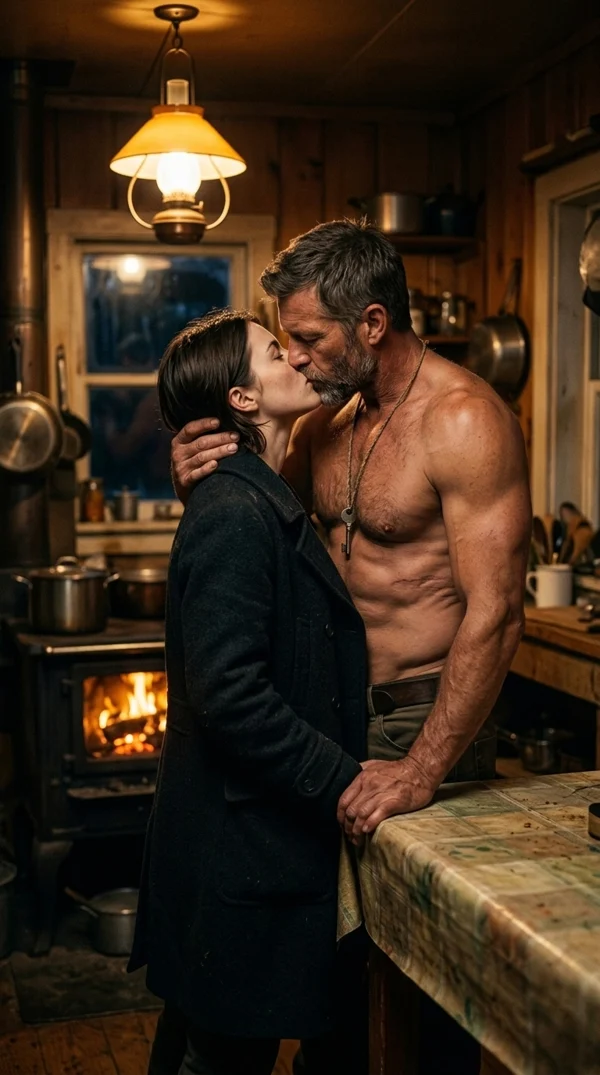
“Half past one.” I got up, and he got up after me and went down past me on the stair, close, his hand flat on the wall for the turn and his breath on my cheek for one tread, near enough my lips that I forgot to breathe. At the bottom he stopped with his hand still on the wall.
“Goodnight, Nia Rune.”
He went into the passage, and the door shut behind him. I said it to the door anyway.
“Goodnight, Lorne.”
What did you think?