The fog came in at five, and by half past five you could not see the Bell Rock from the gallery. I crossed the twentieth off the calendar at half past five, seventy-four left, and then the radio came on with the fog in the forecast. There was no more of the morning for anything else.
The forecast at twenty past five gave fog banks, dense in the approaches, lifting by the afternoon. Wind variable two or three, sea one. Lorne had the radio on the table. He wrote FG in the weather column and sat with the pencil in his hand, his eyes on the window and nothing in it.
“Fog’s the worst of it. Not the wind. The wind you can hear.”
He took me through and showed me the striker properly. It is a box on the store room wall, with a handle like a fire pump’s, a brass hammer on a spring and a weight on a ratchet. When he pulled the handle, the hammer went over and hit the bell. The note went out across the water and came back off the point like a hand clapping in a barn.
Twenty minutes on the ratchet. Twenty minutes, and the weight is down, and it winds again from the top.
“You do it on the twenty. Not nineteen and not twenty-two. The boats count the gaps.”
“And if I’m late?”
“Then a man counting gaps will think the bell’s stopped. The next thing he’ll do is come in on where he thinks it was — and it won’t be where it was.”
It was the longest morning of my life, and nothing in it but a handle. Just a handle and a bell, honestly, and my own two arms.
Twenty past six, twenty to seven, seven, twenty past, twenty to eight. The bell went out, and the fog took it roughly four hundred yards off and gave it back wrong. Once a boat’s engine came through the murk, close, and went slowly away north. By half past eight my shoulder had a hot wire in it. By nine I was pulling with the whole of my back and getting the ratchet over with a grunt, my shirt stuck cold to my spine. Who builds a light with a bell you have to pull by hand? Nobody I could complain to, that was who.
He worked the lamp behind me and left me to the bell, the way you leave a person to a job they have promised. Every twenty minutes he came to the top of the store room steps, checked the ratchet with one glance and went quietly away again.
At twenty past nine I got it wrong. I pulled too far, and the hammer went over twice, and the bell said clang-clang in half a beat. I stood there with my hand on the shaft and my heart slamming. Oh, fuck.
Lorne was at the top of the store room steps with the oil pot in his hand. “That’s a double.”
“I know it’s a double!”
“A double on a bell’s a different signal. There’s a boat out there counting three and one, and you’ve just given it three and one and one.”
“Then tell me how not to.”
He came down the steps and set the oil pot carefully on the shelf. Then he came round behind me and put his hand flat on the back of mine on the shaft. His chest was close at my shoulder blade, not quite touching.
“The ratchet does it. The handle only follows. Get your hand down here and pull it to the click. Stop at the click, and let it go.”
He moved my hand down the shaft to the ratchet’s own lever. His hand was warm on the skin of mine, and the shaft was not. My breath caught in my throat, and I badly hoped he had not heard it.
“To the click. Try it.”
I did it to the click. The bell went out once, clean, and came back off the point.
“Again.”
I did it four more times and got it exactly right four times. He took his hand off, went up the steps for the oil and carried on with the lamp. The back of my hand stayed warm for a long time after. Just my hand. It was ridiculous.
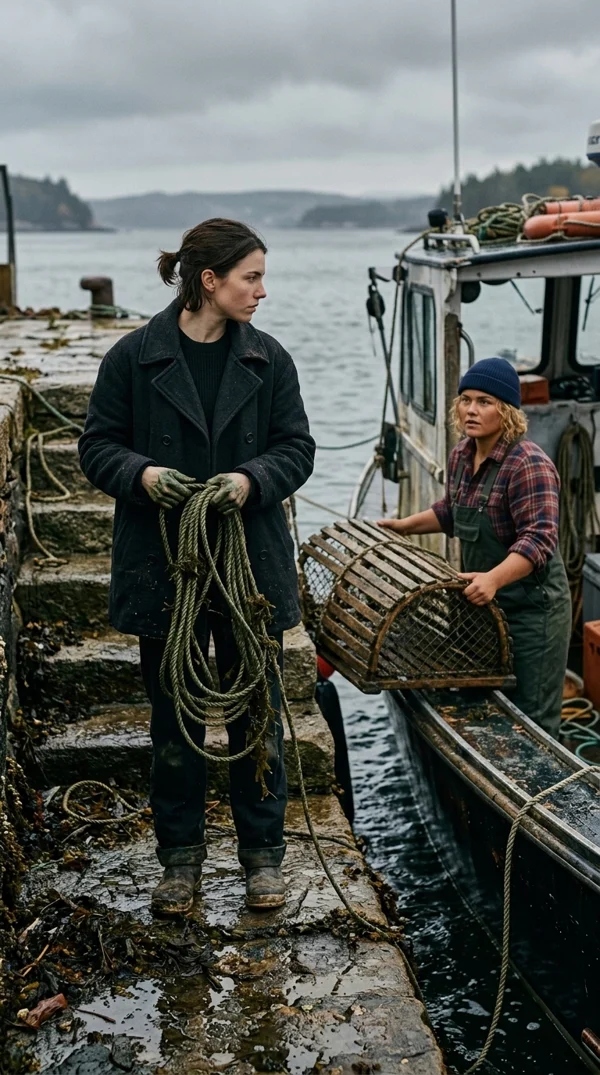
At ten past ten the Bellwether came out of the fog with her engine going slow and her bow up on the swell. Juna was in the bows with a line, her mouth open in a shout I could barely hear: Nia! Get the line!
She had a bag of bread and the mail sack and Noyce’s letter. Her father was on the gear off the point and had brought her out on the way. He would bring her out again tomorrow, because the point’s string had to come up, and she was not going to be dropped ashore on her own for it.
She came up the path with the sack on her shoulder and her hat pushed back, and stood dripping in the kitchen. “You look like something the tide left.”
“Good morning to you too.”
“Don’t start. I’ve been out in this an hour with my father telling me the whole way that nobody with any sense is out in this shit.” She dropped the sack. “He’s not wrong.”
“Did he bring you?”
“He brought me because my mother made him, and he’ll be wanting the fare off you.”
Her eyes went over the two cups and the coats on the hooks, and she made a face I could not read. “Where is he?”
“Up the lamp.” It came out like a wife saying down the shed, and I could have bitten my own tongue off.
Juna sat down at the table and put her chin in her hand. “The whole harbor’s talking about you and the light. Well — about you, mostly.” Dunc Chalk had been in the co-op telling everybody I was early and rattled. Half of them believed him, because he had a face like a drowned pup and they were sorry for him.

 100 to start reading with.
What did you think?