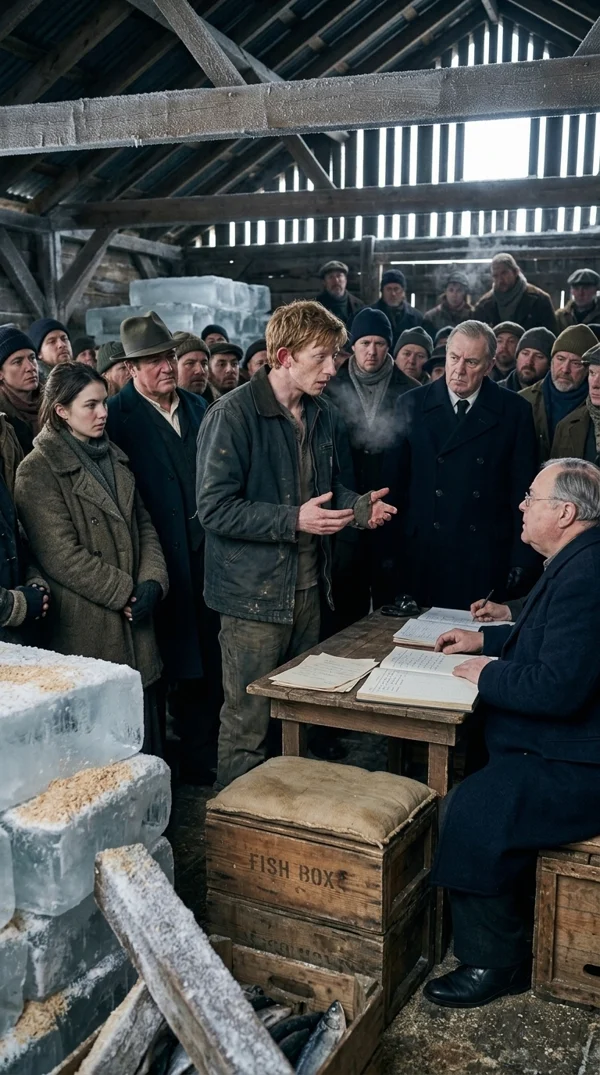
Twelve days. We swept the ice house from six in the morning and put the five trestles up on their ends. There was a cloth over the lot and a pitcher at the end of each. Sada and Aaron did the trestles, I did the floor, and Lorne did the bracket light.
The ice house is roughly thirty foot by eighteen, with a drain down the middle of the floor. The smell never leaves it, whatever you do, and it sat in the back of my throat all morning: brine and old cod and wet concrete. We hung a bit of tarpaulin over the fish box and put the fish box at the end for the chair.
A board needed a clock, according to Sada, and there was no clock, so she took her watch off. Aaron wanted it on the trestle and not on her wrist, because a board would want to see the time it was being given. Sada tapped the watch face at him. “And the pitchers filled and the floor done at seven, not at half past. And be sitting down before Cusk’s in his chair, not after.”
“Then it’s done at seven, and it’s all done at seven.” I pushed the broom hard at the drain. “And the two of you’ll have a cup of tea at seven and not before.”
The fleet came from eight.
Emlyn Gobie came first, with his bad hand in his pocket and his good one out. He read the seventh page carefully and signed the bottom of it, and put the date and the hour himself, and stood back. There were four behind him, he warned. Two would want to read the whole batch and two would want to be told where to sign, and neither lot would want to be first in the door.
They could come in twos, then. They’d come in twos, he agreed. He went out and stood squarely at the door with his back to it, and stayed there all morning. That’s what a man does when he’s decided to be a wall.
By ten there were nine skippers on the pages and a line of two on the step. The ones still inside reading were the slow ones, and the slow ones were the ones that counted. Aaron stood at the end of the trestle with the pen held patiently out for a man with a bad hand. He didn’t once open his mouth. Was this the same brother who’d talked through every supper of my life? It was. I could’ve kissed him.
At half past ten a man called Rogerson came in and read four pages and put the pen down. “I’ll sign if there’s no writing in it.”
“There’s the date and the hour.”
“That’s figures.”
“Then it’s figures, and your name’s letters, and that’s the lot.” I turned the sheet round to him. He’d not be signing a sentence or a paragraph, I promised him. There was nothing in it but a number and a boat, the gallons billed and the gallons drawn, and read and true as to the hour.
Rogerson read it again, slowly, his lips moving on the figures, and signed. He signed small and neat, with the pen in his fist. That made ten. How many more were there in a harbor this size? Not many. It would just have to be enough.
Fenella Kell came at a quarter to twelve, on her own, in the van. My heart just about stopped. What did she want? What could she possibly want here? The line on the step in front of her was three men. She stood behind it in her coat like a member of the public, which is what she is now.
She came in with her bag over her arm and stood at the end of the trestle. Her eyes went over the five trestles and the cloths and the pitchers and the tarpaulin, the shape of a board’s room made in an ice house. “You’ve done it properly.”
“Sada did the trestles.” It came out of me in a croak. My mouth had gone dry as a bait bag.
“Then Sada’s done it properly.” She put her bag down. Was that praise? Off Fenella Kell, it was practically a parade. “I’ll have the counter’s line on the sheet before I put my name to anything.”
The counter’s line? She explained it the way you’d explain a tide to a child. The counter writes the ticket, and the ticket’s got the counter’s number on it, and the number’s in the ticket book. The ticket book had the truck’s weights and the gallons drawn and the boat and the day. It was the only book in that shop that was ever honest. She got a pencil out of her bag. “The sheet wants the number on it if it’s got the ticket’s gallons. Give it here.”
She ruled a column neatly at the right-hand end of the page and headed it counter no. Then she went down the rows and wrote the numbers from memory. She has the counter’s numbers in her head the way I have the slips in mine, and each one took her barely four seconds. Jesus. Who knew she had all that in her head? Nobody, because nobody had ever thought to ask her.
At the bottom she put the pencil down deliberately and didn’t reach for the pen.
“You’ll not read it?”
“I’ve read it. I read it on the twelfth, and I read it in the night.” She put her initials at the head of her column, and the date and the hour, and nothing at the foot where the skippers were. “And put the plant in it somewhere before the twenty-second, or it’ll read as a girl’s arithmetic and not a harbor’s.”
The plant wasn’t on the pages. Then put it on a separate sheet, she came back, and let it be a harbor’s arithmetic. She picked her bag up. “Say it in your own words, and say it plain, and don’t say fraud at them. When Cusk says it’s not evidence, you say no, it’s a loss, and let the room work out who’s lost it.”
She went as far as the door, and stopped, and came back and put her hand out for the sheet.
“There’s a thing.”
“Say it.”
“It was 2023.” She kept her eyes on the sheet and not on me. Nevin had done it against the ice plant’s loan, and she’d done the books for it. Twenty-two thousand at the bank for the compressor, in his own name, because no bank would look at the co-op. And the short gallons to carry it, four hundred and more in a bad week. The plant had been on that loan ever since, and there were three years left of it. She let go of the sheet. “The gallons paid for the plant and the plant pays for the gallons, and not a dollar of it’s gone out of the harbor. That’s what he’ll say on the twenty-second. It’ll be true, and it’ll be the best of him.”

 100 to start reading with.
What did you think?