Moonrise, chapter 5 of Kill Me Before It Burns
Brask sent us to Hollin because nobody else remembered it was there.
“The old Aerie,” she said, packing bread and smoked fish into a sack at a speed that meant she’d been thinking about it all night. “When Vael died the Corona let it go to the goats. There’s vents under it, warm as a bath, and stalls built for hatchlings, if they haven’t fallen into the Gale by now. Lanterns won’t look there. Lanterns can’t look anywhere they haven’t been told about.”
“And you?” I said.
“I’ll be here, minding my business, where Coyle can watch me do it.” She tied off the sack. “Jory’ll take you and come back. Two days, we’ll come out with food and whatever news there is.” She looked past me at Idris, who was in the doorway with Grudge asleep inside his coat, because that was where Grudge now preferred to sleep. “You’ll look after her.”
It wasn’t a question. Idris met her eyes.
“Until the rite,” he said.
Brask held his look for a long breath. Then she turned and put the sack in my arms and said, “Go on, then,” in a voice that wasn’t quite steady, and went inside before I could ask her why.
Hollin is a day’s flight south and west of Lowmarrow, across the open sky where the isles thin out and there’s nothing to break the wind. Jory took us off the Hook before dawn and we flew all morning in a hard bright cold, the Gossip’s sail cracking like a whip and the three of us huddled in her belly under oilcloth. Idris was sick over the side twice.
“You fly every week,” I said.
“I fly in Crown ships.” He wiped his mouth. “Crown ships don’t do that thing where they drop.”
“Lift pockets,” Jory said cheerfully. “She loves a lift pocket. Wait till we get to the squall.”
“What squall?”
Jory pointed with his chin. Out to the west a wall of cloud stood up from the Gale like a cliff, black at the base and bruised violet on top, and as we watched, lightning walked across its face.
“We could go round,” said Idris.
“We could go round for six hours,” said Jory, “or through for one. Your Lanterns have got skiffs too, Breaker. I’d like to be somewhere else by dark.”
We went through.
I’d been in squalls before. You don’t grow up on Lowmarrow without learning to lie flat in the bottom of a boat while the sky tries to tear it open. But I’d never been in one with a dragon. Grudge woke when the first rain hit, put her head out of Idris’s coat and went rigid, every scale lifted. The bond went hot in my mouth, not fear, something sharper. Hunger.
“Hold her,” I said.
“I am holding her.”
The light went green. The rain came sideways and then upward, which it does near the Gale, great slapping sheets of it rising out of the dark below us. The Gossip bucked. Jory was laughing, which he does when he’s frightened, and fighting the tiller with his whole body. Thunder hit so close it wasn’t a sound, it was a blow to the chest.
Then lightning struck the mast.
There was a white crack, and a smell like hot coins, and every hair on my arms stood up. The top of the mast glowed orange. The sail was smoking. And Grudge went straight out of Idris’s coat and up the mast like a squirrel, through the rain, claws scrabbling on the wet wood, and wrapped herself round the burning tip of it and opened her mouth.
“Grudge!”
She was drinking it. I could see it. The orange glow went out of the wood and into her, down her throat, along her belly seams, until she was lit up from inside like a lantern with the shutter open. The bond hit me like hot wine. I gasped. Beside me Idris made a sound, and when I looked at him he had his hand pressed flat over his own heart, as if something had knocked there.
She climbed down when she’d finished. She climbed down slowly and dropped the last three feet into the boat, and she was bigger.
Not a little. A lot. She’d been cat-sized at breakfast. She was the size of a fox now, long-legged and gangly, her wings still folded but longer than my arm, her tail thick as my wrist. She sat in the bottom of the Gossip in two inches of rainwater and looked at us with her brass-coin eyes and waited for applause.
Then she sneezed, and a ring of smoke came out of her nose, and hung in the air, and broke up in the rain.
Nobody said anything. Jory, at the tiller, looked like a man who’d seen a god.
“That’s smoke,” Idris said at last.
“I can see it’s smoke.”
“That shouldn’t happen for a week.” He had gone pale under the rain. “First fire needs iron in the belly and heat, and it comes early on both. She’s eaten a cutlery drawer, a coal scuttle and a lightning strike.” He looked at me. “If she keeps on like this, she won’t wait two weeks.”
The squall broke round us into ragged cloud, and the sun came through it, low and gold, and I sat in the wet bottom of the boat and did the sums.
The rite would be when the Marshal said it would be. Before the rite, the Breaker would kill me, or try to, and offer Grudge the next heartbeat. But if Grudge fired first, there’d be nothing left to break. Killing me would kill the last dragon in the Ninefold. Nobody, not the Marshal, not the Crown, would be fool enough to do that.
If she fired first, I lived.
I looked at Idris. He was looking at me, and I saw him see me work it out. He didn’t say anything. He just turned and looked out at the cloud.
We flew the last hour in sunlight with the sail scorched black at the top and Grudge sprawled across both our laps, too big to fit on either one now, steaming gently as she dried.
“Can I ask you something?” I said.
“You will anyway.”
“Three years. Nine isles. Why did you never catch me?”
“I nearly did. Eleven times.”
“Twelve.”
“The twelfth didn’t count. You were in a bath-house.”
“It was a very good bath-house.” I’d taken a reliquary scale off a Lord’s mistress in a steam room on the Spindle, and gone out through the boiler flue, and the last thing I’d seen was the Breaker in his full black coat in a room full of steam and naked aldermen, looking murderous. “I lost my best pick down that flue. Tallow steel. I still miss it.”
He didn’t say anything to that. He looked at the dragon.
“You went red,” I said.
“I did not go red.”
“You went the colour of a boiled crab.”
“It was hot.”
“An alderman offered you a towel.”
“An alderman offered me his towel,” he said, with dignity. “While wearing nothing else. I’d like the distinction recorded.”
“I’ll have it carved on your tomb.”
“You’d sell the tomb.” He kept his eyes on Grudge. “I didn’t want to catch you, at the end.”
I turned my head. “What?”
“After the first year. I wanted to see your face.” He said it flatly, like a man reporting the weather. “I’d chased a coat and a pair of boots across every roof in the Ninefold. I wanted to know what you looked like when you weren’t running.”
The wind had dropped. The boat was very quiet.
“And?” I said.
“And you’re running,” he said, “all the time. Even sitting still.”
Jory, at the tiller, made a small noise, the noise of a pilot trying hard to become part of the boat.
Hollin came up out of the haze at dusk, a long green hump of an isle with a crown of grey ruins along its spine. Jory set us down in a meadow full of goats and handed out the sack and the oilcloth, and hugged me, and then, to Idris’s visible alarm, hugged Idris.
“Two days,” Jory said. “Don’t kill each other.”
“That’s the plan,” I said. “Eventually.”
He looked from me to Idris and back, and for once didn’t make a joke. He just squeezed my arm, and pushed off, and the Gossip went up into the last of the light with her black-topped sail.
Grudge watched the skiff go. Then she saw the goats.
She went after the nearest one in a long, gangling, delighted lope, all legs and tail, and the goat went over the meadow wall like a thrown stone, and Grudge came back a minute later looking enormously pleased with herself, with a dented iron goat bell in her mouth. She lay down at our feet and ate it. It clanked all the way down.
Idris watched it go. “That’s another hour off the clock,” he said quietly.
I didn’t answer. Neither of us needed me to.
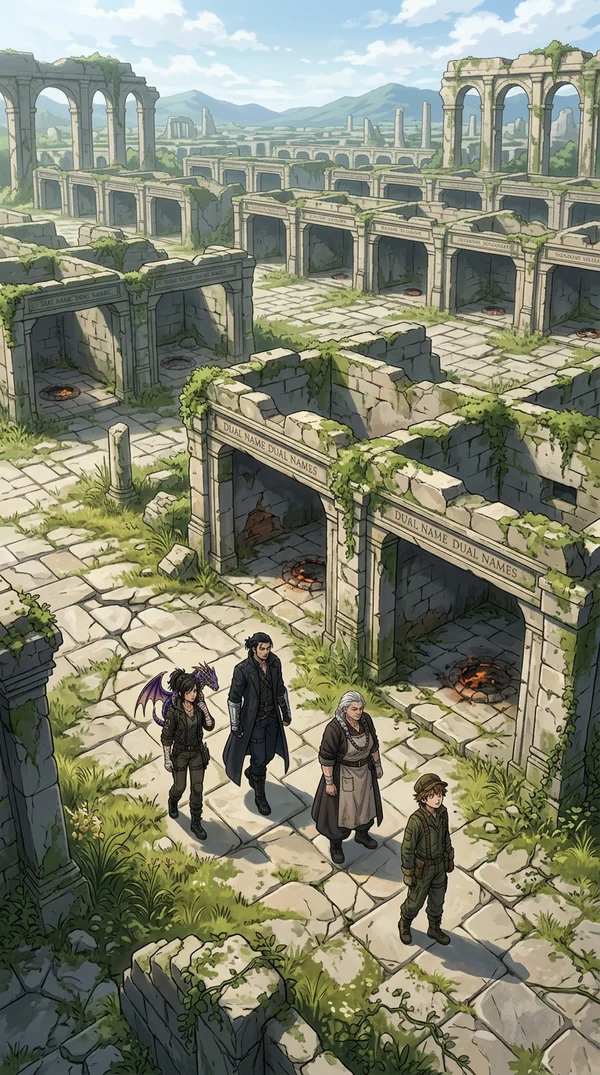
We climbed to the ruins in the dark. The Aerie was a great broken horseshoe of stone stalls around a courtyard, open to the sky, half the roofs gone. The air coming up through the cracks in the floor was warm and smelled of wet iron. Grudge went into the first stall she found, turned round three times on a floor that was warm as a hearth, and went to sleep with a sigh. We sat with our backs to the wall, close because there was no fire and the stone was warm only underneath, and ate Brask’s bread without talking much.
The moon came up over the eastern ruins, fat and yellow.
I felt it go. The Latch. It wasn’t dramatic. It was like a knot in my throat letting out a turn, the second heartbeat sinking deeper into me, steadier, as though it had decided to stop holding on so hard because it didn’t need to any more. Grudge stirred in her sleep and settled.
Beside me, Idris drew a breath. He felt it too. Of course he did.
Third moonrise. From now until first fire, he could kill me and she’d live.
Neither of us said it. I lay down on the warm floor with my back to him, and Brask’s oilcloth over me, and I listened to him not move, and went on listening, and then I slept, because I’d been awake for most of three days and my body didn’t care who was watching it.
I woke at midnight. The moon was high and white.
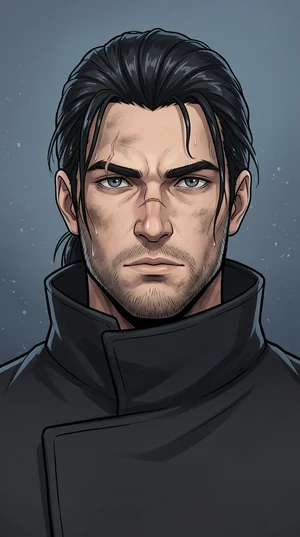
He was sitting where I’d left him, back against the stall wall, awake. Across his knees lay a short knife I hadn’t seen before, with a horn handle worn pale and a blade no longer than my hand. The Breaker’s knife. The one for the rite.
His hand rested on it. He was looking at me.
My heart went hard. The second heart, in my throat, went hard with it, and in her sleep Grudge whimpered.
I didn’t reach for anything. I had nothing worth reaching for. I sat up instead and pushed the oilcloth off and turned to face him, so he’d have my throat if he wanted it, because I have never in my life been able to stand waiting for a thing to happen to me.
“If you’re going to,” I said, “do it now. She’s eaten a goat bell and a lightning strike. She’ll fire inside a week, and after that you can’t touch me without killing her.” My voice came out steadier than I was. “So kill me before it burns, Breaker. That’s the job. Or put it away and let me sleep.”
The moon put silver down one side of his face and left the other in the dark. His thumb moved on the horn handle, once, the way it had moved on my shoulder at the Hook.
“Go back to sleep, Vantry,” he said quietly.
He didn’t move his hand from the knife. And he didn’t move it toward me.
What did you think?