Balance Due, chapter 1 of Married to My Ex's Billionaire Boss
The bride stood on the pedestal in my gown, turned once for the mirror and her mother and her six bridesmaids, and said, “Well. It’s fine, for what we paid.”
What they’d paid was nothing yet. The contract said balance due on the wedding day, and this was the wedding day, two hours before the ceremony, in the bridal suite of the St. Regis in Buckhead.
The groom was my ex-fiancé.
I didn’t go looking for this job. Six months after Ryan left me, Sloane Whitfield’s mother called my shop and said she’d heard I was “very reasonable,” and I had four months’ rent overdue and a landlord who’d stopped being kind. I needed eighteen thousand dollars more than I needed my pride. I told myself I was a professional.
“Honestly,” Sloane told her bridesmaids, “I think it’s sweet. Ryan said she’d want to feel included.”
They laughed. One of them filmed it.
I pinned the bustle anyway. My hands knew how. Then her mother handed me an envelope with a check for two thousand dollars and a note on hotel stationery: For your trouble. We’ve decided the gown wasn’t to standard.
I packed my kit in the hallway on my knees, because my legs wouldn’t hold me long enough to do it standing. That’s where he found me.
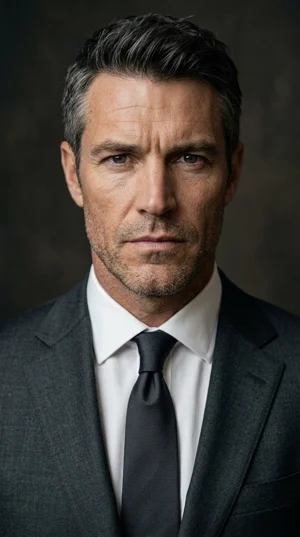
A pair of very good shoes stopped beside my sewing case. I looked up a long way, at a gray suit and a stern face I knew from the business pages. Rhys Kensington. Ryan’s boss. The man whose company Ryan bragged about at every dinner we’d ever had.
“How much,” he said, “for everything you’ve designed this year?”
I stared at him.
“All of it.” He was already taking out his phone. “And the designer.”
There is a particular silence a hotel hallway makes on a wedding day. Carpet the color of weak tea, thick enough to swallow footsteps. Somewhere a room-service cart rattling. Behind the door of the bridal suite, six women and a mother laughing at something that was probably still me.
“I’m sorry,” I said. “I think you have me confused with someone who’s for sale.”
“I don’t think I do.” He didn’t smile. He had the kind of face that had decided a long time ago that smiling was a negotiating concession. “What was the balance?”
“That’s none of your business.”
“Eighteen thousand?”
I looked at the envelope in my hand. I hadn’t told anyone the figure except Imani, and Imani would rather eat glass than tell Rhys Kensington anything.
“Ryan talks,” he said, as if I’d asked. “At length. In meetings.”
That, at least, I believed.
The door of the suite opened and the bridesmaid with the phone leaned out. Kinsley. I knew her name because I had let out the side seams of her bridesmaid dress three times in two months and she’d thanked me once, by text, with a heart emoji. She was still filming. The little red dot glowed on the screen like the light on a smoke alarm.
“Oh my God,” she said. “Is she crying out here? Sloane, she’s—” Then she saw who was standing over me, and her mouth stayed open a second after the words stopped.
“Keep filming,” Rhys said to her.
Kinsley blinked.
“Go on. Get all of it.” He finished typing something on his phone with one thumb, without hurrying, and put it away. Then he held out his hand to me, palm up, the way you’d hold it out for a dancer or a dog you didn’t want to spook. “Ms. Calhoun. Get up off the floor.”
I didn’t take his hand. I want that on the record. I put my own hand on the brass rail of the luggage cart somebody had abandoned by the elevator and got up by myself, and my left knee cracked like a knuckle, and I stood there in my black work clothes with a pincushion still strapped to my wrist and thread on my sleeve, and I was taller than Kinsley and shorter than him by a good eight inches.
He picked up my sewing case. Just picked it up, the old aluminum one with my grandmother’s initials scratched into the lid, P.D.C., and the dent from when it fell off a church folding table in 1996. He carried it like it was his.
“That’s mine,” I said.
“I know.” He pressed the elevator button. “I’m carrying it, not keeping it.”
Kinsley’s door closed. Through it I heard Sloane say, very clearly, “Who?” and then a chorus of shrieks, and I thought, distantly, that I’d done good work on that gown. Silk mikado, ivory with a little warmth in it, because Sloane was pale and the photographer had told me the light in the chapel ran blue. A sweetheart neckline she’d demanded and an illusion panel I’d talked her into, hand-sewn with four hundred and twelve seed pearls I’d stitched at my kitchen table while Ryan’s new life went on across town. The bustle was a French one, eleven points, tied with ribbons I’d color-coded so a bridesmaid could do it drunk at the reception.
Not to standard.
The elevator came. He held the door with one hand and waited for me to step in, and I did, because I’d have walked into a lion’s mouth just then to get out of that hallway.
The doors closed. We were reflected in brass, the two of us and my sewing case. He looked like the business pages: forty, maybe, the gray at his temples so even it looked chosen, a suit cut so well it embarrassed everybody else in the building. I looked like a woman who’d been up since four steaming a train.
“You’re a guest,” I said. “Of the groom.”
“I was.”
“You were invited to Ryan’s wedding.”
“He invited the whole executive floor. I think he wanted us to see the Whitfields.” He watched the floor numbers. “I was leaving before the ceremony. Then I saw you.”
“On my knees.”
“Yes.”
The elevator hummed. My face was hot to the roots of my hair. I put my fingers to the chain at my throat, where my grandmother’s silver thimble hung, and held it the way other women hold a cross.
“Mr. Kensington—”
“Rhys.”
“Mr. Kensington. I don’t know what this is. I don’t know if this is some kind of rich-man joke, or a dare, or if Ryan put you up to it, but I’ve had a morning, and I’d like my case back, please.”
The doors opened on the lobby. Marble, flowers in urns as tall as children, the smell of lilies and expensive air conditioning. Two women in pastel silk looked at Rhys and then at me and then at each other.
He walked me through all of it carrying my case. At the valet stand outside, Georgia hit me like a warm wet towel: April in Buckhead, pine pollen yellow on every windshield in the motor court, the sky that hard blue it gets before the afternoon storms build. A black car was already idling, a driver already out and holding the rear door.
I stopped on the curb.
“I’m not getting in a car with you.”
“I’m not asking you to get in a car.” He handed my case to the valet and told him, “Ms. Calhoun’s van. The white one, with the dent.” Then he turned back to me. “I’m asking you to marry me.”
A bellman dropped a garment bag.
I laughed. It came out of me ugly and high, the laugh of a woman who’s been carrying too much and just felt the strap break. “You’re insane.”
“I’m in a hurry. It’s not the same thing.” He took a card from his inside pocket, plain and white and heavy, and wrote on the back of it with a fountain pen, his hand steady in the heat. “My father has called a vote to take my company. I need a wife by the eleventh of May, and I need her to be someone who can stand in a room full of people who think she’s beneath them and not blink.” He held out the card. “I watched you pin that bustle with them laughing at you. Your hands didn’t shake once.”
“They’re shaking now.”
“Yes,” he said. “I noticed that too.”
My van came around the curve, white and dented and absurd among the black cars, my shop’s name on the side in letters I’d painted myself. The valet set my case in the back like it was made of glass. Up above us, somewhere on the fourth floor, a window full of bridesmaids was probably watching.
I took the card. On the back, under an address on Peachtree Road and a floor number, he’d written: 9 a.m.
In my other hand I was still holding the envelope with Celeste Whitfield’s check in it. Two thousand dollars. For my trouble.
“Why me?” I said.
He didn’t answer. Down West Paces Ferry, from the church where at one o’clock my ex-fiancé would marry a woman who thought my best work was fine, a bell began to ring eleven.
Rhys Kensington opened my van door for me and waited until I’d gotten in.
“Nine o’clock tomorrow,” he said. “Bring a lawyer.”

What did you think?