The waiting list went to next March by the first of May.
Thaddeus kept it in a ledger, a real one, green cloth with red corners, because he said spreadsheets had no soul. He wrote each bride in fountain pen in a hand like a wedding invitation and read them out to me in the mornings while I drank my coffee on the pressing table: a pediatric surgeon from Decatur, a pair of sisters from Macon getting married on the same day to men who’d been in the same fraternity, the parachute silk from Thomasville, the September bride, who had cried in my shop for twenty minutes and then apologized for crying and then cried again.
“And the Abernathy girl,” Thaddeus said, “second fitting, Wednesday the sixth, two o’clock.”
The Abernathy girl was Lacey Abernathy, a dental hygienist from Smyrna, twenty-six, marrying a lineman for Georgia Power. Her mother had come in with her the week after the ball, holding a coupon book in her lap like a hymnal, and asked in a very small voice how much a gown like the honey one cost. When I told her, she’d nodded and said, “Well, thank you for your time,” and started to get up.
I’d made Lacey’s gown at cost. I’d told her mother it was a sample I needed to test on a real bride, which was a lie, and the only one I told that whole month, and I’d tell it again.
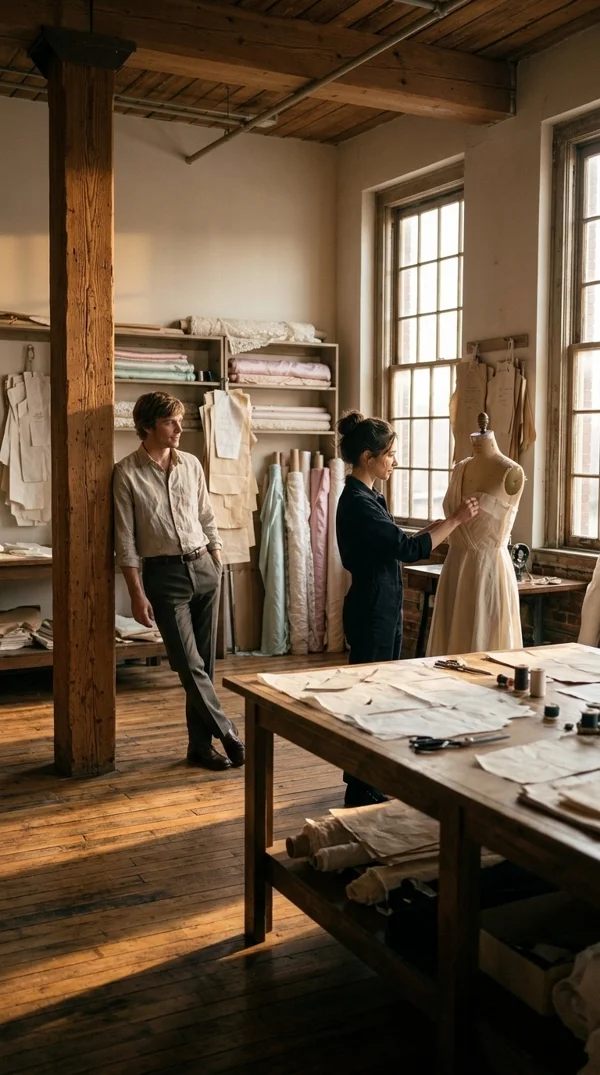
Her toile was on the form by the window now, pinned and chalked, with a paper tag hanging from the shoulder in Thaddeus’s beautiful hand: ABERNATHY. 2nd fitting Weds May 6, 2 p.m.
“We’re going to need another machine,” Thaddeus said. “And another cutter. And another me, honestly, but there’s only the one.”
“Then we’ll get another machine.”
“Look at you.” He took a pin out of his mouth and pointed it at me. “Three weeks ago you were sleeping on that table.”
He was right. I didn’t like to think about it, so I didn’t.
Rhys took me to the yard at five in the morning on a Monday because I’d asked to see what I was saving.
Kensington Freight’s main yard is in Forest Park, south of the city, on forty acres of concrete between the airport and the rail lines, and at five in the morning in May it’s the loudest, brightest place I’ve ever stood. Sodium lights on poles. Rows of trailers, white and red, KENSINGTON down the sides in the old script. Tractors idling in a line at the gate with their running lights on like a parade waiting to start. The air smelled like diesel and hot rubber and, underneath it, the faint jet-fuel sweetness off the airport, and every forty seconds a plane went over so low you felt it in your teeth.
He walked me through it in jeans and a canvas jacket I’d never seen. The men at the gate knew him. Not Mr. Kensington: Rhys. A dispatcher in a booth who’d worked for his grandmother. A driver named Ellis, sixty if he was a day, who’d taught Rhys to back a fifty-three-foot trailer when Rhys was seventeen and still told the story of the first time he’d jackknifed it. A woman named Verna who ran the fuel island, who looked at me, and then at Rhys, and said, “So you’re the one,” and shook my hand so hard my rings clicked.
“Saxby leases the routes,” Rhys said, when we were alone, walking back along the line of trucks with the sky coming up gray and pink behind the terminal. “Subcontracts them out. These men become independent operators overnight. They buy their own trucks on credit from a company Saxby also owns. Within three years most of them are out of business.”
“And your father knows that.”
“My father doesn’t care.” He stopped by the cab of a truck at the end of the line, an old one, a Peterbilt from the eighties, painted the old Kensington red, kept up like a show car. “This was my grandmother’s. She drove the first Atlanta-to-Savannah run herself because the driver quit.” He opened the door and held it for me. “Get in.”
I got in. He climbed up after me on the driver’s side. It smelled like old leather and coffee and a little like a cigar somebody had smoked forty years ago, and through the long flat windshield the whole yard spread out in the dawn like a city.
“I’ve never told anyone about my mother,” he said, looking out at it. “Not Augusta. Not the woman I almost married when I was thirty. I told you in a kitchen at midnight because you were hemming a handkerchief.”
“Organza.”
“Because you were hemming organza.” He turned his head. “I don’t know what I’m doing, Brynn. I want you to know that. I know how to run this. I don’t know how to do this.”
I kissed him in his grandmother’s truck. I climbed half into his lap to do it, over the gearshift, which was not comfortable or dignified, and he laughed against my mouth, a real laugh, and then he stopped laughing and pulled me the rest of the way over. The leather creaked. The windows fogged at the corners. Out in the yard somebody blew an air horn twice, long, and somebody else whistled, and he didn’t stop and I didn’t either, and a plane went over so low the whole cab shook.
“Ellis,” he said into my neck, “is never going to let me hear the end of this.”
Celeste Whitfield came to my shop on a Tuesday in a white linen suit, without an appointment, and rode up in the freight elevator because the stairwell light was still out.
I knew it was her before I saw her. I knew the perfume, a big expensive gardenia, from the bridal suite. Thaddeus, at the cutting table, looked up, saw her face, and stopped humming in the middle of Some Enchanted Evening.

 100 to start reading with.
What did you think?