The Human Problem, chapter 3 of Mated to My Ex-Husband's Alpha
The cut in my hand had bled through the bandage by ten past eight on Monday morning, which is a thing you find out when you go to unlock the counter drawer and leave a red thumbprint on the laminate.
“Jesus, Marlo.” Odette came around the partition with her coffee and took my wrist before I could hide it. “What did you do?”
“Glass.”
“Glass where?”
“Window.” I got the drawer open with my other hand.
She turned my palm up. The sliver had gone in at the heel of the hand, deep, a neat dark line now, and the skin around it was puffed and hot. I had wrapped it myself at two in the morning with a paper towel and tape, which is what you do when you are too tired to be sensible and too stubborn to go to the emergency room.
“You need a stitch.”
“It’ll hold.”
“It’s swollen up like a golf ball.”
“It’ll hold, Odette.”
The third floor of the City-County Building at eight fifteen on a Monday is a particular kind of noise: the coffee machine, the printer, four phones and a man from Brookline arguing about a porch. The Bureau of Building Inspection counter has a bell on it that nobody rings and a laminated sign, PATIENCE PLEASE, that somebody taped up in 2019 and that has become, over the years, the funniest thing in the building.
Behind the counter is the wall of files, and on the wall of files, third row from the bottom, is a green folder with ASHBY WORKS typed on the tab in a font that has not been used since typewriters.
By nine, the folder had moved to Beverly’s desk.
Beverly Marsh is fifty-seven and has run the Bureau for six years, which means she has survived six mayors’ worth of priorities by being almost entirely made of caution. She came out of her office with the green folder held against her chest like a hymnal.
“Marlo. In here.”
Beverly’s office has one window with a view of a parking garage and a framed photograph of her holding a fish. She shut the door. She did not sit down.
“The Ashby file is sensitive now,” she said.
“The Ashby file is a lapsed occupancy certificate and a missing sprinkler riser.”
“It’s sensitive.”
“It’s been sensitive since June, when they let it lapse. Nobody in this office cared in June.”
“In June there wasn’t a hearing.” Beverly put the folder down on the desk and squared it with her fingers. “As of this morning, the mill is on the riverfront trail study. The trail study is on the mayor’s desk. The mayor has a ribbon in a drawer.”
“So Kilbride’s illegal assembly space is now a political object.”
“Kilbride’s illegal assembly space is now a political object,” Beverly agreed. “And you’re the inspector of record. Which brings me to the other thing.”
She opened the folder. Inside, clipped to the front, was a single page: a letter on Kilbride Demolition letterhead, signed E. Kilbride, dated yesterday, Sunday.
To the Bureau of Building Inspection. Kilbride Demolition & Salvage will provide a vehicle and driver to accompany Inspector Hartigan on all site visits in the river wards until further notice, at no cost to the city. The driver will be Keegan Pruett.
Beverly watched me read it.
“At no cost to the city,” she said. “Which is the phrase that makes it impossible to refuse.”
“Keegan Pruett.”
“Your ex-husband, if the gossip is right.”
“Your ex-husband” is the sort of phrase people say to you at a counter while holding a folder, as though it were a category of weather.
“Whose idea was the escort?” I said.
“Kilbride’s. Yours, by extension.” She sat down. “Kilbride has a man in the city garage as of this morning, by the way. Second shift. He has a cousin on the mill crew. He’ll keep his mouth shut and he’ll keep an eye on your car.”
“He’s a wolf?”
“He’s a cousin.” Beverly took her glasses off and rubbed the bridge of her nose. “Marlo. I’m going to say this once. The Foundry is the mayor’s ribbon. The mill is the trail study. The two of them are the same riverfront and the same election, and you are going to be standing in the middle of it with a clipboard. If the Foundry passes and the mill fails, somebody will be humiliated. If it’s the other way around, somebody else will be.”
“Which somebody do you work for?”
“I work for the pension,” Beverly said.
At ten, Keegan Pruett walked into the counter in a Kilbride Demolition jacket with his name stitched over the pocket, and the whole floor looked.
He had a clipboard. He had shaved. He stood by the pigeonholes the way a man stands in a house he used to live in, careful of the furniture.
“Alpha’s orders,” he said.
“I read the letter.”
“Then you know.”
Odette leaned over the counter on her elbows. “Do you two need a minute?”
“No,” we both said.
The first inspection of the day was a three-story on Wenzel Street with a stair that was pulling away from the wall. Keegan followed me up it and held the flashlight without being asked, and knew which way to point it before I said, and that was the worst part. Nine years is a long time to teach a man your habits.
In the car between Wenzel and the second address he drove and I read the file and neither of us said anything. He had put the heater on my side. He had always done that.
At the third red light he said, “You could have said no.”
“To what?”
“To the release. You could have refused and made me come to you. It’s allowed. I’d have had to come to your place with a witness and take it on my knees on your step.”
“I know what’s allowed.”
“Then why didn’t you?”
“Because I wanted it over.”
He nodded slowly at the windshield. The light went green and he didn’t move for a second, and the car behind us tapped its horn.
“It wasn’t over for me,” he said.
“Well.” I turned a page. “It is now.”
We finished at four. He walked me to the city garage on Third because the letter said all site visits and a garage is not a site, and I let him because my hand hurt and because arguing about it would have taken longer than the walk.
My car was on the third level, nose in, and even from the ramp I could see something wrong with the angle of it.
Both front tires were flat. Not flat from a nail, either. They had gone down quick and hard, and when I crouched, the sidewalls were laid open in three long slits, left front and right front, clean, with a blade.
Keegan crouched beside me and put two fingers in a slit, and his jaw went tight.
“Knife,” he said. “Not a nail gun. A knife.”
“Can it be plugged?”
He shook his head. “Sidewall. Both of them. You need two tires.”
“On a Monday at four thirty.”
“I’ll take you.”
I looked at my city car sitting on its rims and thought about the fact that the garage had a wolf on second shift as of this morning and that it had not helped.
We drove to Rankin in his truck. He pulled up on Fifth Avenue outside my building and put it in park, and the river was a gray sheet at the bottom of the hill, and the streetlights were coming on early because of the snow.
“Thanks,” I said. It cost me.
“Marlo.” He had his hands on the wheel. “About last night. The shot in the office. Nobody saw him and nobody found tracks and the pack is saying the wrong things about it. It could have been a deer poacher. It could have been somebody’s kid. But the pack is saying it was a warning.”
“Was it a warning?”
“I think so.”
“From who?”
“From whoever wants you to quit.”
I got out. He waited until I had my key in the door before he pulled away, which is a thing he used to do, and I hated that I noticed.
The crow was on the doormat.
It had been laid out with its wings spread, head toward the door, feet toward the steps, and it was still glossy, so it had not been there long. Somebody had taken the trouble to arrange it.
I stood on the step and looked at it for a while. Behind me a car went by and the snow on the sidewalk was already gray at the edges.
Then the hall light came on, and Bryn Kilbride opened my door from the inside.
“Don’t step on it,” she said. “It’s bad luck in some families and dinner in others.”
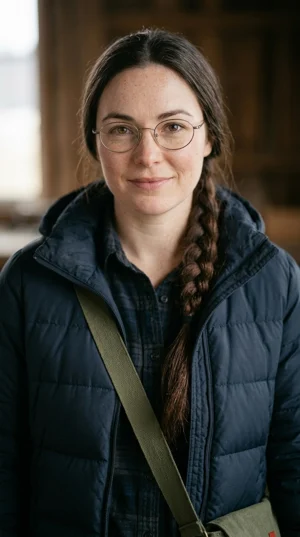
She was smaller than she had been in the mill, or she had made herself smaller: a puffy coat, a braid over her shoulder, a green canvas bag in her hand with a red cross on it. She looked at the crow, then at me, and her mouth pulled to one side.
“Keegan still had your spare key,” she said, before I could ask. “He gave it to me this morning, before he went to fetch you.”
“Your hand,” she said.
“It’s fine.”
“It’s the size of a golf ball.” She held the door. “I’m the pack’s healer and my brother sent me and if you send me away he’ll stand in the street and text me all night. Come in and let me look at it.”
I came in.
My apartment is two rooms and a kitchen along one wall, and it is warm because the radiators in that building run like a boiler room in hell, and Bryn Kilbride took off her coat and put her bag on the table and ran hot water before she said another word to me. She made me sit. She unwrapped the paper towel and looked at what I had done to myself and made a sound through her nose.
“That’s not a dressing. Where did you learn to wrap a hand, a car manual?”
“It stopped bleeding.”
“It stopped bleeding because it’s packed with a paper towel.” She had gloves on now, and a stainless dish, and the water steaming. “This is going to sting and then it’s going to feel better. Do you want to hold something?”
“Your brother.”
She laughed, one short note. “He’s at the yard.”
She cleaned it. It stung exactly as much as she said, and then the heat of the water took the throb out of it and my whole arm felt lighter. She put two in my palm — “you don’t need the ER, you need somebody who isn’t squeamish” — and dressed it with gauze and tape, and did it so quickly and so well that I understood she did it most weeks.
“Who’s the crow?” I said, while she worked.
“Anybody’s guess. It’s old, though. Crows on the step go back before the war.” She taped the last end and sat back. “There, it’s a hand again.”
I looked at the neat white dressing and then at her.
“Why are you here, really?”
“Because Keegan saw that hand last night and told me you’d be too proud to go to the ER, and because my brother told the pack to be nice to you and the pack is being nice to you the way a cat is nice to a bird.”
She started packing her bag.
“The pack thinks you trapped him,” she said. “They think you stood up at the mating as a stunt and that Easton is being chivalrous and that you’ll be gone by Christmas. Nils is telling everybody you’re a city plant.”
“And what do you think?”
Bryn zipped the bag. She looked at me a long moment, glasses and all, and her face was the face of a woman deciding how much of the truth to hand over in a stranger’s kitchen.
“I know Keegan,” she said. “I’ve known him since we were kids. He’s a good man with one bad habit, and the habit is letting other people do his hard talking. You didn’t trap him.” She pulled her coat on. “You didn’t even fight him. That’s what scares them.”
She left the green bag on the table, open, with a spare roll of gauze and a box of tape in it.
“Keep that. There’s a number in the front pocket.”
“Bryn—”
“It’s my cell, not the pack’s.” She opened the door and stepped around the crow. “Text me if it gets hot or hard or starts to streak. And Marlo — don’t take the bandage off in the shower, and don’t let anybody tell you the crow was nothing.”
She went down the steps. Her car started. The snow had filled in her footprints by the time I shut the door.
I stood in my kitchen with my hand wrapped and my coat still on and looked at the crow through the glass, and then I took the card out of the front pocket of the bag and got my own phone out to save her number, and it buzzed in my hand before I had even unlocked it.
Unknown number.
Leave the valley, human. Last warning.

What did you think?