Ira had asked me for one week in January. He called at seven the next morning, nine weeks late, while I was lying awake in my own bed with the night before still in the palm of my hand.
“I saw your name in the paper,” he said. “In the box on that demolition. That’s two of us with our names on things we didn’t walk. Come to the house.”
I went because there was nothing else in the valley that morning I could stand to do.
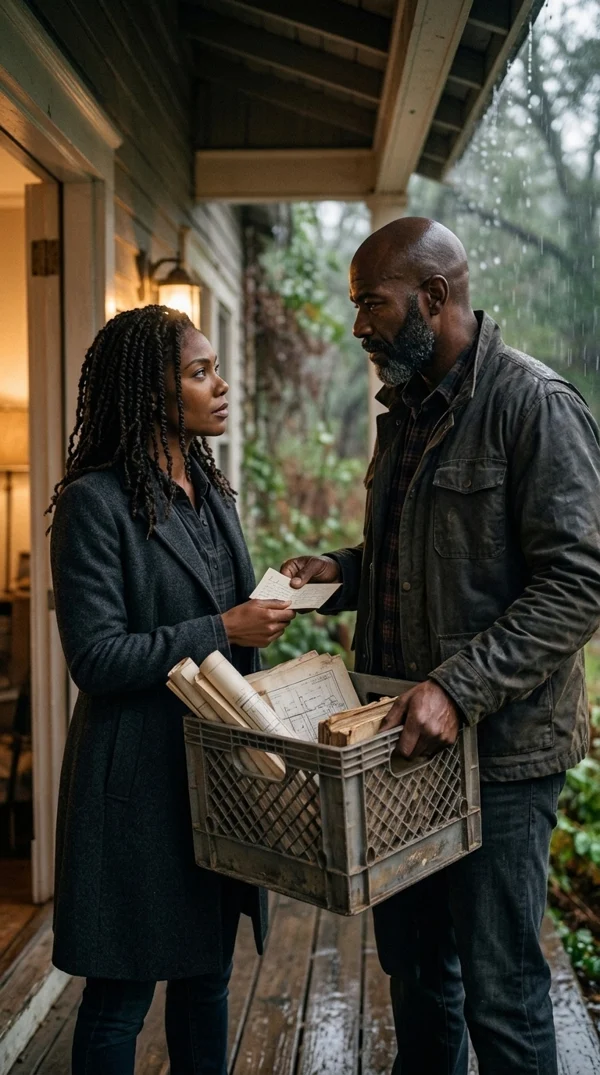
Ira Szymanski’s house in Brookline was a brick duplex with a porch and a bird feeder and a handrail on the steps that he had put in himself the year his knees went, and he met me at the door with his cardigan buttoned wrong.
“You’ll want the back room,” he said. “My daughter’s here with the kids. She won’t come back here.”
The back room had a TV and a recliner and a wall of photographs and a desk in the alcove with a drawer that had a key in the lock, and he sat down at the desk and put both hands on it the way he had in the diner.
“All right,” he said. “Ask it.”
“When did he ask you?”
“October fifth. A Monday.” Ira looked at the drawer. “Miles called me at the office. He asked would I do them a favor and walk a progress for the drywall stage, and he said it was a formality, and he said the September eighteenth one had been ‘a bit thin’ and the Department liked a second set.”
“Was it a formality?”
“It was a favorable report. It’s a different thing.” Ira’s mouth pulled. “A formality’s when there’s nothing to find. A favorable report’s when you’ve been asked what you’re going to write before you’ve been out.”
“You told him no.”
“I told him no on Tuesday. I said I was on light duties till the end of the month and I’d do it in November and it could wait.” He rubbed one knuckle with his thumb. “Then on Thursday there was a second call and it wasn’t Miles. It was a man from the Deputy’s office.”
“In January you told me Miles walked you around and asked after your granddaughter, and that was all.”
“It wasn’t only Miles.” He did not look up. “I told you the half I could stand to say over soup. I said yes in the end. I just said it to a different man.”
“At the Foundry?”
“No. At the city.” Ira reached over and got a thin folder off the shelf behind the desk and put it down. “The man from the Deputy’s office is called Kostelnik and he was very pleasant, and he said the Foundry was a mayoral priority and the ribbon was in December and the Department was under a bit of pressure, and would I mind terribly doing the second visit favorably this week.”
“He said favorably.”
“He said favorably.” Ira’s face was gray. “And I said yes, and then he said the second thing. He said, ‘I hear your granddaughter’s at the North Shore place now,’ and I said she was, and he said, ‘It’s a lovely spot. I hope it does well. Restaurants are a tough business, aren’t they, with the licenses and the inspections and all.’”
“Licenses and inspections.”
“Licenses and inspections.” Ira opened the folder. “That’s a city man telling an inspector that his granddaughter’s job depends on a license in a department with three people in it who could make trouble for a restaurant, and he never once said ‘do it or else.’”
“Did you tell anybody at the Bureau?”
“I told Beverly I’d done a second visit. She said, ‘Good, get it off the desk.’” He shut his eyes briefly. “And then the September eighteenth visit came back at me in the file and there’s two visits by a man on light duties and one of them while he’s under a stent, and the second one favorable, and there’s the eighteenth and the fourteenth in the same hand and neither of them walked.”
The television was on low in the front room and a child’s voice went up and came down.
“Show me what’s in the folder,” I said.
Ira turned it around and opened it with two fingers, and there was a stack of paper in it, and he went through it slowly and named each sheet as it came.
“That’s Miles’s email of the fifth. That’s Kostelnik’s call note, my own writing, dated. That’s the report I filed on the fourteenth — a copy, because the city’s got the original. That’s a print of the diary page. That’s the September eighteenth report. That’s the two dates of the site visits from the request log.”
“And the payments?”
Ira’s face did something.
“There’s no payment to me,” he said. “Not a cent, not a card at Christmas. If there was a payment there’d be a tax question and I’ve been twenty-two years clean.” He turned a page. “But look at that.”
It was a print of a bank statement page, with a line ringed in pencil.
“That’s my grandson-in-law’s landscaping account. He does driveways and patios and the odd deck, and in October there’s a job in there he never did.”
“Whose job?”
“Northbank Foundry. Eight thousand eight hundred, paid on account, described as ‘groundworks, phase one.’” Ira put his finger on it. “There’s no groundworks, not by him. He’s a kid with a pickup and a rototiller and the Foundry had their own men in with machines in October. It’s a hole in the books with a Northbank check going through it.”
“Did he know?”
“He knew he’d gotten a check and that his wife’s grandpa was scared, and he’d bought a van on credit.” Ira sat back. “So there’s your money. Not to an inspector, to a kid who never did a day and can say so under oath, and both of them can say it and the bank’ll have it.”
“Does the kid know he’s a bribe?”
“The kid thinks he did a job he can’t remember. He’ll be a nightmare on the stand.”

 100 to start reading with.

What did you think?