Storage B, chapter 1 of Mine in Every Lifetime
My husband fired me at four o’clock on a Monday.
By five, the donor’s daughter was in my office.
I had been the archivist at the Thorncroft House Museum for fifteen years. I knew every letter in the building, every spoon, every chair, and which drawer of the slant-top desk stuck in August. Philip had been the director for fourteen of those years and my husband for thirteen.
It took him eleven minutes.
“We’re restructuring collections,” he said, from behind his desk, with the board’s lawyer on speakerphone breathing between us like a third person in the bed. “It’s a strategic decision, Clem. It’s not about you.”
Then he said Delphine Ware would be leading Collections Strategy, as deputy director, starting today.
Delphine is thirty-one. Her father chairs our board. She has an MBA and a camel coat and very round handwriting, and by five o’clock her framed diploma was hanging on the nail where my grandmother’s watercolor of the Isles of Shoals had hung since 2011. My ficus was in a banker’s box in the hall with my pencils and my reading lamp.
“Phil,” she said, when he came to the door to see how she was settling in. Not Philip. Phil.
She put her hand on his arm. Just for a second. He covered it with his own, as if to keep it warm, and then he saw me standing in the hall with my box and took his hand away too fast.
That’s how I found out. The same hour.
“Fine,” I said.
I’d been saying fine to Philip Ashworth for thirteen years. It came out on its own, like a number you’ve dialed so often your thumb knows it.
I went down to Storage B to return my keys.
That’s where I found my face.
Thorncroft House stands at the bottom of Cordwainer Lane in Portsmouth’s South End, three storeys of slate-gray clapboard with a railed walk on the roof, built in 1791 by a sea captain with West India money. It missed the great downtown fires, all three of them. Since 1932 it has been a museum. The third floor isn’t shown. The deed of gift kept it for the family, and the family never comes.
Over the parlor mantel hangs our most famous object, 1931.1.12: Evander Thorncroft (1756 to 1798), the captain’s eldest son, painted in his forties in a black coat with his own dark hair tied back and a look on his face like he was about to say something he’d waited years to say. He’s on the brochure and the tea towels. For fifteen years I’d walked past him every morning with my coffee and said, out loud, “Morning, Mr. Thorncroft,” because the house was empty at seven and nobody could hear me.
At 5:40 it was dark outside. The house goes quiet once the docents leave, as if it’s been holding its breath all day. I turned off the lights in the archive office that wasn’t mine anymore. I didn’t look at the diploma. I carried my keys down the back hall to the old kitchen ell, where the museum keeps its storage, and swiped my card at Storage B, and it still worked, which felt like a small, stupid mercy.
The motion lights came on. They always come on. They came on for me and the docents and the HVAC man and once, famously, a raccoon.
There was an easel in the middle of the room.
We don’t keep easels in Storage B. Storage B is shelving and acid-free boxes and a flat file of maps, and a tall clock’s hood on a padded block, and the smell of nothing, which is what a well-kept storeroom smells like. Somebody had set up a painter’s easel under the lights, and on it, unframed, a canvas about the size of a pillowcase.
There was a yellow Post-it stuck to the corner of the stretcher, in very round handwriting.
SELL? —D.
Adhesive. On a stretcher bar. In my storeroom. I actually put my hand out to peel it off before I stopped myself, because I’m an archivist and I look at the label before I look at the thing, even when the label is an outrage. So I read the Post-it twice and only then looked at the woman in the painting.
She was about forty. She wore a white muslin gown with a high waist and a fichu crossed over her breast, and a lace cap set back on dark hair, and she held a folded letter in her right hand with the red seal turned toward the painter, as if she meant him to see she hadn’t opened it yet. There was a smudge of ink on the second finger of that hand. The painter had put it there on purpose. It was the only careless thing in the whole picture.
She had a gray streak at her left temple.
She had an eyetooth that sat a little crooked, which showed because her mouth was pressed shut at one corner, as if she were trying very hard not to say something.
I know that mouth. I’ve seen it in the bathroom mirror every morning for forty-three years.
I didn’t drop my keys. I want that on the record. I set them down on the shelf beside the tall clock’s hood as carefully as if they might break, and I went around behind the easel because my hands needed a job.
On the back of the canvas there was an old paper label, brown at the edges, glued to the stretcher bar. The ink had gone the color of tea.
Not to be catalogued. Property of E.T. —C.Q. 1932.
C.Q. was Cordelia Quimby. Everyone who has ever worked at Thorncroft House knows that name: our first curator, from 1931 until she died in 1944, the woman who painted an accession number on every object in the house with her own brush. We have no photograph of her. We have her numbers.
The hand was neat and quick, with a leaning d and a little hook on the tail of every y. It looked so much like my own handwriting that for a second I thought I’d written it, in some lost afternoon, and forgotten.
I looked for the accession number. I couldn’t help it. Every object that belongs to this museum has one, painted small in red where a visitor’s eye won’t land: under the left rear rail of a chair, inside the base ring of a bowl, on the lower left of a stretcher. Three numbers with dots between them. Year, lot, item. I checked all four stretcher bars and the tacking edges and the back of the canvas itself.
Nothing.
The painting had never been ours. In the language of my trade, it had no provenance in this house at all. It had just been waiting.
And I knew whose it was before I could have told you how.
Same size as the canvas over the parlor mantel. Same muddy green ground under the background, the same thin, quick brushwork in the lace, the same habit of putting the light on the left. The man in the parlor holds a letter too. I’d catalogued it. It’s in his left hand, and its seal is broken, and for fifteen years I had assumed, like everyone else, that it was a bill of lading or a note from his father.
Pairs of portraits were painted when people married. A husband faces right and a wife faces left, so that when they hang side by side on a wall they look at each other across the space between the frames.
She faced left.
Somebody had painted the two of them to look at each other for the rest of their lives, and then somebody had wrapped her up and put her where no one would ever see her, and written not to be catalogued on her back in my handwriting.
That was when the lights went out.
Motion lights go out when nothing’s moving. I was moving. I waved my arm over my head like a woman hailing a cab, and they stayed dark, and the only light in the room came from the exit sign over the door to the gallery, a red glow that made the woman on the easel look like she was standing in front of a fire.
It got cold.
Storage B is kept at sixty-five degrees and forty-five percent humidity, and I’ve worked in it in every season, and it has never once been cold like that. It was the cold of a cellar door swinging open in the dark, the breath that comes up from a place that has never seen the sun. It went across the backs of my hands and up my arms under my sleeves.
Footsteps.
They came from the gallery, the long dim passage that joins the ell to the main house. A man’s step on old boards, unhurried and sure, the step of someone who knew exactly where every board would answer.
Nobody was in the building. I had watched Philip’s car leave. I had watched Delphine’s car leave right behind it.
“Hello?” My voice came out thin. “The museum’s closed. If you’re with security…”
He stepped into the doorway, into the red light.
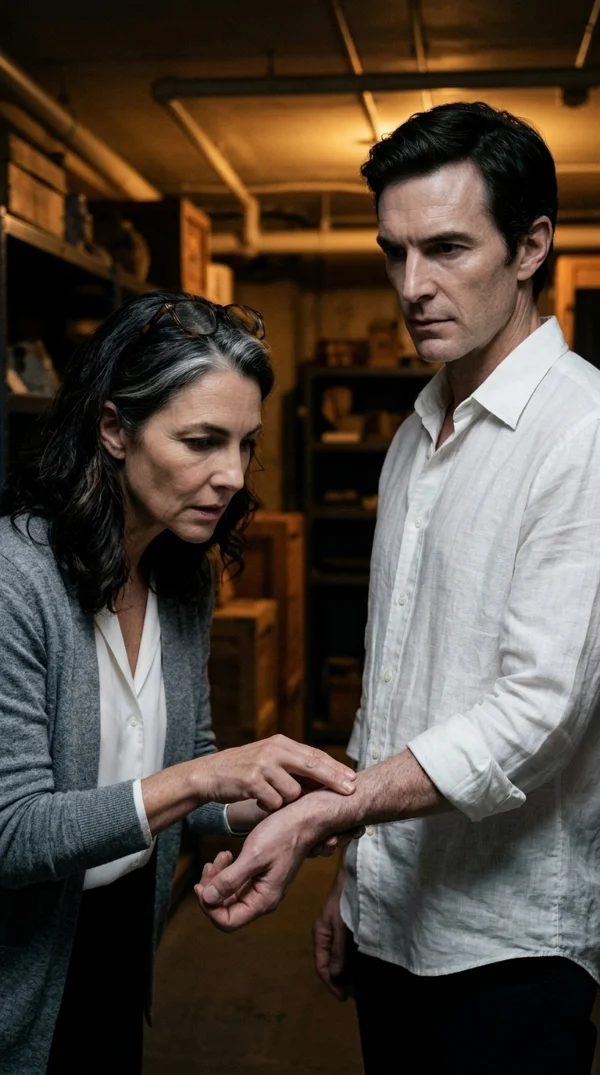
He was tall. Dark hair, cut short now, with no gray in it at all. A white shirt with the collar undone, the sleeves turned back, dark trousers, no coat on a night when it was thirty degrees outside. His face was lean and still and very pale, and I knew it. Of course I knew it. I had said good morning to it every day for fifteen years. The only thing the painter in the parlor had got wrong was the eyes. In the painting they were brown. In the doorway they were brown too, very dark, but behind the brown there was a light, low and gold, like a candle seen through smoked glass.
He wasn’t looking at the painting.
He was looking at me, and nobody had looked at me like that in thirteen years. Maybe ever. Like I was the only object in the room with a number.
“You came back,” he said.
His voice was low and quiet, with something old in the shape of the words, and it went through me like the cold.
“You always do.”



What did you think?