The Reserved Rooms, chapter 3 of Mine in Every Lifetime
At ten to seven the next morning I was standing in my own kitchen on Richards Avenue in my coat, holding a mug of coffee I hadn’t drunk, looking at the refrigerator.
I don’t remember the drive home. I remember that he walked me down through the dark house to the garden door and stood in it while I crossed the brick path to the lane, and that when I looked back from the car he was still there, a white shirt in a black doorway, steady as a lighthouse. That’s all.
Philip hadn’t come home. His side of the bed was flat. At 7:14 my phone lit up on the counter.
Staying in town for a few days. Think it’s best. We should talk about next steps. P.
In town. We live in town. Richards Avenue is a twelve-minute walk from Market Square. He meant Bow Street, where Delphine Ware has a condo on the top floor of an old brick warehouse with a deck that hangs out over the river. I’d been to a fundraiser there in September. I’d admired her kitchen.
“Fine,” I said, out loud, to the refrigerator.
And I heard myself.
Fine about the house, which was his before we married and stayed his, though I’d painted every room. Fine about children, later, Clem, when things settle, until later turned into not now and not now turned into forty. Fine about the eleven minutes yesterday, and the hand on his arm.
It wasn’t fine. None of it had ever been fine. It had just been easier to file.
I put the coffee down.
Daylight is hard on a thing like that. In the dark, in the green lamplight, with his cold wrist under my fingers, I’d believed him. At seven in the morning with the garbage truck grinding down Richards Avenue and a robin on the feeder, I stood in my kitchen and thought: Clementine, you have had a terrible day, and you are forty-three years old, and you were very tired, and you saw a painting that looked a little like you, and a very good-looking man in a white shirt told you a ghost story in a dark house.
So I did what I do with a box that comes in without provenance. I checked it against the record.
I keep scans of the museum’s founding documents on my laptop, because I’m the kind of person who backs things up twice. I opened the deed of gift. Indenture made the twelfth day of November, 1931, between Evander Thorncroft, Esquire, of Portsmouth in the County of Rockingham, and the Trustees of the Thorncroft House Trust. I’d read it a hundred times. I’d quoted bits of it to donors at cocktail parties like a party trick, because it was so old-fashioned and particular.
I read it again, out loud, slowly, as I’d read a will to a family.
Reserving, nevertheless, unto the said Donor and his heirs, for their own use and occupancy, so long as any of them shall live, the whole of the third storey of the said dwelling house, and the carriage house standing in the rear thereof, with free passage to and from the same at all hours.
And further down: The said contents shall be kept together in the said house and shall not be sold or dispersed.
So long as any of them shall live.
We’d always laughed about that clause at the museum. The family that never came. Philip called the third floor “the attic of the rich and absent”. The board treasurer, Judge Leclair, said every New England house museum had a mad aunt in the deed somewhere and ours just happened to be a whole floor.
The alarm company sends me a weekly log on Tuesdays. Sent me. It was still in my inbox, because nobody had taken me off the list yet. I opened it with my coffee going cold beside me.
There is a code in our alarm system that has been there since 1998, set up at the request of Quarles & Bramhall for “the family’s use”. In fifteen years of Tuesday logs I’d never once seen it entered.
Monday, 11/30, 5:38 p.m. Disarm, Zone 3 (third floor). User: FAMILY.
Two minutes before I swiped into Storage B.
I sat down on the kitchen floor with my back against the dishwasher and stayed there a while.
The courier came at eleven.
He was a young man in a puffer jacket with a clipboard, and he had come from Boston on the train, and he needed me to sign. The envelope was stiff gray stock with an engraved return address: Quarles & Bramhall, Counsellors at Law, State Street, Boston. Inside, one page, typed, on the same gray stock.
Dear Mrs. Ashworth,
We write on behalf of our client, the Thorncroft family, to invite you to undertake the arrangement and description of the family’s private papers, 1760 to 1931, at present held in the reserved portion of Thorncroft House. The papers have never been processed. Our client estimates their extent at approximately forty-one linear feet.
Our client proposes a fee of (and then a number that made me put the letter down and pick it up again) for the first year, with lodging in the carriage house of the property as permitted by the deed of 1931. Your hours would be at your own discretion, provided you are available for consultation with the family’s representative in the evenings.
We should be grateful for your answer at your convenience.
Yours faithfully, Maura Quarles
And underneath, in ink, in that hand: With thanks. E.
He’d sent it at night. A courier at eleven meant a call to Boston long before dawn. I wondered what kind of lawyer answers her phone at two in the morning for a client who sleeps all day, and then I thought I could probably guess.
I called my sister.
Teddie is four years younger than me and sells houses in Dover and the towns around it, and she answers the phone like she’s already halfway through an argument. “Talk fast,” she said. “I’m in a basement in Rollinsford with a sump pump and a couple from Connecticut.”
I told her Philip had fired me. I told her about Delphine. I didn’t tell her about the portrait or the man in Storage B, because I am not insane, and I didn’t want Teddie to drive over with a casserole and a psychiatrist. I told her I’d been offered a job by the Thorncroft family, cataloguing their papers, with a place to live.
“How much?” said Teddie.
I told her.
There was a silence in the basement in Rollinsford. Then the sump pump came on.
“Take the money,” my sister said. “Then call me tonight and tell me who he is.”
“Who says it’s a he?”
“Clem. You said family’s representative in a voice.”
I wrote the contract myself.
I’ve never told anyone that I liked that afternoon, but I did. I sat at the kitchen table in Philip’s house with my laptop and a pad of yellow paper and a pencil, and for once in my life I wrote down what I wanted before somebody else could tell me what I was getting.
My rate, by the hour, in figures and in words, so there could be no mistake.
My hours, set by me.
My notes and my working files are mine and leave with me.
Original order respected: I don’t rearrange a family’s papers to suit a theory.
A public finding aid, one day, so the papers can be found by people who need them.
Nothing goes in the record that I know to be false.
And the last line, which I wrote and crossed out and wrote again: The family’s representative will not enter the carriage house without the archivist’s invitation.
I printed two copies. At four, as the light went out of the sky over the South End, I put them in my bag and drove to Cordwainer Lane.
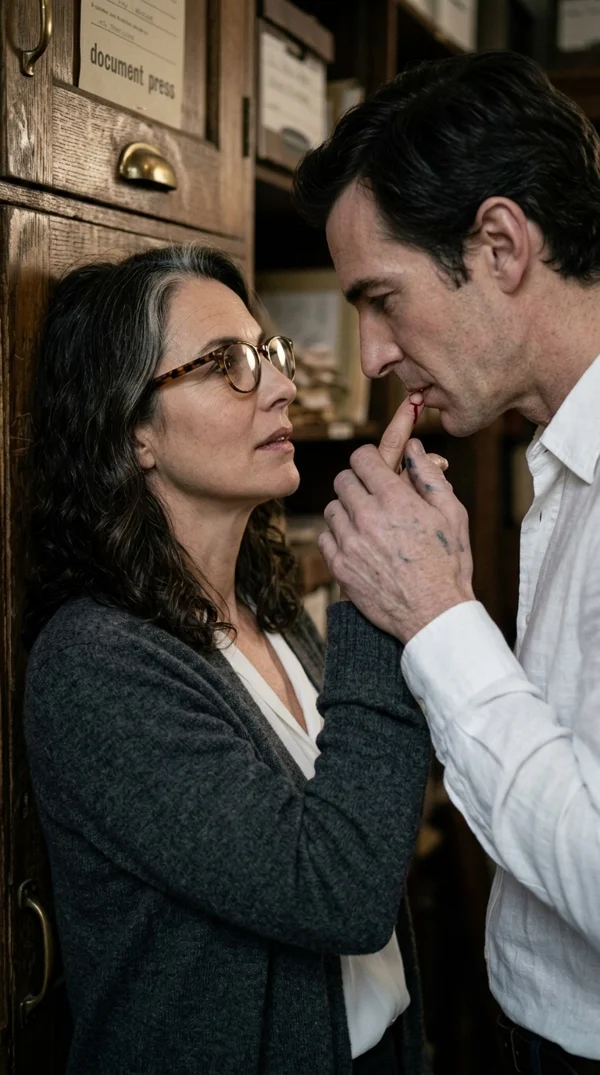
He was waiting at the garden door. He didn’t say anything. He stood aside to let me in, and we went up through the dark house the way we had the night before, and the six-panel door was standing open, and the green lamp was on.
I put the contract on Captain Reuben’s desk and sat down in the hard chair, because I wanted to be sitting when he read it.
He read every line.
I know that sounds like nothing. It isn’t nothing. Philip never read anything I wrote. Not my reports to the board, not the exhibit labels, not the birthday cards. He’d look at the first line and the signature and say great, babe. Evander Thorncroft stood under the lamp and read two pages of my terms the way I read a deed: every clause, twice, his lips not moving, his finger resting on the paper beside each line and never on the words.
When he got to the last line he stopped.
“Fair,” he said. He picked up my pencil, then put it down and took a pen from his pocket, an old black fountain pen, and signed both copies. E. R. Thorncroft. The loop on the E. Then he looked up. “I’ll agree to all of it. Every word. I have one addition.”
“You don’t get additions. I wrote it.”
“I know. That’s why I’m asking.”
I folded my hands on the desk. My heart was going too fast, and he could hear it. I knew he could hear it; he turned his head a little, as if toward a radio in another room. “Go on.”
“I won’t stay away from you.” He said it quietly. “I’ll keep out of the carriage house unless you ask. I’ll keep to every term. But I won’t stay away. I tried that.” He looked down at the contract. “For fifteen years.”
“What does that mean?”
“You came for your interview on the ninth of May, 2011,” he said. “In a green coat. It was raining and then it stopped. The old director walked you round the garden, and he said something about the magnolia, that it had been planted the year his grandfather was born, and you laughed. Here.” He touched the shutter beside him with two fingers. “I was asleep. The sun was up. Nothing wakes me. I heard it anyway, like a voice in a dream, and when the sun went down I woke with it still in my ears.”
I didn’t have anything to say to that. I’ve had fifteen years of filing things. Nothing in me knew where to put it.
“I knew your laugh before I knew your face,” he said. “So I stayed up here. Every day that you came to work, every evening you stayed late in the ell with the lights on, every summer party, I stayed up here behind that door and didn’t come down.”
“Why?”
He looked at me then, straight at me.
“Because every time I’ve come down those stairs to one of you,” Evander said, “you’ve died.”



What did you think?