He didn’t take my hand. He turned it over, gently, so the palm faced up to the stars, and laid it on the rail between us. Then he lifted his own left hand to his mouth and pressed the pad of his thumb against his eyetooth.
I saw it then for the first time. The tooth. I’d felt it in the kiss without knowing what I was feeling. It was longer than a man’s should be, and sharper, and it went into his own skin as easily as a pin into a cushion. A dark bead came up on his thumb, almost black in the starlight.
“A drop,” he said. “No more. It’s very strong.”
“I’m forty-three. I’ve had tequila.”
“Not like this you haven’t.” He held his thumb out to me, an inch from my mouth, and waited. Of course he waited. “You can still say no.”
I didn’t say no. I took his wrist in both my hands, the cold of it, and put my mouth to his thumb.
It was cold first, like a coin on the tongue. Then bitter, like the dark end of a cup of coffee. Then sweet, so sweet it ached in my teeth, a taste I didn’t have a name for, like cloves and snow and something burning far off.
And then I wasn’t on the roof.
I was standing in a doorway on Market Street on a wet afternoon in October, and I was a tall man with a ship’s log under my arm that I was ashamed of.
I was inside his height, his long legs, the weight of his wool coat damp at the shoulders. I could feel his tiredness, ten weeks out of Barbados with a bad mate, and under it a loneliness he’d never once put a word to. I could smell the street: horse, rain, tar from the wharves. Over my head a painted sign creaked on its iron arm, a black inkhorn with a white quill stuck in it.
Inside, the shop was small and warm and smelled of paper.
She was behind the counter, ruling a ledger. A ruler, a pen, a little dish of ink, her head bent. A lace cap. A gray streak at the left temple. She didn’t look up when the bell rang over the door. She held up one finger, wait, and finished her line, and blotted it, and only then raised her head.
My face. Her face. And through his eyes, the most beautiful face he had ever seen. It wasn’t pretty, exactly. It was so completely busy with its own thinking, and then all at once it turned and gave the whole of that attention to him.
“Mr. Thorncroft,” she said. Her voice was low and dry. “Is that the log you bought from me in July?”
He put it on the counter. She opened it. She ran her finger down a column of his figures, and her mouth went down at one corner, and he felt his face go hot, a grown man of forty with his own ship.
“These are a disgrace,” said Kezia Tolman.
And he laughed. In the doorway of her shop, in the rain, he laughed out loud for the first time in a year, and she looked up at him with ink on her second finger, startled, and then she laughed too.
It went past me in pieces after that, like a dream after waking. His hand on the shop door every Tuesday, and then every day. The North Mill Pond in winter with the ice booming under them. A painter’s room over a tavern in the summer heat, the man from Newburyport saying Turn your head a little left, Mrs. Tolman, toward the gentleman, and her turning, and looking at him across the room for an hour while the painter worked, and him looking back. Just looking. Not being allowed to touch, not being allowed to speak, and her eyes on him the whole time, steady and amused and certain.
That was the thing he’d carried longest: that hour, and being looked at like that.
I came back on my knees.
We weren’t on the roof. Somehow we were through the hatch and at the bottom of the ladder stair, in the dark third-floor hall, and I was kneeling on the floorboards with my face against his shirt, and his arms were round me, and I was crying. I hadn’t meant to. I didn’t feel sad. It was more like something in me had been folded small for a very long time and had just been opened out flat.
“It was me,” I said into his shirt. “And it wasn’t me.”
“Yes.”
“She was so…” I didn’t have the word. “She knew she was worth looking at.”
“Yes.” His hand was in my hair. “Clem. Listen to me. You’re not her.”
I lifted my head.
“You have her face,” he said. “You have her hand, and her hand had Adeline’s and Cordelia’s. But I know the difference between you. I’ve known it for fifteen years. You hum when you’re working, under your breath, and you don’t know you do it. She never hummed in her life. You put your pencil behind your ear and then hunt for it; she never lost a pen in forty-three years. You’re you.” His thumb moved on my cheek. “I’m not looking for her in you. I want you to know that before anything else happens. I’m not trying to get her back.”
“What are you trying to do?”
“Keep you,” he said.
I’d chosen on the roof, with my hand held out. I chose again, on my knees in the dark hall, because I wanted him to hear it.
“Take me to bed, Evander.”
I’d never been through the door across the hall.
He opened it for me and stood back, and I went in first.
It was a plain room. I’d expected velvet. A tall bed with four posts and hangings of undyed linen, a washstand, a chair with his good black coat over its back, two windows shuttered and barred with iron. No mirror anywhere. A lamp on a chest by the bed gave a low gold light. The room smelled of cedar and cold linen and him.
He shut the door behind us and leaned his back against it, and kept his hands flat on the wood.
“The last time I did this,” he said, “there were stays, and a great many hooks, and I had a valet to dress me again after. I’m out of practice, Clem. You’ll have to show me where things are.”
“Cardigan,” I said. “Buttons. Seven of them.”
He crossed the room and kissed me first, slowly, one line at a time. Then he looked down at my cardigan as though it were a document in a hand he’d never seen, and undid the top button and stopped, and I nodded, and he undid the next. He stopped at every one. By the fifth I was laughing at him under my breath and shaking, both at once. I’ve never been so glad of a cardigan in my life.
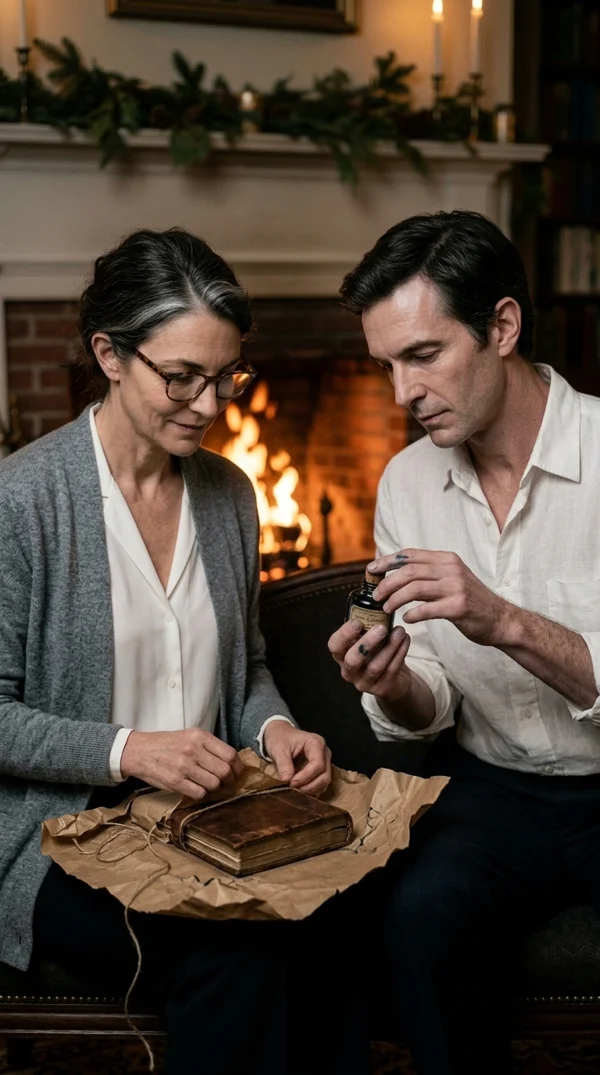
When it was my turn, I didn’t start with his shirt. I took his right hand and turned it to the lamp. I’d seen the stain three weeks before, on the dockets, and filed it: a faint blue-black shadow along the side of his first two fingers, where a pen rests.
“Iron gall,” he said. “I was writing up the books the week I died. It went into the skin and never came out. Nothing changes on me now.”

 100 to start reading with.

What did you think?