He was in the garden before I’d finished saying his name into the phone.
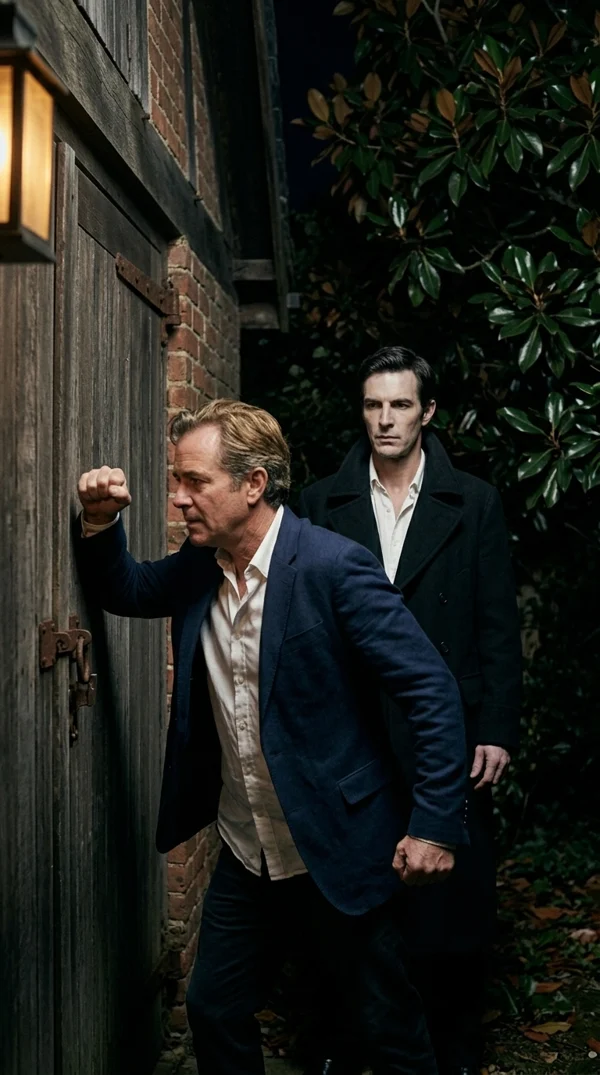
I watched him from my window: a dark shape going along the granite wall faster than anything that size should move, stopping, bending, going on. He searched every yard of it. There was nobody. The gate in the back wall, the one that opens on the alley behind the cooperage, had fresh bright scratches round its old lock, as if someone had worked at it with a pick and a lot of patience.
He sat on the bottom step of the carriage house stairs for the rest of the night with his back against my door. At twenty to seven he knocked, once, to tell me he was going in. I heard the garden door of the big house close behind him at a quarter to.
Detective Mattock took the report the next afternoon. The number belonged to a prepaid phone bought for cash at a gas station in Kittery. “Huh,” he said, looking at the photograph of my window. Then he gave me his own cell number and told me to use it, and asked, without looking up, whether my sister was still driving me places.
Delphine came on a Tuesday in March, at ten in the morning, with two coffees.
I was at the carriage house for an hour to meet the furnace man, and I opened the door because I thought she was him. She stood on the gravel in the camel coat, with her hair in a low knot and her sunglasses pushed up, holding out a paper cup.
“Oat milk, no sugar,” she said. “Bettina told me. Don’t be cross with her, I asked very nicely.” She smiled. “Can we talk? I’ll stand right here. I know the rules about the carriage house.”
I didn’t take the coffee. She held it out a little longer, then set it on the granite step between us, as if leaving food for a cat.
“I’ll be quick,” she said, “because you’re busy, and so am I. My father would like this to be over. So would I. So, I think, would you.” She ticked it off on gloved fingers. “The police referral goes away. Daddy can do that; it was his to begin with. You get a reference from the trust that says fifteen years of distinguished service, which is true. And there’s a position as head of collections at a museum in Cincinnati: a lovely old house, very well endowed, my father’s on the board. You’d start in June. It’s a real job, Clem. It’s a better job than this one ever was.”
“And?”
“And you give the Thorncroft papers back to the trust, where they belong. And you leave Portsmouth before spring.” She said it lightly, as if spring were a train. “That’s all.”
I looked at her. Thirty-one. Clever. Pretty in the expensive, careful way of women who were pretty at fourteen and have never once had to stop. And under the cleverness, something else, something steady and cold that I hadn’t seen in her before and that I recognized, after a moment, from the parlor fire on Twelfth Night.
“What happens if I don’t?”
“Oh, nothing happens,” said Delphine. “That’s the thing. My grandmother says you never take the offer.” She tilted her head, interested, as she had on this same step in December. “She says you always stay. It’s the twenty-ninth of September, isn’t it, your birthday? Michaelmas. Gran calls it that. She’s old-fashioned.” She said the date like a line from a recipe: an ingredient, a quantity, a temperature. “Anyway. Think about it. The job’s open till Easter.”
“No,” I said.
“You haven’t thought about it.”
“I thought about it,” I said, “while you were talking.”
And I shut the door, not hard, and stood behind it with my hand flat on the wood and listened to her heels go away down the brick path. When I opened it again an hour later for the furnace man, the coffee was still on the step, cold, with a skin on it.
“Go to Maine,” he said that night.
I was at Reuben’s desk. He was standing in the middle of the counting room, which he never did. He always stood by something, the shutters, a press, the door.
“There’s a house on a lake north of Rangeley. Maura found three this afternoon. I can buy one by Friday. Nobody would know where you were but Maura and me and your sister. You’d stay until October.” He spoke very fast for him, as if he’d rehearsed it, which I think he had. “You’d be alive in October, Clem. You’d be alive.”
“And you’d be here.”
“I’d be here.”
“Alone. Behind the door. Not in the room.”
He flinched. I’d never seen him flinch.
I didn’t argue with him. I’d been carrying it in my bag for five weeks, in its square ivory envelope, and I’d been waiting, I think, for exactly this. I took it out and put it on the desk and turned it so he could read the front.
For the next one.
He knew the hand. Of course he did. He looked at it without touching it. Then he picked it up and took out the single sheet and read the one line on it, and I watched his face while he did.
If you are reading this, he found you again. Don’t let him decide for you.

 100 to start reading with.

What did you think?