Evander
For eleven years I knew her only by her handwriting.
She came to the house in the autumn of 1931, the month the deed was signed, to be its first curator, and she numbered everything in it by Christmas. I heard her at it, by day, in the rooms below me, when I couldn’t hear anything: the scrape of a chair turned over, the little clink of a spoon laid down on felt. By night I’d go down and read what she’d written. She left her working notes on the dining room table, and her hand was the hand from the shop on Market Street and the studio on Congress Street, and I stood over it with a candle and didn’t touch the page.
I didn’t go to her. After Adeline I’d decided it was my coming down that killed them. So I kept the door. She wrote to me instead. She left notes on the third-floor stair, folded once, in the curator’s register hand: Mr. Thorncroft, there are moths in the second-floor chamber and I propose to fumigate. Mr. Thorncroft, the crucifix: Spanish? Please advise. I answered under the door. Maura’s grandfather carried the rest. When I asked her, by note, to label the portrait of a lady that I kept in the attic storeroom not to be catalogued, she did it the same day, and wrote back: Done. She has a very sensible face. C.Q.
Eleven years of notes.
Then one night in March of 1942 she came up the third-floor stair with a candle in a brass stick, in her cardigan, with her reading glasses on their chain and a clipboard under her arm, and knocked on the six-panel door, and when I didn’t answer, said through it:
“I know you’re there, Mr. Thorncroft. I’ve known since 1932. You might as well come out and help me with the inventory.”
I opened the door.
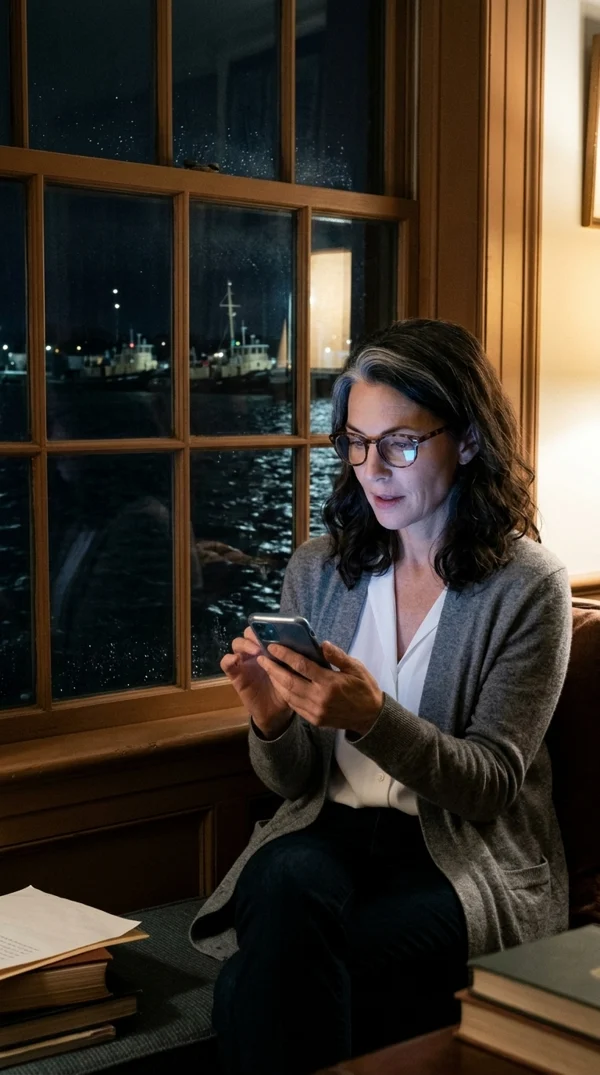
For a long time she studied my face in the candlelight, the face over the parlor mantel. She didn’t scream or cross herself. She was forty-one, and she’d been a curator for eleven years, and she’d seen a great many things that weren’t what their labels said.
“Well,” said Cordelia Quimby. “You’re younger than your portrait.”
Two years.
I’ll tell them quickly, because they were happy, and happy things don’t take long to tell.
She was funny. She made terrible jokes about the collection, about the Spanish crucifix and the andirons and the tall clock that ran eight minutes slow and always had. She kept a pot of red lacquer on the windowsill of her office and a sable brush in a jar, and she painted numbers the way some women knit, without looking, while she talked. She read Reuben’s letters aloud to me in the counting room until two in the morning, and laughed at my father’s spelling, and cried once at a letter he’d written me at sea in 1782 that I’d never read because I’d been at sea when it came.
Across the river the Yard’s lights burned all night. They were building submarines faster than anyone had ever built anything. Some nights we stood on the roof walk and counted the launches by the cheering that came across the water.
In August of 1943, on a hot night with the shutters open to the dark, I told her about the date. Not the others yet; only the date, and the age, and that I’d seen it twice. I’d thought she’d be frightened. She took off her reading glasses and polished them on her cardigan and put them back on and looked at me through them.
“So you’re telling me,” said Cordelia, “that I won’t see forty-four.”
“I’m telling you what’s happened.”
“What’s happened twice is a coincidence,” she said. “Three times is a pattern, and I don’t intend to be one.” She picked up her pencil. “I’ll see it out of spite. You watch.”
She wrote it in her pocket notebook that night. I know because I watched her do it, pressing so hard the pencil went through to the page behind. She told me she wanted it on the record.
That Christmas it snowed for three days, and she made me carry a spruce up the ladder to the roof walk and tie it to the rail with clothesline, and hung it with the brass hooks from the tall clock’s spare parts, because she said a house that old deserved one tree it could see from the sea.

 100 to start reading with.

What did you think?