I went back to the house on the second of September, at dusk, with my laptop in my bag and my badge on its lanyard round my neck. Not my suitcase.
I’d thought about that all afternoon. I’d chosen to leave until the twenty-ninth, and I’d meant it. But a choice isn’t a vow to be stupid. I had forty-one certified frames of a family’s murders in a folder, and the only other person on earth who could read them as I could was up three flights of stairs behind a six-panel door. So I went as what I was: his archivist, and the state’s, with evidence.
I let myself in by the garden door with the museum’s key. The house was empty and dim, the docents gone, the last of the light coming gold through the fanlight onto the floor of the front hall. I went up the main stair and the narrow one, and unhooked the velvet rope, and hooked it behind me, and stood in front of the six-panel door with my iron key in my hand.
I didn’t need it. The door was open an inch.
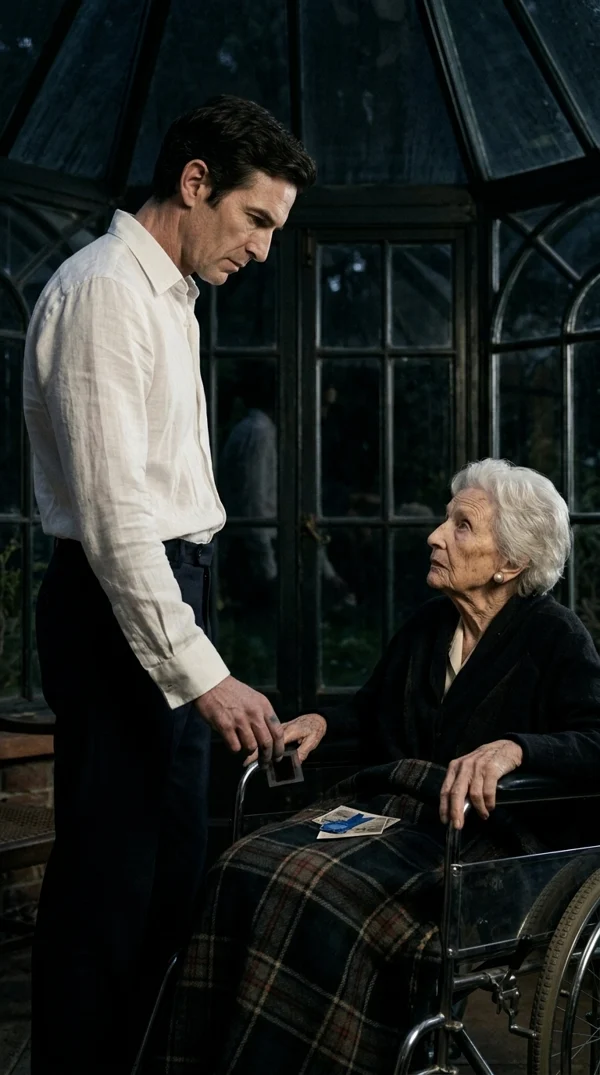
He was standing by Reuben’s desk with his hands at his sides. The lamp was lit. He’d lit it for me.
He didn’t come toward me. He’d worked out, I think, how far away he had to stand to be sure he wouldn’t touch me, and he stood exactly that far, and kept his hands behind his back.
“Clem.”
“I brought you something to read,” I said, and put the folder on Reuben’s desk.
He read all forty-one frames standing up, under the lamp. It took him an hour. I sat in the hard chair by the desk and watched his face, and I’ll tell you what I saw on it, because I’ve never forgotten.
At Mrs. T. shall not see Michaelmas, nothing. Stillness.
At The matter of Mrs. T. concluded. The fever serves, he closed his eyes.
At 3 February 1799. E.T. seen in Cordwainer Lane at night by myself. He lives, he made a sound. Not quite a laugh.
“I remember that night,” he said, without looking up. “It was the first time I’d let anyone see me. February, snow on the ground. I met Jotham in the lane at the bottom of the garden and he stepped back into a doorway and crossed himself. I thought he’d seen a ghost. I thought he was being kind.” He turned the page. “He wrote God help this house. I always thought it was the only Christian thing he ever did.”
At Mrs. Thurlow. 28 Sept., in Lemuel’s list, between the bank’s roof and a boiler, his hand closed on the edge of the desk, and I heard the old wood creak, and he let go of it.
At C. is a good girl, he put the page face down on the desk and stood with his hand flat on the back of it, and didn’t move for a full minute.
Then he turned it over again and read the rest.
When he’d finished he squared the pile of frames with both hands, as I square letters before I folder them, and looked at me across the lamp for the first time.
“I believed it was me,” he said. “Since the night Adeline drowned. Longer.”
“I know.”
“Every one of you. I stood on that roof three times and asked to burn for something a family wrote down in a ledger like the price of a boiler.”
“I know,” I said. “That’s why it’s going to court.”
“Did you keep anything?” I said. “From 1944. From that night. Anything at all.”
He looked at me. Then he went out of the counting room and across the hall, and I heard a drawer open in his room, a stiff old drawer that hadn’t opened often, and he came back with something in each hand.
In his left hand, a pair of white kid gloves, yellowed with age, so fine and thin they’d fold into a walnut shell, with a smudge of ink on the second finger of the right one.
I didn’t reach for them. I couldn’t. I sat with my hands folded and looked at Kezia’s wedding gloves, inked, as she’d promised, before the parson finished the first prayer, except that there had never been a parson, or a prayer.
“I took them from her counter,” he said. “In the morning. After the inquest.”
In his right hand, a length of ribbon. Blue grosgrain, gone gray-blue with age, about a foot long, with a frayed end where it had been torn.
“It was on the rose trellis,” he said. “Where she fell. On a thorn. In the fog, at first light. I put it in my pocket. I don’t know why. I put it in the drawer a week later with the gloves.” He laid it on the desk in front of me. “I’ve taken it out and held it a hundred times since.”
I didn’t touch it either. I took a pair of nitrile gloves out of my bag, the ones I keep for photographs and textiles, and put them on, and only then did I pick it up and turn it to the lamp.
About two inches from the torn end, there was a fault in the weave: a single pulled thread that had made a little pucker in the ribs of the grosgrain, the kind of thing a girl would never notice and a camera would never miss.
“Press nine,” I said. “Box eight.”
Cordelia’s files had gone in the garden incinerator at Ware Point in 1954. But Cordelia had kept her own copies of things, upstairs, in the presses, with him, as I keep two of everything. I’d found the album in July, in press nine, and catalogued it and boxed it and never looked at it closely, because I’d been looking for other things.
Thorncroft House. Volunteers. 1944. A little black album with photo corners, a dozen pages. Group pictures, mostly, on the front steps of the house, in the sun: women in cotton dresses and cardigans, two old men in straw hats, a boy too young for the war with his hair slicked down. A curator at one end of the back row, in a cardigan with her reading glasses on a chain, squinting at the camera, with my face.
And in the front row, second from the left, a girl of about nineteen, slim, very straight, with a pale serious face and her hair pulled back from it and tied, at the nape, in a bow of ribbon. C. Ware, it said underneath, in pencil, in Cordelia’s hand. July 1944.
I got the magnifier out of my bag and held it over the photograph, and laid the ribbon beside the album, and looked from one to the other.

 100 to start reading with.

What did you think?