Cash Accounts, chapter 5 of My Father Lost Me in a Card Game
Monday night I did the credit memos on his living-room floor.
Nine hundred and four of them since February two and a half years ago, when Ritchie took over what he called the key accounts. Every one a printout from our system, every one saying the same thing in the same three words: Returned wet flour. So many bags, so many dollars, credited to the customer’s account.
I sorted them by customer. Then I sorted the customers.
Abruzzo has a hundred and forty accounts. A hundred and seventeen of them pay by check: the big wholesale bakeries in Bay Ridge, the pizzerias with an accountant, the hotel on Surf Avenue. The other twenty-three pay cash, on account, once a week. Little places. A cannoli shop on Eighty-Sixth Street. A Georgian bakery with a clay oven. Three pizzerias whose owners don’t believe in banks.
I went through all nine hundred and four twice, because my mother raised me. It took until three in the morning.
Not one memo was on a check account. Not one. In two and a half years, not a single bag of flour had come in wet for anybody who paid by check. Every wet bag in Brooklyn had gone to the twenty-three customers who paid in cash, to Ritchie Falco, in person, on Tuesdays.
Two hundred and thirty-one thousand four hundred dollars.
I sat back against his couch with the memos around me in a ring. Every printout had the same little stamp in the top corner, T2, which is the terminal in the sales office, and the same login under it, GABRUZZO, which is mine. Ritchie installed our system four years ago and never bothered to set up his own login; the sales office has used mine ever since. I’d complained about it twice. I noted it now and moved on, the way you step over a crack in the warehouse floor you’ve stepped over a thousand times.
Lev came in from the deck and saw the ring of paper, and my face.
“Wet flour,” I said, “only happens to people who pay cash.”
Tuesday is cash day. I rode the Brighton route with Hector in the number two truck, as I used to when I was twelve, with my feet on the dash and a clipboard on my knees.
Grisha followed us the whole way in the gray Lincoln, half a block back, through every double-park on Brighton Beach Avenue. Hector watched him in the side mirror for twenty minutes and finally said, “Gina. Honey. There’s a Russian following us.”
“He’s mine,” I said, and Hector gave me a look I’ll remember on my deathbed.
At every cash stop Hector unloaded, got a signature on his delivery ticket, tore off the white copy for the customer and the yellow copy for the office, and put the pink copy in a spiral book in the glove box. My grandfather taught him that in 2000. Twenty-six years of pink tickets in rubber bands in Hector’s garage.
“What about returns?” I said. “When somebody sends a bag back wet.”
“Goes on the truck. I write it on the ticket. Returns, so many bags.” He shrugged. “Nobody sends back. Not in years.”
I went through the pink copies for the last month. Returns: 0. On days when there were memos in my bag for those same customers saying six bags, eight, ten.
“And the cash?” I said. “Who takes the money?”
“Ritchie,” Hector said. “Comes by himself, Tuesday afternoons, with his little bag. Says the key accounts need the personal touch.” He said personal touch the way you’d say head lice.
I saved Faina for last.
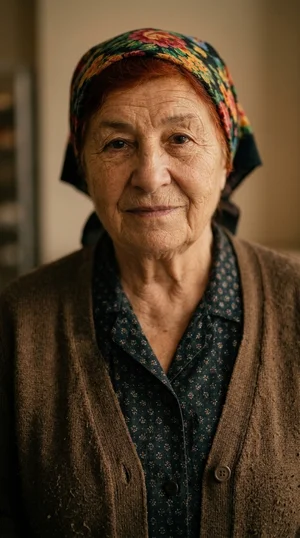
Faina’s is on Brighton Sixth Street, a storefront no wider than our office, with a window full of honey cakes and poppy-seed rolls and a napoleon the size of a cinderblock. Faina Gurevich has bought flour from Abruzzo since my grandfather drove the route himself. She is seventy-seven, under five feet, with dyed red hair and forearms like a longshoreman’s, and she would sift wet flour through a nylon stocking before she’d admit anything was wrong with it, let alone send it back.
According to my memos she had sent back a hundred and four bags.
“Back?” She looked at the printouts the way she’d look at a cockroach on her counter. “I don’t send back. Thirty years. Your grandfather, I never sent back. Ritchie, I never sent back.”
“Do you have receipts, Mrs. Gurevich? For what you paid him?”
She looked at me as if I’d asked whether she had a nose. Then she went into the back and came out with a stack of blue school notebooks held together with a rubber band from a head of broccoli.
Every Tuesday for two and a half years. The date, in a careful, slanted hand. The number of bags. The amount she’d paid, in cash, in full. And next to it, every single week, a signature: R.F., in a quick ugly loop like a dropped spring.
I stood very still in that tiny bakery with the smell of honey and burnt sugar all around me and looked at that loop.
I’d seen it. Saturday night, in green ink, in a cage book from upstairs at the Zolotoy. I couldn’t be sure. I’d need the cage book in front of me. But my heart had started to pound.
Faina’s numbers didn’t match my books. They never had. She’d paid full price every week; my books showed less, and a memo for the difference.
“He told me prices went up,” she said. “Cash only, to him only, because your father is having trouble and the bank must not know. I paid. For Carmine’s family, I paid.” Her mouth went thin. “Your father is having trouble?”
“My father has Ritchie,” I said.
I photographed every page. It took forty minutes. Faina fed me rugelach the whole time, and when I was done she put her floury hand on my wrist.
“You are staying with Lev Sokolov.”
The whole avenue knew. He’d told me they would.
“I’m staying at his house.”
She nodded slowly. “Nineteen years ago my husband, Misha, God rest him, plays at the old man’s table. He loses. He cannot pay. After the Settling, they come for his hands. Misha was a baker. A baker with no hands.” She shrugged one shoulder. A story about the weather. “The night before, a boy comes to my door. Eighteen years old. Skinny. He has the money in a bread bag from this shop. He says, Tell your husband the markers are paid. Tell him not to play anymore. He doesn’t say whose money. He doesn’t want anything.” She let go of my wrist. “That was Lev.”
My throat shut.
“But I don’t go up those stairs,” Faina said. “Not for you, not for him, not for nobody. The old man frightens me. I’m seventy-seven. I want to die in my bed.”
I came back to the house on the water after dark with the case in my bag like a winning ticket.
I’d never had a winning ticket. I’d never bought one. But I knew how it felt now: like your whole skin is too small for you. I’d sat in that box truck and in Faina’s shop and I’d found the thing, the actual thing, the crack in the jug, and it had Ritchie’s name on it in his own hand, and I’d done it with a clipboard and a box of photographs and my mother’s rule.
The house was dark except for the kitchen. His door at the top of the stairs was half open, lamp on.
I didn’t knock. I stood in the doorway the way he’d stood in mine.
He was sitting on the edge of the bed with his shirt off, a book open on his knee, and he looked up and went still.
“I’m calling it,” I said.
He closed the book and put it down. He didn’t come to me. He stayed exactly where he was and let me come to him, every step mine, across a floor with nothing on it.
“Say it,” he said, when I was standing between his knees.
“Yes.”
“Say it like you know what it means.”
I put my hands on his shoulders. His skin was warm and he was holding so still I could feel what it cost him.
“I want you,” I said. “Not for the markers. Not because you folded. I want you, Lev, tonight, all of it. Yes.”
He shut his eyes for one second. When he opened them he was almost smiling.
Then he was very slow, and very sure, and in charge of every second of it. He undid my blouse as he had on Sunday, one button at a time, and this time nobody said anything to stop him, and he slid it off my shoulders and let it fall. His hands were warm at my waist, at my back, unhooking things with a patience that made me want to scream. He told me what he was going to do before he did it, quietly, against my throat, and asked, and waited for my yes, and I gave it to him every time, and every time it was easier. He laid me back on his bed. His mouth was at my collarbone, my shoulder, lower. I stopped being able to think about columns or numbers or anything that added up.
I’ve been touched before. Two years of Ritchie. It had been like being handled by a man moving furniture.
This was being read. Line by line. Every place he put his hands, he watched what it did to me and remembered it, the way he’d looked at his cards once and never needed to look again. When I gasped he stopped and did it again, slower, until I said his name in a voice I had never once used in the office.
At some point I wanted, badly, to have him the way he had me.
I pushed at his shoulders, and he let me, and I rolled him onto his back on that big quiet bed and climbed over him with my hair coming down around both our faces, and I looked down at Lev Sokolov, who controlled every room he’d ever walked into, lying under me with his gray eyes gone almost black.
He laughed. Low. Surprised. I’d never heard him laugh.
“I fold,” he said.
I kissed him to make him stop laughing, and he didn’t stop, not really; I could feel it going on in his chest under my hands. Then I couldn’t, because we’d come together, slowly, and his breath went out of him all at once and his head went back against the pillow.
He let me set the pace. That was the thing I couldn’t get over, then or later. Lev Sokolov, with his hands at my hips holding on rather than holding me, letting me decide how slow and how much and when. I went slow until neither of us could stand it. His eyes never left my face. When I bent down to him he kissed my throat, my jaw, the corner of my mouth, and said things against my skin in Russian, and then one thing in English, low: “Don’t stop. Please.” I had never heard a man say please like that, as though it cost him and he would pay it gladly.
The window was open and the ocean was loud, and he said my name, my whole name, Regina, the way nobody had said it since my mother. When it broke over me it went on longer than I knew it could, and I held on to his shoulders with my forehead against his and rode it out. He came apart a moment later with his face turned into my shoulder, and he didn’t let go of me afterwards, not even to breathe properly.
We lay there in the heat with the sheet kicked off and the curtain moving.
“You found it,” he said into my hair. It wasn’t a question.
“I found it.”
“Tell me in the morning.” His arm tightened. “Tonight you’re off the clock.”
I almost laughed. Then, on the nightstand, my phone lit up.
I’d turned the sound off at Faina’s. The screen said fourteen missed calls, every one from Dad. Under them was a text, from him too, forwarded, and I could see the picture before I opened it: the boardwalk, the streetlight, my hand on Lev’s chest, my face turned up.
Ritchie had sent it to my father. My father had sent it to me.
Under it Ritchie had written: She’s sleeping with the guy who holds your markers.
And under that, my father, in capitals: COME HOME.
What did you think?