Wear came at ten with the folder and a junior. He put his card on the front parlor table in front of me, which nobody else had ever thought to do.
His eyes went over me once, the way a man checks a fence line. “Rowland Wear. You’re Twyla. I’ve read your table.”
I kept my eyes on the card. “Then you’ll know the road’s in the bed.”
He did know, obviously. He’d put the access into phase two, so it was the plan’s problem and not his until the plan was through, which was better for me, at this stage, than everybody thought. Nothing would happen to the bed until somebody with a committee had put a hand up. He sat down and opened the folder as if that settled it.
Was that supposed to make me feel better? It sort of did, which was worse.
He is forty-eight, with a good plain manner, and he never really oversells. If he’d been a hustler with a big watch, I could just have hated him and been done with it.
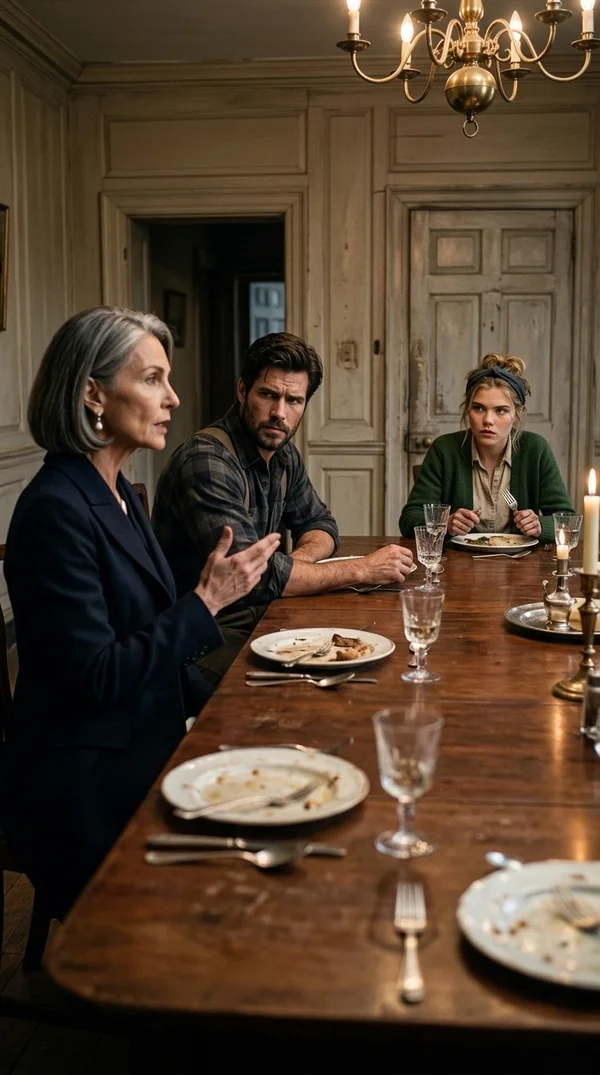
Sibyl sat at the end with her glasses on. Bertie had been told to be there and was at the window, thumbing idly at his phone.
The option was fourteen pages and the schedule was on page nine. Wear walked us through it patiently, one line at a time. The price and what it was made of. The deposit, the purchase and sale agreement, the closing and the outside date. The penalty, the title search, the perc tests, phase one and phase two.
“One point nine.” He laid his pen across the page.
Against a hundred and nineteen thousand by March, which on this place was not a small number. Five percent deposit on signature, ninety-five thousand as good as in the bank in two weeks, against a sale that could take a year and probably would. Purchase and sale agreement by the outside date, the twenty-third of June. Closing at the end of September. He turned each page with one finger, gently, like a man who had never once in his life been in a hurry.
I sat forward, my spine off the chair. “And the garden.”
The garden was a great asset. The wall was the best thing here, and it stayed. “The wall and the bench and the lawns — in principle, the walled garden’s a feature of every plot that looks at it.”
“And the frames?” My jaw had started to ache.
Phase two. They came out when the road came in. And what was I meant to force in then, the gravel?
I swallowed, and my throat clicked. “And the forcing house?”
“The forcing house comes out.” He met my eyes and didn’t blink. He’d be straight with me, at this stage: it was the one thing on the place a buyer’s inspector would call a liability. A slate off. Standing since 1908. “It’s a shed.”
A shed. A fucking shed! The skin on my neck went hot. “It’s been standing since 1908 because the wall needs it. Take the forcing off the wall and you’ve got a warm face of brick with pears on it that won’t ripen.”
Wear studied me briefly with his lips pursed. I could keep a bit of it, he offered. The bothy end. “A shed with a bit of character.”
“A shed with a bit of character.” I barely got it past my teeth. As if the thing were a sweater with a pull in it.
He put his pen down. “Miss Brice. I’m not going to pretend I’m the village’s friend.” He did twelve of these a year, and the ones that went wrong were the ones where somebody had promised to keep something they couldn’t afford to keep. The wall was a keeper and the business of it wasn’t. “You’ll get a better price for the house if the garden’s a garden and not a truck farm with a smell.”
“You’d say that if you were buying a truck farm.”
“I’d say it if I were selling one.” One side of his mouth almost smiled. “Which I would be, by September.”
Wear asked to see the wall before he went. Sibyl waved me at him — “Take him round, then” — and went to answer the telephone, and we went out into the cold with his junior behind us taking notes.
He walked it properly, I’ll give him that. He laid his palm on the brick and studied the lime, and then the cement patch on the north side. Who’d done the cement? Somebody in 2019. It had blown behind, and there was a whole panel of it that wanted raking out and doing again. Four thousand, and exactly the sort of job that got left. The trees were good, though. Somebody had tied them.
“I’ve tied them.”
“Then you know what a proper wall costs to keep. Four thousand a panel, and about twelve panels. A garden doesn’t pay for that. A building does.” He stopped at the fourteen. “What’s this one?”
“Unrecorded.” My breath smoked between us. Nobody had written a name for it in a book since 1908, and the state university was going to be asked to.
I’d been told to keep it from Sibyl. Nobody had said a damn thing about Wear.
His eyes stayed on the copper label a long while. Then I should put a value on it, on paper, before Friday. At the moment what I had was a story about a pear, and a story was worth nothing in a schedule. “If it’s worth something, it’s worth something to the price, and I’d rather pay it than argue about it in June.”
“Would you?”
“At this stage, yes. The wall’s the thing that sells these houses. A name on a pear’s a paragraph in the brochure.”
He started back up the path. I called after him, and he turned.
“If you build the twelve, what happens to the wall in ten years?”
Nothing, if it had a body on it. Somebody had to point it and tie it. He pulled his gloves on slowly, finger by finger. If nobody did, the trees came off, and then it was only a wall. “In about twenty years it’s a wall with a hole in it, and a developer who’s got a hole in a wall puts a gate in.”
“So it wants keeping worked.”
“It wants keeping worked.” He went in, and I stood there with my palm on the cold brick. Was that a warning, or was he just being honest? I genuinely couldn’t tell which was worse.

 100 to start reading with.
What did you think?