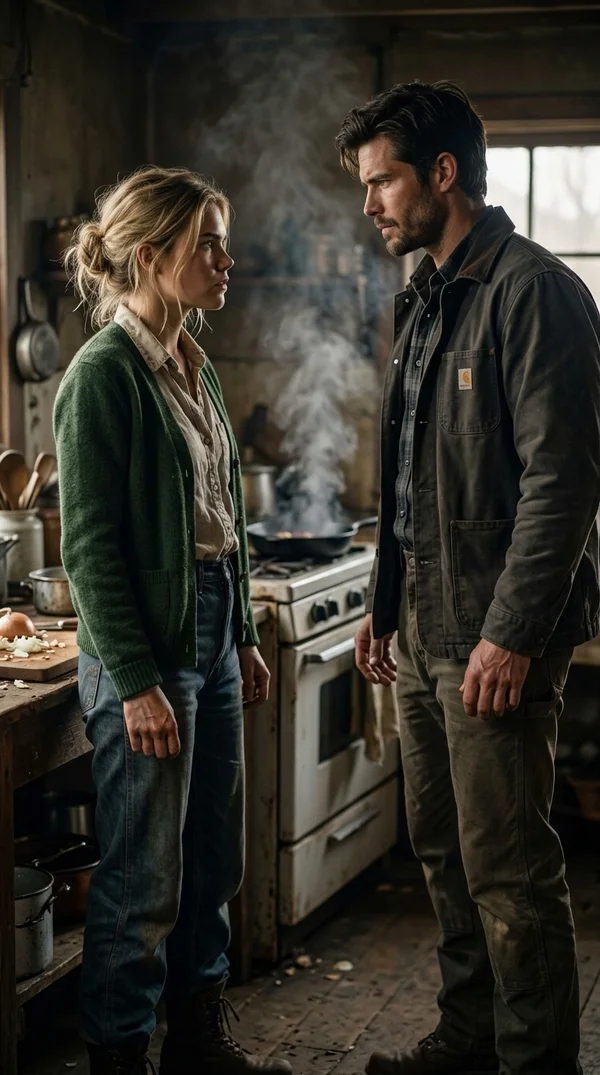
“I don’t want to shout.” I didn’t, either. What I wanted was to hit him, just once, somewhere it would show. “I want the reason.”
The reason wasn’t a good one, he warned me. I’d be the judge of that, I came back, and he shook his head slowly, because that was exactly the trouble. I wouldn’t be. Then he unfolded his arms. There were three reasons. The first two were respectable and the third one wasn’t, and he’d had seven weeks of knowing the third one was the true one. I’d get them in that order.
I put my back against the door. The cold of the planks came straight through my coat to my spine, and I kept it there.
“Before you start, I want a thing on the table, or this is all going to be about your father and you’ll get away with it.” My throat had gone tight, and I made it work anyway. A shipping shed on the seventh of January, where he’d sworn it was the fourteenth of December for him. A bothy at ten-thirty at night on the eleventh. Both times, not one word about the box. In here he’d had his hand on the wall six inches from my head, and the box was on the bottom shelf of the office, which isn’t six inches from anything. “So you didn’t forget. You stood in a bothy being in love with me and quietly held back a paper.”
His mouth went thin. “It’s both.”
“Seven weeks of both.” I folded my arms. Was he really going to stand there and do sums at me? Of course he was. “Go on, then.”
The first reason came out steadily, his eyes on mine the whole time, like a man reading figures off a sheet. If it had come out in November, the sale was dead in November. Wear reads twenty-one years and a binding clause and a duty to fund, and he doesn’t walk. He goes round the ditch at a hundred and thirty and takes it off the price. Vaux has nothing on the table, and there’s a foreclosure by February. I could check every word of it with Gorham, and I knew I didn’t need to. Did I want it to be a lie? God, yes. It was true, and I hardly had the voice to tell him so.
The second was that in November it would have been a Cabot paper and not mine. A codicil in a lawyer’s safe that a dead man wrote and a son found. Every week it sat there while I argued a road off my own wall without it, it got to be something I’d done and not something I’d been given. By the time anyone really read it in anger, there’d be a photograph of a stake in the town’s file and sixty people who’d been down the bed.
That was true as well. I nodded once and let it be true, and I hated him a little for being right twice in a row.
“Third.” He put his hands behind him and got hold of the bench’s edge, and his knuckles went pale on it. “I wanted to watch you earn it. And I wanted to be the one who decided when you had.”
The fire had taken. It cracked twice in the grate, and neither of us moved for a bit. The skin on my arms came up under my sleeves.
Decided when I had. Who the fuck did he think he was?
“What does that mean — decided when I had?”
It came out of him fast and low through his teeth, like a man getting a splinter out. He’d run this place six years, and every single thing in it was his to say. The roof, the boiler, the wage, the tin, the bothy wood. It was all he’d had since he was twenty-four, and it was what he was for. Then in November there was a codicil in a box that handed a girl of nineteen twenty-one years of the only thing on the estate worth looking after. His father had written it in capitals and had the housekeeper in to witness it, and never breathed one word to him. Nine days and a wedding and two witnesses, and nothing.
His eyes went to the fire, and the skin over his jaw went tight. “So there I was in that office on the night of the twenty-fourth, looking for a bank statement. I had it in my hand. In his writing it read the only person here who can work it. I stood there and read my own father say I wasn’t the one.”
“You were the one who was going to sell it.”
“Yes. And he knew it.” He took his hands off the bench. He’d written to his father in October to leave me nothing, and his father had read the letter and said right. Then he’d found a paper that left me the garden for twenty-one years. Every time he read it, it was the old man listening to him and going and doing the opposite. “It’s a great deal easier to keep that in a box than out loud.”
I stood in the middle of the bothy floor with my pulse going in my ears. Seven weeks. Seven fucking weeks of watching me sweat over a wall he could have handed me in a sentence. I’d been working all that time, and being watched, and not knowing. His word for it had been arithmetic. He’d called the will a permission and a condition, and nothing more had been his own word in October.
“Nothing more was right in October.”
“It was right in October and wrong by the twelfth of November! You’ve known it was wrong since the twenty-fourth!” So much for not shouting. “You let me stand in a hall and tell you the will meant agreement, and you came back with it’s a fifth of the interest. And then you let me stand up in front of the grange hall without it.”
He didn’t argue the fifth. He only let his breath go, quietly. He hadn’t let me do anything. I’d done it, and nobody in that room could have stopped me, and nor could he.
My chest hurt. “You could have given me just one line before you went in. One! Was that so much?”
His jaw moved once. “Yes. I could.”
That was the shape of it, in the end. He could have, and he didn’t. No plot, no crime. A man of thirty with a mortgage and his father’s opinion of him, and a bothy with a woman in it doing the work anyway. What was I meant to do with that? Hate him? I was trying. It wasn’t going well.
He took his cap off and laid it carefully on the bench, and put his hand back behind him on the edge. He breathed out slowly through his nose. “Say the rest.”
“There isn’t a rest that isn’t shouting.”

 100 to start reading with.
What did you think?