Gorham put it to Wear early on the Monday morning. Wear’s attorney came back by ten, and it was certainly not a price.
Mr. Wear is grateful for the disclosure. He is not able to reprice on a document received this morning without a schedule of the affected planting, a plan of the trust area and his own attorney’s view, and he will require the same to be provided to his engineer. Our client reserves his position on the twenty-third.
“So it’s not a number.” I had the letter face up on the kitchen table, my fingers spread on it.
Perrin’s eyes were on the last line. It wasn’t a number, he agreed. Reserves his position was what a lawyer wrote when he’d been handed something he didn’t expect and needed two weeks.
“It hasn’t got two weeks. It’s got five days. Does he know that?”
“Then it’ll be a price by Friday, and a lower one.” He rubbed his jaw with the back of his wrist. “That’s how it goes.”
That’s how it goes. Was that really all he had? I wanted to throw the sugar bowl at him, and I didn’t, because it was Ada’s.
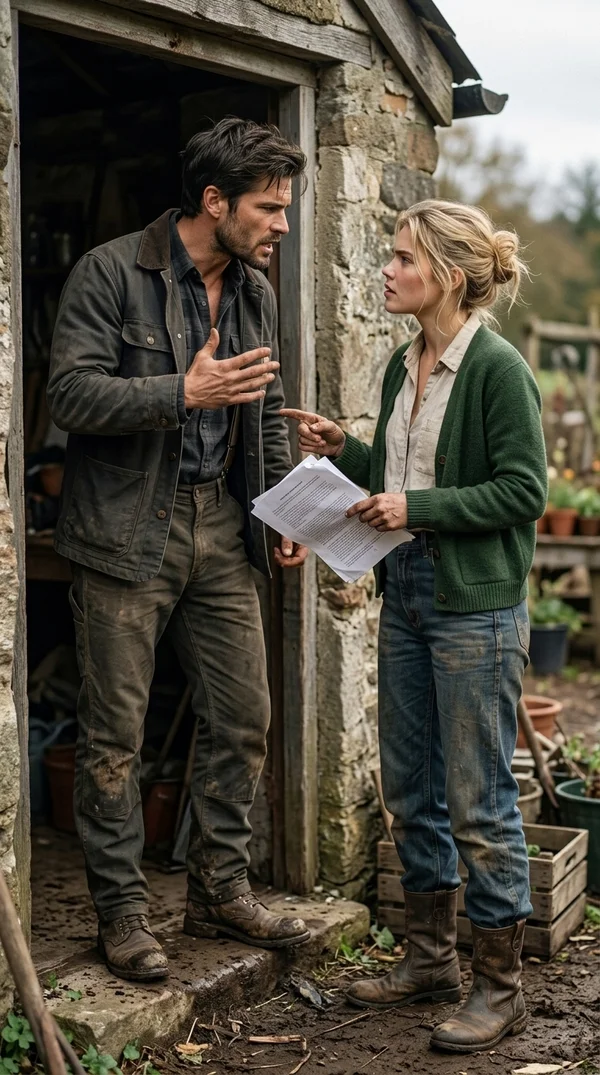
My mother was in the doorway in her coat for Brackenby, keys already in her hand, and she wanted to know what a schedule of the affected planting was. A list of what was on the wall, I told her. My job, and four pages.
“Four pages by Friday! And you’ve got a full day every day!”
“Then it’s four pages by Thursday night.” Just like that, as if I’d ever written four pages of anything.
“That’s exactly what I mean!” She was nearly out of the door already, her mouth still going on the step.
Vaux’s letter came at two, and it was worse than Wear’s.
The nursery’s line of credit was ninety thousand. It had been renewed every March, routinely, for years. This year it wasn’t renewed — it was reviewed, by the committee on the Thursday, and the conclusion was two lines: line withdrawn from the twenty-eighth of February unless estate exposure is reduced by not less than one half. Cross-collateralization to be revisited.
The twenty-eighth of February. Not the thirty-first of March. Four weeks earlier than the estate’s demand, and sixteen earlier than the outside date. Holy shit. Had anybody seen that coming? If they had, they’d just kept it to themselves.
Culver brought it in from the mail and stood silently in the office while Perrin read it, and Perrin’s mouth got thinner by the line. Then Culver sat down heavily on the arm of the chair, which he never does, and cleared his throat. “Withdrawn. Which means what? In practice.”
Perrin let a breath go. “On the twenty-eighth the yard’s overdrawn and there’s no line. Forty-one paychecks come out of checking, and checking goes under in two weeks.”
“Forty-one.” Culver’s eyes were on the window, on nobody. Then he took the letter out into the yard, because he just couldn’t stand in the office with it.
I had it from him afterward. There were four of them on the shipping bench at their break. He read it out to them, then put it on the bench, and they each read it again for themselves. One of them was a kid called Corey, twenty, on the stock side, eight months at Whinfield. Corey rubbed the back of his neck, where the skin had gone red with cold. The twenty-eighth of February was a Sunday, he pointed out. Then it was the Friday before, by Culver’s book, and that made six Fridays.
Nobody spoke for a bit. Then one of the women, with her hands round a mug — “It’ll be all right, though” — in the voice of somebody who didn’t think so. And Corey, in the voice of somebody who was twenty: “It’ll be all right.” They went back on at half past.
Then, by Culver’s own account, he walked to the far end of the yard and informed the tunnels, “Oh, for fuck’s sake!”
Culver brought the letter back at three and laid it carefully on the office desk. Sibyl had it off the desk before Perrin could stop her.
She read it standing, quickly, and one word went out of her under her breath that nobody in that house would have bet on from Sibyl Cabot. “Fuck.” Her eyes did the sum before her mouth did. Then she put it down and went and got her coat. Where was she going? To Wear’s. Without a schedule? Then without one.
“They’ve called the yard, Perrin. Six weeks.” She found her keys. “Forty-one men and women in this town with a last paycheck. The yard’s paid the estate’s shortfall since June, and the yard’s going to be the one explaining why.” So she’d tell Wear the estate wanted the twenty-third, at the price as costed. The trust was a lawyer’s problem after the closing.
And what was Wear going to say to that?
“Something with a number in it. That’s what a man like Wear does when a woman’s upset in his office.” She pulled her gloves on, tugging each one down over her fingers. A real number, by her account, and not a letter. Then the girl could have her schedule and her arm numbers and her university, and the buyer got the road, and everybody kept something. She got the door open, and the cold came in round her ankles. “Five days. Forty-one jobs. I’d sooner be wrong in Wear’s office than right in this one.”
I got the schedule properly started that afternoon. I’d promised four pages. What I had was a headful of numbers with no order to them.
Marden’s forms are good, and they are also a form — twenty-two columns. A schedule of affected planting wants three things a form hasn’t got. What’s there. What it’s worth there. What happens if it goes. The third is the one that matters, and it’s the one a buyer’s engineer reads and a lawyer quotes.
I sat in the bothy with it until four-thirty, with my shoulders up round my ears and my eyes stinging, and got a page and a half. It was a list. A fucking list, like a seed order — and what use was a list to an engineer? — and the whole wall was riding on it.
Culver came in at four-thirty and read it over my shoulder, his breath all coffee. “You’re doing it backwards.”
“I know I’m doing it backwards!”
“Then just do it forwards and I’ll leave you alone.” He got as far as the door and turned with his hand on the latch. Perrin had the bank in the morning, by his account. He was asking them to move the twenty-eighth to the fifteenth of March. He wouldn’t get it — hardly anybody did. “He’s going anyway, in his good coat, and it’s the first time he’s ever asked them for anything.”

 100 to start reading with.
What did you think?