Perrin — Monday 25 January
The frames came back this morning. Nobody told me they were coming, or where to put them. Who would have? Nobody tells the man who wasn’t there. They’re stacked in the yard on a pallet with a tarp over them. Nine of them — three with no glass at all, and the rest with a light or two out.
The run of brick where they stood is one long bed now, with nine holes in it and the spurs of the crates still in them. The ground under each one is pale and dry and dead. It has a saucer shape in it from thirty years of pots.
I stood over it for a while, with my hands in my pockets in the cold. Then I got the wheelbarrow and did the nine holes, slowly. What else do you do with a hole?
None of them is big. Just a barrow of manure, a fork, a quarter of an hour each. The soil comes back level and darker than the rest, and the run looks like a bed with nine scabs on it.
While I did it I counted under my breath, because counting’s what I do when I can’t think.
Stakes standing in the asparagus bed. The crowns on the heap, and the heap has till Friday before it’s turned. Ninety crowns in the forcing shed, and they’re up. They want the door open at noon. The thermometer’s still at fifty, because she set it on Saturday before the frames came out and nobody has touched it since. I opened the door at noon exactly, and the warm air came out against my skin.
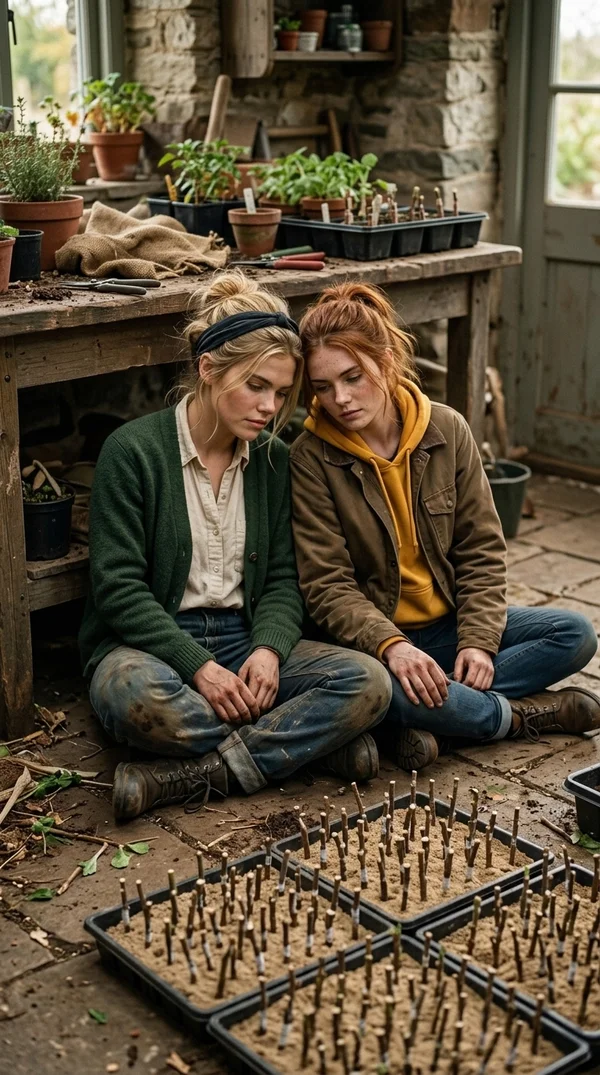
Twenty-nine grafts in a box of sand in the bothy. Two of them are likely bad, and she doesn’t know which two. Neither do I. I just know the odds. In March she’ll look, and two will have no callus, and she’ll know. That’s the point of looking.
Four hundred and twelve ties on the wall, done, the near half by her hands alone and the far half by the two of us. The forty fans pruned to the order I put up, worst first. The fourteen at seven feet and a fan — the correct prune — and the wall above it bare until June.
A girl in the bothy at six in the morning with the fire lit, and the seed stock on the shelf in wooden boxes with the lids on. The last time I glanced in — just glanced — there was a sleeping bag rolled on the bench and a backpack. A plate with a crust of toast on it, and a jar of milk on the sill with the cold keeping it.
She’s been in there one night. It’ll be two tonight. Three by Wednesday? Probably.
Nobody asks what the garden is for.
The estate is for a price and a sale. A hundred and eighty-two thousand off, a buyer, a date, a deed, and forty-one paychecks hanging off it. I’ve done that. I’ll do the rest of it, and it’s right.
The garden is for twenty-one years. The estate has to fund it. A buyer has to take subject to it, and it has to be worked. In September the buyer closes and the estate’s gone. Then there’s a girl in a bothy with a trust, and a clause in the deed that orders the trust not to prejudice the road. Every one of the four hundred and twelve ties I’ve had her doing sits inside a deed she didn’t draft.
So the garden is for a legal obligation. Twenty-one years of one, with a bothy and a fire in it. The man who wrote it is in the churchyard. The man who has to fund it is me, and in September the funding is Wear’s.
It’s a good inheritance. It’s the best thing my father ever did. It’s also a leash, and it’s held by a girl of nineteen who is sleeping in a bothy in January rather than in the east room of a house she’s been left a year of. I haven’t once asked her why. Why haven’t I? There’s no figure for it.
Culver got it out of me easily at lunch, over sandwiches on the shipping bench, with his mouth full.
“She’s in the bothy.”
“She is.”
“Since yesterday.”
“Since yesterday.”
“And you’re in the house with three women and a fireplace. Christ, Perrin. There’s a bothy at the end of the garden. And you’re both of you in the wrong one.” He put his sandwich down on its paper and wiped his fingers. “The yard’s got a bothy too.”

 100 to start reading with.
What did you think?