The asparagus went back to its own bed on the fourth of October, and nineteen of the forty-eight had taken.
Ollis did it with me and didn’t utter a word for two hours. Then he straightened up slowly with a hand in the small of his back and squinted down the row.
“That’s nineteen.” He sniffed. “It’s nineteen more than nothing.”
That was Ollis’s whole opinion, and honestly, it was mine too.
The frames came back into the run of brick on the ninth — nine of them, on a Saturday rate, with Rennie Bishop and his boy. Seven hundred and ten dollars of glass went in them. They were painted and they were level, and they sit in the run of brick exactly where they were in 1974.
The old fig never came back from its stake. The new one went against the east wall in the spring. It’s four feet high now, and it wants a wash of lime behind it in February.
The pear came off from the eighteenth of September.
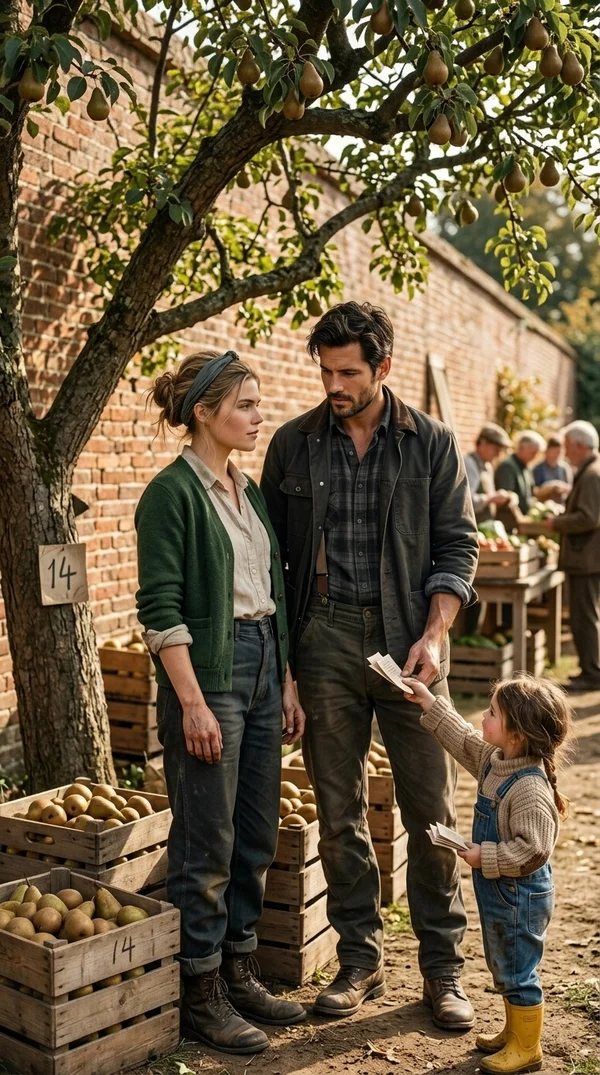
Four crates, and the windfalls. The wall was picked over four days by me and Pip and Ianthe, two of the women from the senior housing, and Sibyl. Sibyl picked in a hat and gloves like a woman at a wedding. She filled a whole crate on her own, carefully, and didn’t once mention the word price. Was she ill? I kept checking.
The wall is four hundred feet: a ladder and a basket and a hand at a time, nine hours a day. Tired? God, yes. It’s the best work of the year.
There’s a way of picking a pear that doesn’t take the spur. You cup it in your palm, lift, and twist. If it doesn’t come, it isn’t ready. Sixty came easily. The rest had to be left and gone back for. On the third day there were wasps in the windfalls, and Pip got stung on the wrist and swore for two minutes straight — “Fuck! Fucking wasps!” — and went on picking.
We picked the fourteen last, a month early, off a wall with the heat on.
The seven feet of fan was loaded with fruit. Not heavy — it wasn’t a heavy year — and the pears were small and hard and russet. It took forty minutes. At the end of it the tree was bare, and the wall above it was going over to fall color. It had stood on that wall since 1908, and it had never once been picked for a certificate.
The graft went in on the twenty-second, in front of the village, because I wanted it seen.
Not on the fourteen. On the sixth bay. The sixth had a Bartlett on it that cankered at the leg and came out in the spring, and now it was bare brick with eight ties’ worth of wire. It’s five bays from the fourteen. Same wall, same heat.
Marden came. She wanted to see it done. The naming had gone to the pomology committee on the first of September, with a paper of four pages and a photograph and my arm numbers. The university takes a real interest now. Have you ever had a university take an interest in you? It’s a truly strange thing. It’s like being looked at by a large, polite owl.
The name is in the committee’s hands. Marden put Cabot’s Late Russet in the paper. There’s a second name down, and it’s hers, and she’s promised she’ll argue for the first.
She stood at the sixth bay with her hands behind her back. “Cut it fresh. Not off the sand box.”
So it came off the fourteen’s own wood in front of forty people. A whip and tongue into the bay’s leg, done on a stool with a knife. It took ninety seconds. My hands barely shook, and my heart was going so hard I could feel it in my lips. Marden waxed the top herself. That was the last of the fourteen to come off this wall for five years, she warned the crowd; everything else went to Whinfield.
“Yes.”
“In five years it’s a fan. In fifteen it’s a tree.” She put the wax brush down and wiped her fingers precisely on a rag. Same bay where the Bartlett cankered, same wall, same heat, same line. That was the argument for a wall and against a road, and nobody put it in a schedule, because a schedule was for a thing that was there — not a thing that wasn’t yet.
Ianthe was at the front with her hands together. Mrs. Ellwood had been brought out in a chair by her daughter. Bertie had Dilly up on his shoulders.
“Is that a new tree?” Dilly’s heels drummed on his chest.
“That’s a new one, Dil.”
“Good!”
Sibyl had brought the basket out and had the four crates by the bothy door. She was just standing there quietly with her hat off. When had I last seen Sibyl Cabot stand still with nothing to say?
The pick of the fourteen came to twenty-four pounds six ounces. Eleven of the pears had a label round them. They went in a crate with the university’s address and a note of the arm and the day. The four crates went at five — two to the wholesaler in Brackenby, one to the cider house at Collow, and one to the shareholders’ orders at fifteen the bowl. The windfalls came to thirty-one pounds and went to Collow too, at ninety cents a pound, cash, in the tin.
And up at the sixth bay, with the wax soft on it and a burlap wrap round its top, there was six inches of this year’s wood on a hundred and nineteen years of brick.
The kiss happened at the south door at half past four, in front of about thirty of them. It wasn’t planned, and it wasn’t a scene. It came out of a thing that was.

 100 to start reading with.
What did you think?