Complaint Number Eighteen, chapter 4 of Ninety Percent Chance of You
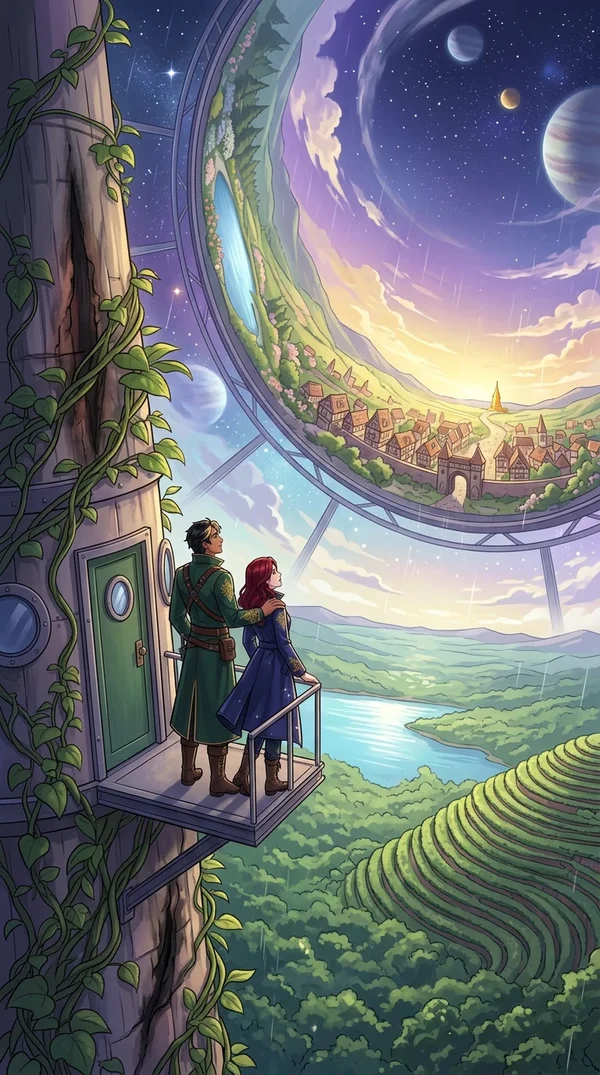
The Wildwood at dusk is a cathedral somebody forgot to put a roof on.
The trees there were planted in Year 2 from seed the Lark carried out from home, and they have had a hundred and fifty years of soft rain, deep soil and no winter worth the name, and they have taken it personally. The smallest are forty meters. The founder oaks of the Old Grove are a hundred, a hundred and twenty. Their trunks go up like the columns of a pier and their crowns knit together so far overhead that the light comes down green and slow, the way light comes down through deep water, and between them the floor is moss and fern and silence and the sound of your own boots.
And the Grandmother, in the middle of the Old Grove, is a hundred and forty meters tall. I’d seen her from the Loom every working day for two years, a dark green dome on the curve of the world. I had never stood under her. You can’t see the top from the bottom. You can barely see the bottom from the bottom. Her roots come up out of the moss in ridges as high as my waist, and Rook walked up to one and put his hand on it, flat, the way you’d put your hand on a horse.
“Evening,” he said to the tree.
I didn’t say anything. I’d decided to let him have that one for free.
The storm came in at sunset, on its own schedule. We heard it before we saw it: a long hiss high up in the canopy, like surf, coming toward us through the crowns. Then the first fat drops came down through the green on their slant and smacked into the ferns, and the Lamp dimmed through amber toward violet, and the Wildwood went dark all at once.
“Up,” said Rook.
The Perch is a platform sixty meters up the Grandmother, built round her trunk on cantilevered beams, with a canvas roof, a tin stove, a rack of ropes and harnesses, a crate of tea that the Canopy crew have apparently chosen specifically for being terrible, and one hammock.
One.
“There’s one hammock,” I said.
“It’s a work platform. People don’t sleep up here.”
“You’ve got a hammock.”
“It’s for lunch,” said Rook, who had a hammock for lunch.
He lit the stove. I sat on a crate with my back against the Grandmother’s bark, which was warm, which I hadn’t expected, and listened to the rain drum on the canvas a meter over my head. It was coming down properly now. Heavy and steady, falling in long silver ropes past the edge of the platform into the dark. The whole tree was moving. Not swaying. Working. You could feel it through the boards and through your back: a long slow creak and settle, creak and settle, as if she were breathing.
I knew that sound. I’d grown up on it. It’s the sound a boat makes at anchor in a swell, the hull talking to the sea.
“She talks,” I said.
“She’s saying she doesn’t like your rain.”
“That’s not what she’s saying.” I listened. “That’s the sound a mooring line makes when it’s holding. My dad used to say if you can hear it, it’s fine. It’s when it goes quiet you worry.”
Rook was crouched by the stove. He looked at me over his shoulder, and then he went very still and listened too, and after a while he said, “Yes. That’s right,” in a surprised voice, as if he’d never had anyone to say it to.
The tea was dreadful. We drank it anyway. Then he went to a shelf at the back of the platform, took down a square tin that had once held biscuits, and sat down cross-legged on the boards in front of me with it in his lap.
“What’s that?”
“My copies,” he said, and opened it.
They were all there. Seventeen complaints, each on the official Weatherworks form, each folded in four, each in his square, careful capitals. He’d kept a copy of every one.
“Complaint Number One,” he read. “Thaw 9, Year 148. ‘Rain sideways onto the Canopy crew at the Perch during the lunch break. Kovach fell out of a hammock. Request that the new rainwright be taught which way is down.’”
“It was a coil error. I was nervous.”
“You said that in your reply.”
“You read my reply?”
He gave me a look and turned the form over. On the back, in pencil, he’d copied out my reply. Word for word. I felt my face go hot.
“Complaint Number Three. ‘Night rain forty minutes over schedule, waking the rooks in the Old Grove.’”
“Forty minutes was a pressure hold. And are you named after them, or are they named after you?”
“They were here first,” he said. “Complaint Number Five. ‘Fog in the Wildwood on pruning day.’”
“Fog’s good for the canopy. Look it up.”
“I did.” He turned to the back. You were right about the fog, he’d written there in pencil. Don’t tell her.
I looked at the pencil for slightly too long.
He went on. Seven: drizzle on the crew’s fortnightly ropes inspection. Nine: “Your Show Rain made a tourist couple propose in my tree. In it. Sixty meters up. They had to be lowered.” I said that wasn’t a weather problem, that was a romance problem, and he said in his tree it was both. Eleven: a mist that beaded every web in the Old Grove so the whole forest glittered for a morning, which he’d filed, apparently, as distracting.
“Distracting,” I said.
“Ilse walked into a branch.”
“That’s not my fault.”
“She was looking at the webs.” He paused. “Everyone was.”
Twelve. He read the date, Turning 30, Year 149, and the complaint, which was one line: Drizzle on the Wildwood during the crew’s memorial walk. And then he didn’t read anything else, and he didn’t look up.
“What memorial walk?” I said.
“My dad’s.” He folded the form. “He died eight years ago. We walk the Grove on the day. You rained on it.”
I hadn’t known. Of course I hadn’t. I’d written that drizzle for the ferns. I sat there with the rain coming down past the platform and opened my mouth to say the numbers, the drought index, the moss, the schedule, and none of it came out, and what came out instead was, “I’m sorry.”
“It was nice rain,” Rook said, to the tin. “Soft. He’d have liked it. I was angry it was nice.”
Fourteen: Your drizzle is too polite. Trees need a proper soak. Fifteen: Rain on Thaw 40 was beautiful. This is not a complaint. But it was eleven minutes late. Sixteen: the honeysuckle on the Perch rail had flowered early because of a warm mist and been eaten by bees.
Seventeen. Bloom 92, sixteen days ago. “‘You drowned the Grandmother’s seedlings.’”
“Your seedlings were in a hollow,” I said. “With no drainage. I did warn you. In writing.”
“You did.” He laid the form on the pile. “I moved them.”
I looked at the pile of paper on the boards between us. Seventeen forms, folded in four, two years of them. And I did the thing I do. I laid them out in my head the way I’d laid out the drums, side by side, with the dates.
His crew. The rooks he grew up under. The Grove on pruning day. His father. His bees. His tree. His seedlings.
Every one of them was a day I’d rained on something he loved. He’d noticed every rain I’d written for two years, the late ones and the soft ones and the beautiful ones, and he’d sat down and written to me about each one in the only form he trusted, on an official piece of paper, folded in four. And he’d kept copies.
Ninety percent of men, I thought, keep a tin like that for love letters.
I didn’t give that number to anyone. I didn’t even give it to myself for very long.
The lightning came after midnight, far off.
It was over the Terraces, beyond the far edge of the Wildwood, a long way up the curve: a white crack, then the slow, heavy roll of thunder coming round to us through the trees. The whole Perch lit up like a stage, every rope and canvas seam and raindrop, and Rook’s face, which was much closer to mine than I had known it was.
We’d both moved. I don’t know when. We’d been sitting either side of the tin and now I was leaning forward off my crate and he was on his knees on the boards, and our faces were a hand apart in the dark, and I could smell the smoke still in his hair from yesterday and the terrible tea on his breath and the rain.
The light went out. The thunder came. Neither of us moved back.
“Isla,” he said, very low.
I thought: eighty. Then I thought: eighty-five. Then I stopped thinking in numbers, which has happened to me perhaps four times in my life, and leaned in.
The Grandmother groaned.
It came up through the boards, through my knees and my hands, a long deep complaint from somewhere down in the wood of her, not the mooring-line creak I knew but something heavier and wrong, like a hull taking a wave it wasn’t built for. The whole platform shifted a few centimeters to the left and stopped.
We both grabbed the nearest thing. In his case, a beam. In mine, him.
Then we let go of each other, very fast, as if we’d both touched the stove.
“She does that,” Rook said, after a while. His voice was rough. “Lately.”
“Right.”
“It’s fine.”
“It didn’t sound fine.”
“No,” he agreed.
We didn’t talk about the other thing. We were both very careful not to. He put the forms back in the tin in order, one to seventeen, and closed the lid, and put it back on its shelf. I took the hammock, because he said so and I didn’t have the strength to argue. He lay on the boards by the stove with a coil of rope under his head and his arms crossed. The rain went on. The Grandmother creaked and settled, creaked and settled, the sound of a line holding. I lay with my eyes open in the dark, rocking very slightly, and listened to him not sleep.
Lights at the foot of the tree woke us both. I hadn’t known I’d slept.
Lanterns. Four of them, bobbing between the roots sixty meters down, and voices calling up through the rain.
“Adair! Rook Adair! Steward’s wardens.”
Rook was on his feet at the rail before I’d untangled myself from the hammock. He motioned me down without looking round, one flat hand, and I lay back and pulled the canvas over me and held still.
“What,” Rook called down. Not a question. A wall.
“We’re looking for the rainwright. Marlowe. She’s to come back to Landing. The Steward’s called a hearing on her standing at noon tomorrow.” The voice was apologetic and determined, a man with a printed order. “If she’s found unfit, the Weatherworks names a new Senior Rainwright. For the ceremony.”
So that was it. He didn’t need my hand on the key. He just needed somebody’s.
“Is she up there with you?”
There was a pause. I lay under the canvas with the rain drumming on it and my heart going and thought: he has seventeen reasons to say yes. Eighteen.
“She was,” said Rook, flatly, to four of the Steward’s wardens, in the voice he uses on trees. “Left an hour ago. On her own. Toward Stem Four.” He leaned on the rail. “You’ll catch her if you hurry. She’s short. Doesn’t walk fast.”
What did you think?