At two in the morning the Ring began to hum, and Rook came back.
I was sitting on the edge of the bed in the dark with my boots on. I hadn’t slept. The reference was on the washstand where I’d left it, folded, pale in the lantern light from the street, and I’d been looking at it for three hours the way you’d look at a dog you weren’t sure would bite. The towel wall was still up. It looked ridiculous.
The hum came up through the floor. I felt it in my heels first, then in the bed frame, then in my teeth: a low, steady note, so deep it was more a pressure than a sound, like standing next to a ship’s engine through a wall. The water in the washstand jug shivered in rings.
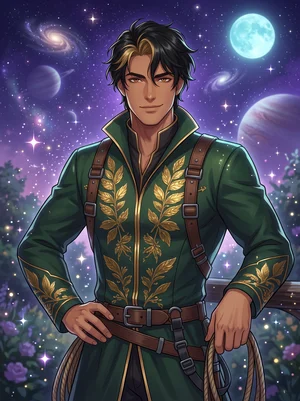
The door opened. Rook stood in it with a lantern and a coil of rope.
He didn’t say anything about the reference. He didn’t look at it. He looked at me, sitting there in my boots at two in the morning, and I think he understood more from that than he would have from anything I said.
“You want to know what’s down there,” he said. “Come on.”
There is an oak at the edge of Coldharbor where the last of the Wildwood comes down to the road, a founder oak, a hundred meters tall, that the Canopy crew call the Doorkeeper. I’d walked past it that evening and thought nothing of it. Rook took me round the back of it, through bracken to my waist, to a place between two roots as high as a cottage roof where the ground fell away into a hollow, and in the hollow was an iron hatch with a crew lock.
“Old trees go deep,” he said, unlocking it. “Forty meters of soil and then they hit the hull, and they don’t stop. They go along it. We’ve got galleries under the Wildwood so we can check the roots. Most of the Ring doesn’t know.” He swung the hatch up. Warm air breathed out, smelling of earth and wet stone and, under that, something metallic. “Dess knows.”
We went down a ladder, and down, forty meters of it in a shaft lined with roots, until my boots hit stone and Rook’s lantern swung out into a gallery.
I’d expected a tunnel. It was a forest upside down.
The roots came down through the ceiling and ran along the walls and floor like the pipes of an organ, thick as my body, grey and gnarled and alive, braided into each other, and in between them the founders had cut a walkway and strung lamps on a wire, most of which had died. The hum was louder down here. The roots trembled with it. Water dripped somewhere. Rook walked ahead through the dark with his lantern held high, and I followed him with my hand on the nearest root, and it was warm.
The root gallery opened at last onto a catwalk, and the catwalk onto a hall, and I stopped.
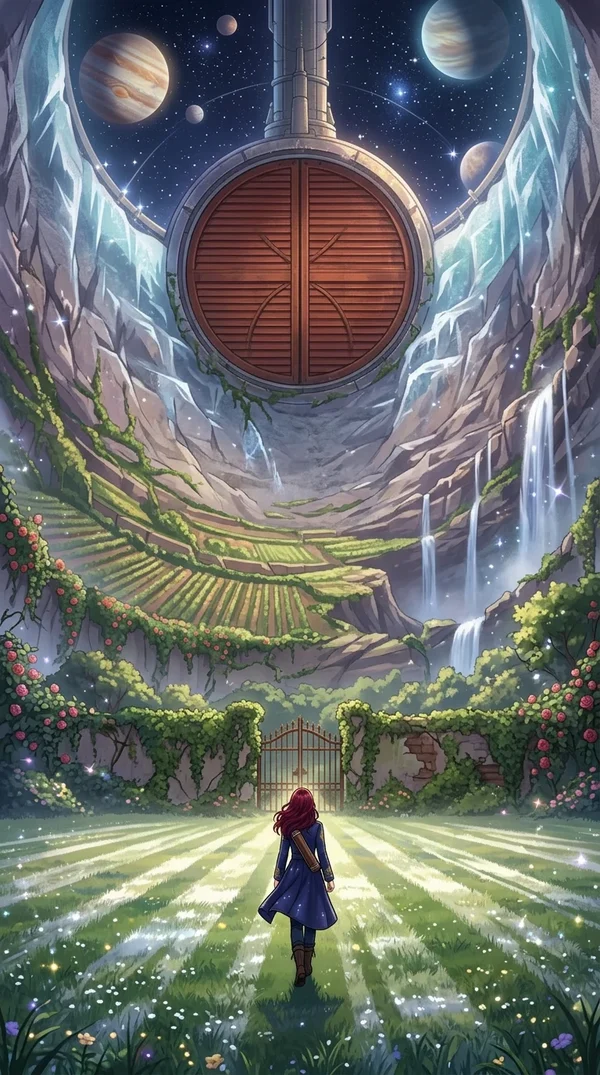
The Underneath is the hull of the world. You forget it’s there. You walk on soil and moss and gravel all your life, and under it, forty meters down, is the actual Ring, the drum the founders built from the hull of their expedition ship and a few hundred thousand tons of comet ice, curving away on every side, holding everything up.
We were standing on a catwalk over a pipe.
It was the biggest pipe I’d ever seen. Five meters across, iron, riveted, running out of the dark on one side of the hall and into the dark on the other, and it was sweating, beaded with cold water, and humming. Somebody a long time ago had painted letters along it in founders’ white.
OVERMERE. DEEP CISTERN MAIN.
It ran away from the lake. Toward the rim.
We followed it. Along the catwalk, down a stair, through a pressure door standing open, and out onto the gallery that runs round the edge of the world.
The Spinner gallery is a long curving hall, so long you can’t see its end in either direction, curving up away from you like a road over a hill. The outer wall is the hull itself, iron ribs and plates, very old. And set into it every so often, far apart, are the Spinners: huge iron housings the size of houses, bolted through the hull, each one with a firebox and a boiler and a nest of pipes. Twenty-four of them, all the way round. Three were lit near us, glowing orange through their sight glasses. The hum was coming from them, shaking the catwalks, shaking the air. Steam roared somewhere outside, beyond the iron, in the dark.
And in a glass booth at the middle of the gallery, alone at a brass board covered in dials and levers, with a mug of something in one hand and the other hand on a throttle, was Dess Kerrigan.
She saw us. She didn’t jump. She just closed her eyes for a second, as if something she’d been waiting four years for had finally arrived and she was too tired to be surprised by it.
“Course,” she said, when we came to the booth door. “Course it’s you.”
She didn’t stop working while she told us. She couldn’t. The burn had a schedule.
“Seventeen’s running rough,” she said, half to herself, nudging a lever. “Lake water. Too much silt in it. She doesn’t like it.” Then, louder, to us: “You know what these are?”
“Spinners,” said Rook.
“Spinners.” She tapped a dial. “The Ring turns. That’s your weight. Every time a hauler docks, every time the wind blows or the river rubs on the walls, it slows down a little. Only a little. And these push it back up to speed. They burn water. Steam out the back, push the hull along. Always have.” She drank from the mug. “Water comes from the Icehouse. Comet ice. The Reach used to send it. Last proper delivery was Year 139. We got two shipments after, years ago, nobody’s ever said who from. That’s the only reason we lasted this long.” She laughed, not very well. “The Icehouse is nearly empty. There’s about enough in there to keep the lights on in the Icehouse.”
“So you’re burning the lake,” I said.
“I’m burning the lake.” She didn’t look away from her board. “Since Year 146. Two till four in the morning. When it’s dark and you lot are writing your rain and nobody’s awake to wonder why the Ring hums.” She glanced at Rook. “The Ring snoring. That’s always been the Spinners, since before you were born. The only new thing’s what I feed them.”

 100 to start reading with.
What did you think?