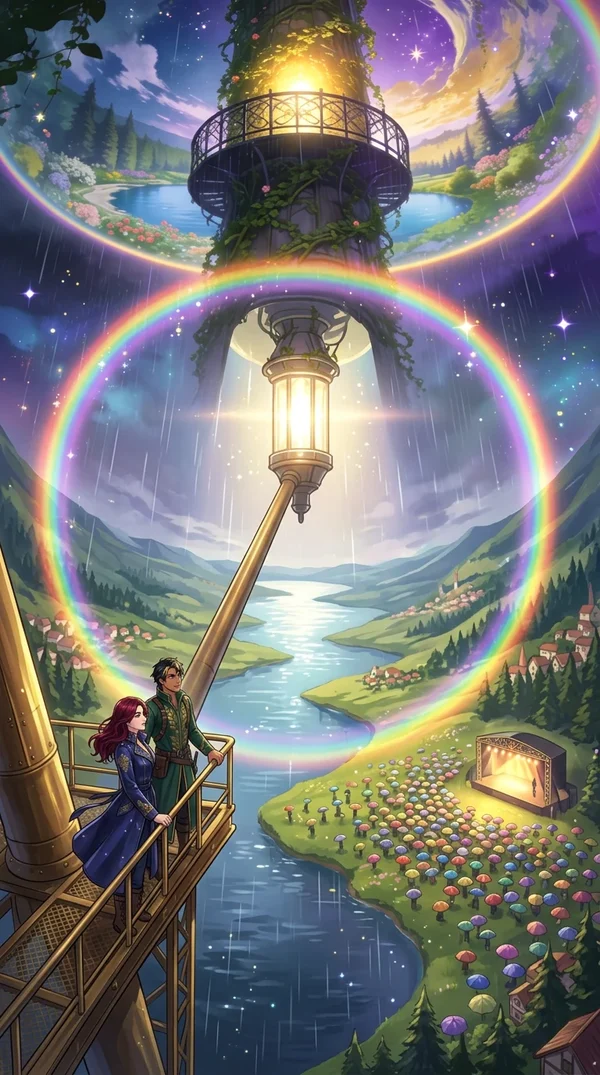
At sunset on the hundred and fiftieth Founders’ Day, twelve thousand people stood on the Long Meadow under a storm, and the Ring began to hum in daylight.
I felt it before anyone else did, because I was waiting for it. I was standing at the back of the crowd below the ceremony stage, with my hood up, and it came up through the wet grass into the soles of my boots: the low note, the Ring snoring, hours early and twice as loud. People looked down at their feet. A child asked her father what it was. He said it was the founders, turning over in their sleep, and laughed.
Somewhere under Coldharbor, Dess was at her board burning the lake, and not in the small hours. Now. As hard as the Spinners would take it. It could only be the Steward’s order: one last great drink before the alarm went blind.
And overhead, the Almanac answered.
The storm had been big all day. Now it grew. It came down off the Axle in a slow grey avalanche, thickening as it fell, spreading out over Stem Six and the whole festival end of the Meadow until the Lamp’s low red sunset light was shut out and the evening went green-dark, the color of deep water. Rain began. Not the cloudburst yet. The warning drops, fat and far apart, slanting in on the wind. Twelve thousand umbrellas went up across the Meadow with a sound like a flock of birds taking off.
Down at the front, in two curving rows below the stage, thirty-eight couples in wedding clothes stood under borrowed umbrellas, holding hands. Del walked up and down the aisle between them with her clipboard, straightening veils.
On the stage, at the foot of Stem Six, beside the arch of the Gate and the brass Gate Board, Steward Corin Vasko stood with his key.
He spoke well. He always did. He talked about the founders and the Lark and the Long Silence, and the first sky lit on this day a hundred and fifty years ago, and the Almanac that had kept that sky for all of them, faithfully, until it began to fail. He talked about the lightning. He talked about the weddings and the work crew. He said that sometimes the bravest thing you can do for an old friend is to let it rest.
“The Senior Rainwright,” he said, “has been asked to join me.”
He looked out over the crowd, gently, patiently, as if he knew I was there.
I took my hood down and walked up through the crowd to the stage.
It’s a long way, through twelve thousand people. They parted for me. I heard my name go out ahead of me in a whisper across the grass, Marlowe, it’s Marlowe, and somebody said where’s Adair?, and somebody else said shh. I climbed the steps onto the stage with the rain coming down harder, slanting across the boards. The Steward held out his hand to me as if he were helping me up into a boat.
“Thank you, Ms. Marlowe,” he said, warmly, for everyone.
I didn’t take his hand. I walked past him to the Gate. The keyhole is in the stone of the arch, low on the right side, brass, worn smooth, the twin of the one on the left where the Steward’s key goes. I’d never seen it used. Nobody alive had.
I took the key out from under my shirt and held it up.
Twelve thousand people went quiet.
“I’m not going to turn this,” I said.
I hadn’t known how loud my voice would be. The Gate has a speaking horn in the arch, founder-built, for exactly this, and my voice went out over the Meadow and came back off the Fore Wall, huge and strange.
“The Almanac isn’t broken,” I said. “I’ve walked the Ring for three days, round five Stems, and I’ve read the drums in the Bellhouses. The old ones. The ones in ink.” I unscrewed my tube and pulled out the rolls and held them up, a fistful of paper, rain spotting the ink. “Nobody can change these from an office. And they say the Overmere has been falling for four years. Every night, a little. And every storm the Almanac’s written that we didn’t ask for has been it trying to put the water back.”
A murmur, rising.
“It’s not attacking us. It’s trying to tell us something. It’s the only thing in the Ring that’s been telling the truth.” I turned and looked at the Steward. “And if I turn this, it stops telling anyone.”
The Steward’s face didn’t change. That was the frightening part. He looked at me with the same sorrow he’d had at the wedding.
“Ms. Marlowe is exhausted,” he said, to the crowd, kindly. “She’s been through a great deal. Wardens.”
They came up the stage steps behind me, four of them, the same four from the Grandmother’s roots, looking apologetic and determined. One of them reached for my arm.
And from the back of the crowd, somebody shouted, “Canopy!”
They came through the Meadow in a wedge.
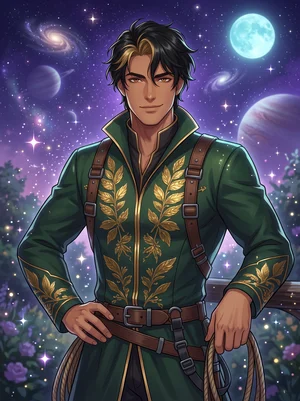
Twenty of them, the whole Canopy crew, in harnesses and helmets with rope coils over their shoulders and climbing irons on their boots, walking fast and close together, and the crowd opened in front of them like grass in wind. Ilse was on the left point with her bandaged hand held up in front of her like a shield. Danny was on the right with his cut forehead. And at the front, the tip of the wedge, enormous, soaked, with a cornflower still in his top pocket, was Rook.
He came up the stage steps two at a time. The wardens looked at the twenty climbers behind him and very sensibly stood still.
Rook walked up to me in the rain at the Gate. He stopped, very close. He was breathing hard. He’d run.
“Complaint Number Nineteen,” he said.
I couldn’t speak.
“You did the last leg on your own.” His voice was rough. “It’s a Walk. You don’t do the last leg on your own.” He swallowed. “And I let you. That one’s mine.”

 100 to start reading with.
What did you think?