By Game 6, Teo had learned to hear forty thousand people booing him as weather.
It had taken three nights at Ropewalk. The first, he’d felt every word of it, the chants and the signs and the man behind the on-deck circle who spent nine innings telling him what he was. By the third it was rain on a tin roof. Loud, constant, and about the people making it.
Jonah had started Game 3, and pitched to him, and that was the headline: no catcher standing up, no rubber chickens, just honest pitches on the outside half of the plate. Teo went one for three. Neither of them touched a thing. They looked at each other across sixty feet and six inches like two men who’d been introduced once at a party and couldn’t remember each other’s names.
Boston won Games 3 and 5, Brooklyn won 4, and they came home down three games to two with the whole borough holding its breath.
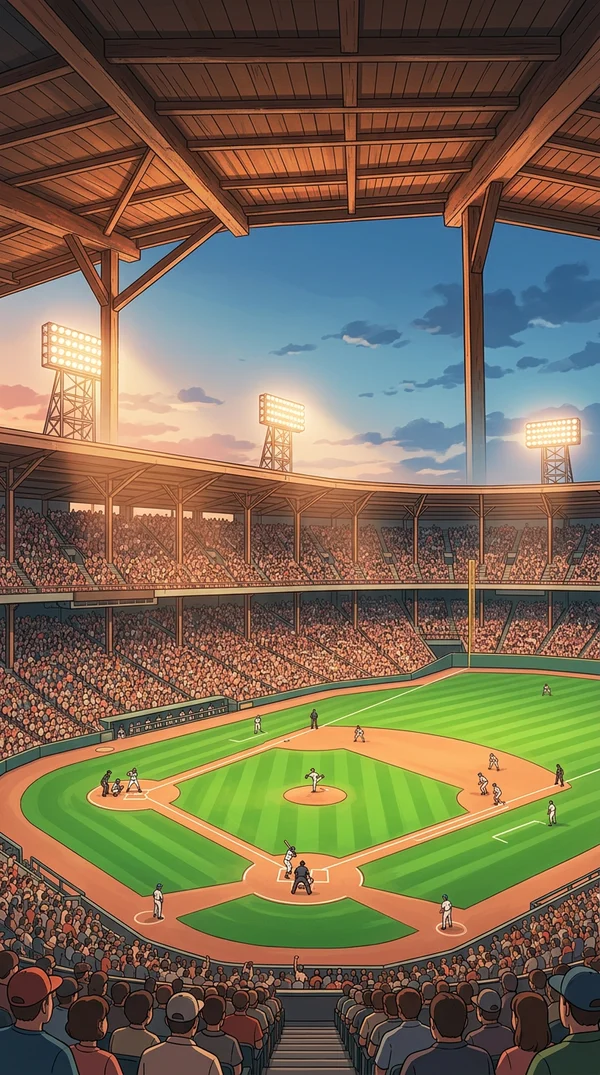
Game 6 was decided in the eighth inning by a ball Teo shouldn’t have been able to reach.
Brooklyn was up a run. Two outs, Boston runners at first and second, and Danny Pham, the rookie, the kid who’d hit the bloop that put Boston in the playoffs, hit a ground ball up the middle that was past the pitcher before the pitcher knew it had been hit. It was a single. Everybody in the building knew it was a single. The runner from second was already rounding third with his arm windmilling.
Teo didn’t think. That was the thing about the good ones; you didn’t think. He was moving before the ball was off the bat, two steps to his left, three, and then he left his feet and was horizontal over the grass behind second base with his arm out as far as his arm went, and the ball smacked into the very end of the web of his glove and stuck there like a burr.
He landed on his chest. It knocked the air out of him. He was on his knees on the infield dirt, in front of forty-one thousand people, unable to breathe, and he thought, very briefly, of a batter’s box three Augusts ago, and then Dez was screaming at him and he flipped the ball out of his glove to second base from his knees, backhand, without looking, and the umpire’s fist went up, and Wallabout Park detonated.
Afterward, in the clubhouse, they made him stand on a chair. They poured a whole cooler of ice water over his head. Lou Marchetti shook his hand without a word and didn’t let go. Teo laughed and shouted and hugged everybody, and he meant all of it, and underneath all of it he was thinking: Tomorrow is Game 7. Tomorrow, Halloran starts Kell.
He went to his mother’s after. He didn’t decide to. He just found himself walking up Fifth Avenue at midnight with his hood up and his hair still wet, past the bodega where Rizzo was asleep in the window under the OUR TEO sign, past his own building, and then up the stoop of the building on Forty-seventh Street, and up the stairs, and his mother was in her kitchen in her bathrobe, heating up a pot of asopao as if she’d known he was coming. She probably had.
He sat in his chair. She put a bowl in front of him. She sat across from him with her reading glasses on their beaded chain and watched him eat it, and she didn’t ask him anything.
“It’s him,” Teo said finally, into the soup. “Mami. In the picture. It’s the pitcher. It’s Kell.”
His mother said, “Yes, mijo. I know.”
He looked up.
“I watch the games,” Rosa said. She shrugged. “Three years, he looks at you like that. I’m a dispatcher. I watched drivers for twenty-two years. I know when a man is looking at the road and when he’s looking at something else.” She reached over and pushed his wet hair off his forehead. “And you. You laugh so much when he’s pitching.”
Teo put his spoon down.
“He’s scared,” he said. “He’s so scared, Mami. And I get it. I do. I was scared too. But I can’t—” He stopped. “I can’t keep being somebody’s secret. I did it in Altoona and I did it for two years and I’m done. I stood up there. I’m not going back up those stairs.”
His mother was quiet for a while. The refrigerator hummed. Out on the street a car went by with its windows down, playing a merengue, and faded.
“Love is not a hiding place,” Rosa said. “Not for him.” She looked at him over her glasses. “And not for you either, mijo. All that laughing. All those jokes. You hide in them. You always did. You make everybody laugh so nobody sees you want something.” She took his hand. “You’re allowed to want something. Out loud. Even if you don’t get it.”

 100 to start reading with.

What did you think?